Science1 publisher2 min readPublished
Degassing sodium out of Na4B60 leaves a boron framework that conducts and bends
The framework was assembled with sodium inside it under high pressure, then emptied. The boron left behind conducts seven orders of magnitude better than beta-boron and still deforms plastically, a pairing the paper calls challenging to achieve.
The Scientist · Science desk
What happened
- Researchers made a boron allotrope they call Imma-B60 by forming a sodium boride precursor, Na4B60, under high pressure and then driving the sodium out of it by degassing.
- The allotrope has a bandgap below 0.2 eV and a conductivity of about 9 x 10^2 siemens per metre, which the paper puts at seven orders of magnitude above beta-boron.
- The same phase deforms plastically by about 23 percent, a deformation the paper attributes to dislocation-mediated slip.
Compiled by The ScientistSomething wrong?How this is made
Why it matters
- capability If the properties survive in bulk samples, engineers get a boron phase that can be deformed into shape and still carry current, an option the superhard semiconducting phases did not offer.
- precedent Fill a framework with an alkali metal under pressure, then degas it: if that sequence works on a second system, synthesis groups gain a path to open frameworks that direct high-pressure runs will not produce.
- constraint Every sample begins with a high-pressure synthesis of the sodium precursor, so quantities stay small and the work stays with labs that own high-pressure apparatus.
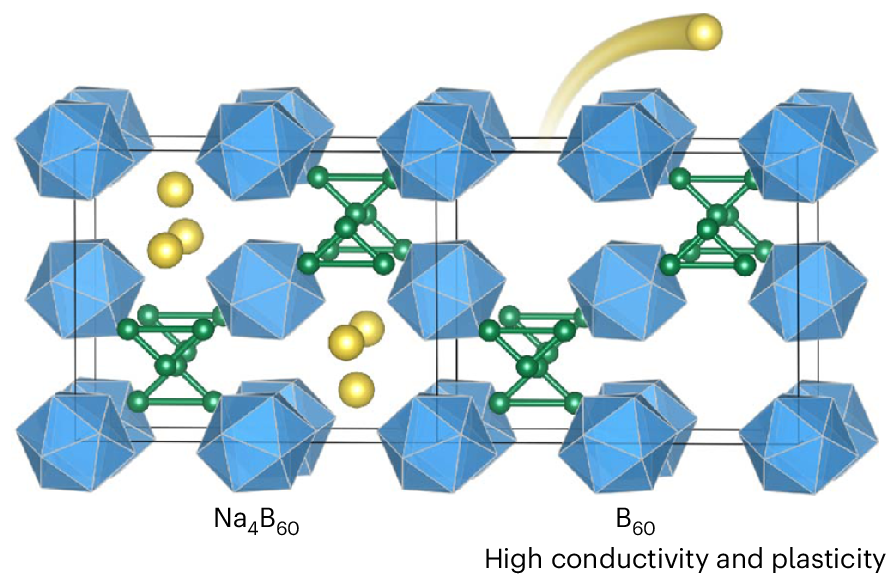
High pressure usually gives you boron's dense phases, which makes an open framework with empty space inside it an awkward target. The reported route goes around that by making a filled compound first. Na4B60 forms under high pressure with sodium sitting inside the framework, and the sodium is then removed by degassing, leaving the boron behind [1]. The skeleton that survives is B12 icosahedra joined by triangular B3 units through two-centre and three-centre sigma bonds [2]. The authors write that the work "establishes a powerful precursor-based strategy for accessing metastable materials" [7].
About 900 siemens per metre works out to a resistivity near 1.1 milliohm-metres: 1 divided by 9 x 10^2 is 1.1 x 10^-3 ohm-metres [10]. The comparison the paper draws is with beta-boron, which at the stated ratio of seven orders of magnitude sits near 9 x 10^-5 S/m [11][3]. The bandgap is narrow but present, under 0.2 eV, so this is a semiconductor and not a metal [3]. One conductivity figure appears in the abstract without the measurement temperature or the sample form, and the full paper is sold for $39.95 [12][8].
Before treating 9 x 10^2 S/m as a property of the empty framework, I would want to know how completely the sodium left. Sodium retained inside an open framework would dope it, and a conductivity measured on a partly filled sample describes the dopant as much as the host. The crystal structure deposited with the Cambridge Crystallographic Data Centre, number 2487320, is the sodium-filled precursor Imma-Na4B60 [6]. Everything else sits in the paper and its Supplementary Information, or with the authors on request [9].
Many boron phases are known, and the paper's own framing is that getting high electrical conductivity and plasticity in the same one has remained difficult [5]. About 23% plastic deformation, accommodated by dislocation-mediated slip, is what the authors put against that [4], and they write that the discovery "substantially expands boron's application potential beyond conventional superhard, semiconducting phases" [7].
What to watch
- Whether about 23% plastic deformation holds in larger specimens, and under a stated test geometry, when another group repeats the measurement.
- Whether the fill-then-degas sequence yields a second open framework from a different alkali precursor, which would make it a method rather than one result.
- Whether the phase holds its structure at ambient conditions over months, given that the paper presents the route as a way to reach metastable materials.