The classroom channel nobody bid out: teacher training as Big Tech distribution
A New York Times investigation traces Microsoft, Google and OpenAI's hold on US schools to professional development rather than procurement. The pharma comparison is the load-bearing part.
The Product Desk
What happened
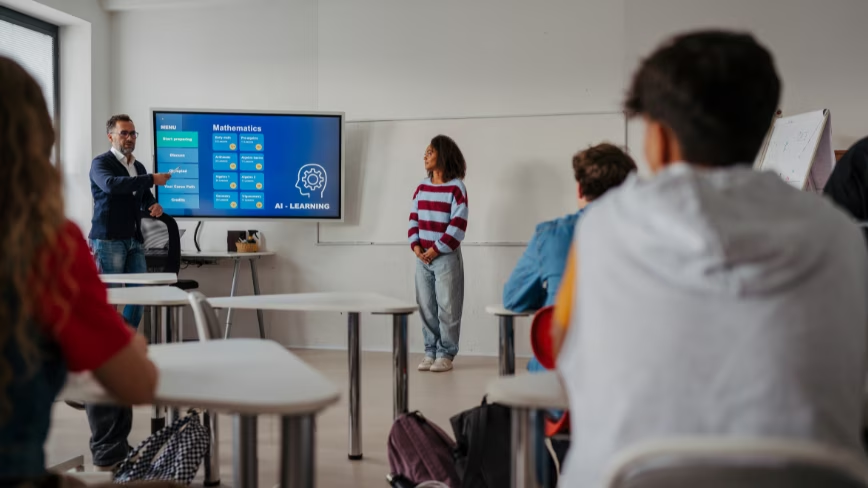
- Microsoft staff spent a summer 2025 session with about 200 Manhattan teachers, having them practise Copilot on parent emails and lesson plans.
- The next day the American Federation of Teachers announced a national AI training programme funded with $23m from Microsoft, OpenAI and Anthropic.
- Natasha Singer's New York Times piece rests on more than 100 interviews and hundreds of school, government and corporate documents.
- A retiree union member, education professor Lois Weiner, told her the arrangement is not an alliance and that teachers are the meal.
- Chromebooks made up 59% of mobile devices shipped to US schools last year, on Futuresource Consulting figures.
Why it matters
- cost Split across 1.8 million members, the vendors' contribution is worth around $13 a head, which means the substantive input is teacher hours and the union's name rather than corporate cash.
- decision Vendors running institutional training now have to pick a lane: book it as marketing spend and disclose it, or keep calling it philanthropy and accept that someone else gets to characterise it.
- precedent The pharma framing hands regulators a vocabulary and a remedy set that already exist for industry-funded professional education, which is far quicker than drafting new edtech rules.
- contradiction Microsoft's defence is that philanthropy filled a public failure, but the absence of any defence-contractor or drugmaker syllabus suggests the sector was permitted rather than needed, and the two...
Detailing works because the person being persuaded is not the person paying, and because the persuasion is filed as education. Natasha Singer's comparison is to the drug-company seminars for doctors she covered years earlier, and the Georgetown pharmacologist she quotes, Adriane Fugh-Berman, states the mechanism without decoration: industry funds what helps industry [2]. A trained teacher is a better distribution asset than a signed district contract. She picks the tool, raises the requisition, defends it in the staffroom, and does the last mile of implementation at no cost to the vendor.
The sharpest evidence in the piece is an absence. Apple gives away an Advanced Placement computer science curriculum built on Swift, its iPhone language, and Microsoft offers a competing AP Computer Science Principles course with Minecraft Education [10]. There is no Raytheon AP physics course and no Pfizer biology course [11]. Brad Smith's answer is that public schools looked ill-equipped to teach modern subjects and private philanthropy filled the gap, and that this is not how public education should work [12]. The second half of that is the sentence a regulator copies out.
Set the sums side by side. Google agreed in 2019 to pay $170m over regulator complaints that YouTube had illegally harvested children's data, and millions of schoolchildren have since taken its Be Internet Awesome privacy lessons [16]. That settlement, covering one data channel, was roughly seven times the size of the fund now paying to train American teachers on chatbots [18]. Enforcement has priced student data. It has not priced the teacher.
What capture looks like on paper is duller than the workshops. After the Gone Google campaign, schools across nine states published near-identical handbook lines about Chromebooks empowering students to reach their potential [15]. That is vendor prose arriving in district policy without a bid, an evaluation, or a named author. Singer reached her conclusion about a handful of firms shaping nearly every step of the supply chain from more than 100 interviews and hundreds of school, government and corporate documents [1], and the documents are where the channel is visible.
Randi Weingarten conceded the obvious point to Singer, that some of the companies her union is working with are in it for profit and that profit and public education are different goals [8][9]. For anyone selling into institutions, the operational read is narrow and unhappy: your enablement programme is your distribution channel, and it is the part of your go-to-market with the least documentation. If a state attorney general applies the pharma frame, the first request will be for the training deck, the trainer list, and the accounting treatment. Procurement keeps those records. Philanthropy budgets usually do not.
What to watch
- Whether the AFT publishes the programme curriculum and the split of the $23m between Microsoft, OpenAI and Anthropic.
- Whether any state attorney general or education department opens a review of vendor-funded teacher training rather than student data collection.
- Whether districts carrying the identical Chromebook handbook language can produce the contracts or templates behind it.
Clarity's read
What the record supports and how the coverage leans. The claims behind it follow.
Reality
- Evidence64
- Adoption71
- Hype gap+12
- Incentives81
- Confidence58
Claim ledger
Ranked by verification strength, evidence, and original report placement.
- [1]
Singer interviewed more than 100 education and tech industry figures and reviewed hundreds of school, government and corporate documents, concluding that a handful of giants have influenced nearly every step of the education supply chain.
- [2]
The workshop reminded Singer of seminars organised by drug companies for doctors that she had covered years earlier; Adriane Fugh-Berman, a Georgetown pharmacology professor who studies drug industry influence on medicine, told her: "Industry funds what helps industry."
- [3]
Lois Weiner, education professor emerita at New Jersey City University and a retiree member of the United Federation of Teachers, argued the national union was selling out, telling Singer: "This isn't an alliance. We aren't sitting at the table. We're the meal."
- [4]
Eric Schmidt, then Google's executive chairman, told an audience in Scotland in 2011 that British schools were failing to teach computer science; Microsoft issued a similar admonition to the US a year later citing an engineer shortage; and the message took off in 2013 when the nonprofit Code.org posted a video starring Bill Gates and Mark Zuckerberg.
- [5]
On a humid afternoon in the summer of 2025, Microsoft representatives presented Copilot to about 200 teachers in a downtown Manhattan conference hall, having them practise writing emails to parents and customising lesson plans, and screened an explainer video from Microsoft's Minecraft Education division.
- [6]
Natasha Singer, who has covered school technology for the New York Times for more than a decade, was in the room and published her findings in the paper on Sunday; the article is an adapted excerpt from her book Coding Kids.
- [7]
The day after the Manhattan workshop, the American Federation of Teachers announced a national programme to train teachers on AI, with Microsoft, OpenAI and Anthropic putting up $23m.
- [8]
The American Federation of Teachers has 1.8 million members, and its president Randi Weingarten said the partnership would help educators learn to use chatbots "safely, wisely and ethically" and get them a seat at the table as the products were built.
- [9]
Asked by Singer about the fox-and-henhouse problem, Weingarten acknowledged the dissonance, saying some of the companies the union is engaged with are in it for profit and that those are two different goals.
- [10]
Apple offers a free Advanced Placement computer science curriculum teaching high schoolers to code in Swift, its language for iPhone apps, and Microsoft offers a competing AP Computer Science Principles course with Minecraft Education.
- [11]
Singer makes her point by absence: there is no Raytheon-branded AP physics course and no Pfizer biology course.
- [12]
Brad Smith, Microsoft's vice chair and president, said the dynamic began because public schools seemed ill-equipped to teach modern subjects, that private-sector philanthropy is doing the work because the public sector has failed, and that this is not the way we should want public education to work.
- [13]
Maggie Johnson, who runs Google's giving arm, made similar arguments and said the company has supplied free coding materials to millions of underserved students.
- [14]
Chromebooks accounted for 59% of the mobile devices shipped to US schools last year, on Futuresource Consulting figures cited in the article.
- [15]
An early Google campaign called Gone Google helped build its school position, and schools in nine states later published near-identical handbook lines about how Chromebooks empowered students to reach their potential.
- [16]
Google agreed to pay $170m in 2019 over regulator complaints that YouTube had illegally harvested children's data, and millions of schoolchildren have since taken its Be Internet Awesome lessons on privacy.
- [17]
The $23m put up by Microsoft, OpenAI and Anthropic works out at roughly $13 for each of the union's 1.8 million members.
- [18]
Google's $170m payment over the YouTube children's data complaints was about 7.4 times the size of the $23m teacher AI training fund.
Get this ledger inside ChatGPT. Ask about any of our stories and the answer brings its figure, each claim’s verdict and the sources. Free, no account.
Sources
1 independent publisher whose own reporting we read for this story.
- thenextweb.comHow Google, Microsoft and OpenAI came to shape what US children learn
1 article · August 25, 2026
Topics and entities
Follow any of these and your For You feed starts watching them — no settings page required.
Topics
Entities
- OpenAIFollow
- Maggie JohnsonFollow
- Code.org / CodeAIFollow
- Schools Beyond ScreensFollow
- Eric SchmidtFollow
- GoogleFollow
- MicrosoftFollow
- American Federation of TeachersFollow
- Brad SmithFollow
- Computer Science Teachers AssociationFollow
- United Federation of TeachersFollow
- AppleFollow
- ChromebookFollow
- SwiftFollow
- The New York TimesFollow
- Natasha SingerFollow
- Futuresource ConsultingFollow
- AmazonFollow
- Minecraft EducationFollow
- Lois WeinerFollow
- Microsoft CopilotFollow
- Randi WeingartenFollow
- Bryan TwarekFollow
- Los Angeles Unified School DistrictFollow
- Adriane Fugh-BermanFollow
- AnthropicFollow