Invest4 publishers3 min readPublished
Washington's two AI drafts offer oversight where the Pro-Human Assembly asked for a pause
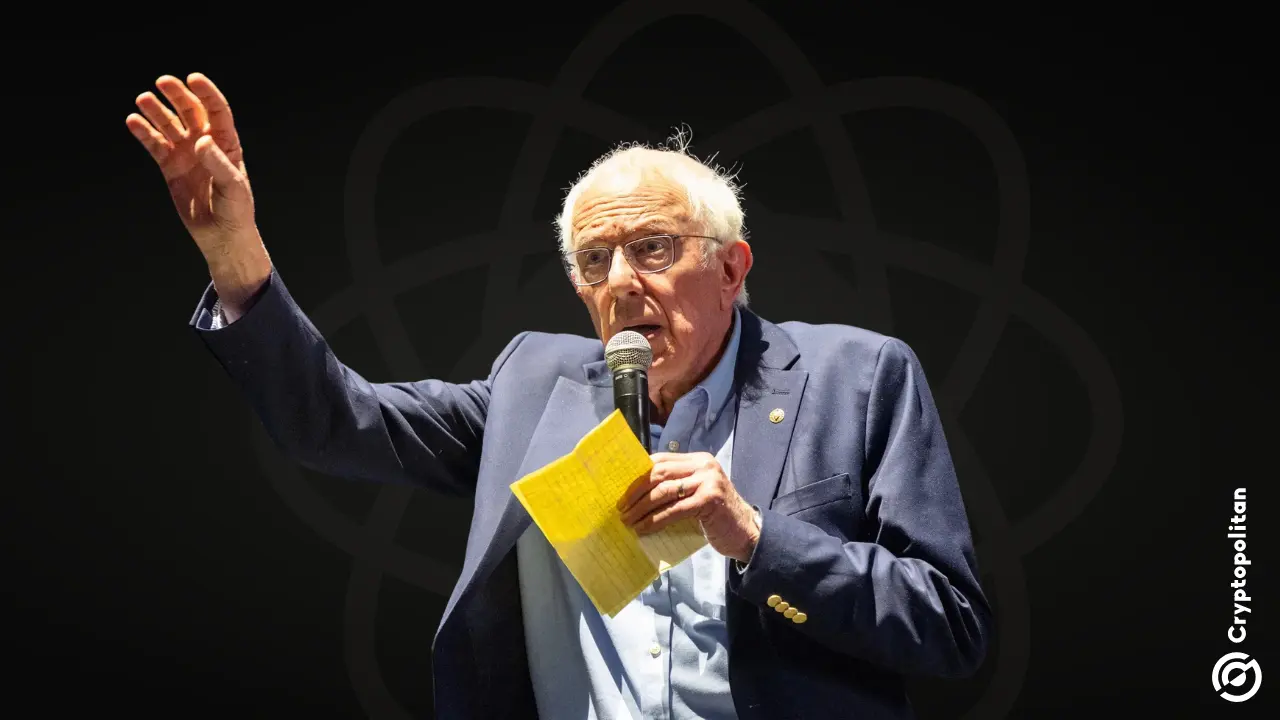
Bernie Sanders and Steve Bannon shared a Washington stage on Tuesday to press Congress for binding AI limits. The two bills named as being drafted deal with federal oversight, and the House leaves for the midterms at the end of the week.
The Investor · Invest desk
What happened
- Bernie Sanders and Steve Bannon appeared together at the Future of Life Institute's all-day Pro-Human Assembly in Washington on Tuesday to press Congress for stronger AI guardrails.
- Sanders asked for binding regulation in place of voluntary commitments, and his agenda includes pausing advanced AI development and permanently banning superintelligence.
- Cryptobriefing cites a Reuters/Ipsos poll in which 77% of those surveyed said they were concerned about higher electricity costs from AI data centres.
Compiled by The InvestorSomething wrong?How this is made
Why it matters
- constraint The calendar caps what the coalition can produce this year: an AI firm planning against a federal statute is planning against the next Congress, not this session.
- contradiction The breadth of the stage tells you nothing about the text that could move, because the bills being drafted do not include the pause or the superintelligence ban.
- exposure The complaint with 77% behind it is electricity prices, so the developers signing power and siting contracts are reachable well before the model labs are.
- decision Sanders' treaty ask puts the pause question in front of the executive branch next week, where a president who calls the risk a hoax decides it alone.
Two bills are named in the record, and neither one pauses anything. Senators John Thune and Amy Klobuchar are drafting a measure that would enforce federal oversight, and Representative Lori Trahan is working with Republican Jay Obernolte on a separate bill called the Frontier Act [6][7]. Sanders asked for binding rules in place of the voluntary commitments companies have offered, for a pause on advanced development and a permanent ban on superintelligence [4], and separately for a moratorium on new data centres [5]. The two drafts cover none of that [21].
Republicans hold both chambers, and the House is scheduled to break at the end of the week and stay out until after the November midterms [8]. The days left this week are therefore the only House floor time available before the election [22]. Hakeem Jeffries has asked Speaker Mike Johnson to delay the recess [9]. Trump wrote on social media that a "strong and smart" President is all the safety AI needs. The concern about AI "taking over the World, destroying Humanity, and all other things bad, is a HOAX", he wrote [10].
The speaker list was genuinely wide. On it were Senator Marsha Blackburn, Representative Greg Casar and New York Assembly member Alex Bores, alongside actors Ashley Judd and Joseph Gordon-Levitt, San Francisco Archbishop Salvatore Cordileone and the National Association of Evangelicals' Walter Kim [18][25]. Bannon, a former adviser in the Trump White House, called AI "the defining issue of our time" and aimed at what he called "tech oligarchs" [26][12]. Sanders, the independent senator from Vermont, said "AI has the potential to eliminate tens of millions of jobs, wiping out entire professions and making it harder for our young people to enter the workforce" [26][11].
The one binding instrument anyone brought to the stage was a contract. Randi Weingarten of the American Federation of Teachers referenced a deal between the teachers' unions and Microsoft that shields student data from AI training. Elected officials, she said, "need to say we are going to make safety as important as innovation" [14][13]. Jacob Coxon, who worked at OpenAI and then Anthropic before quitting the latter over safety fears, had been lined up to speak and pulled out over what he and the organisers described as a miscommunication [17].
Cryptobriefing cites a Reuters/Ipsos poll in which 77% of those surveyed said they were concerned about increased electricity costs from AI data centres [15]. A member facing a primary can read that number, and it points at siting and power. Of Sanders' asks, the data centre moratorium is the most legible. Anthropic's Dario Amodei has called for slowing development; Trump's adviser David Sacks said the requests are "becoming a panic" [19][20].
In my view the shared stage moves the odds of hearings and of a narrow disclosure or oversight bill. It does not move the odds of a moratorium. An AI company allocating capital against a federal compliance date is still allocating against the next Congress. Blackburn's presence on that list is the best evidence for the other reading: a coalition this wide is how a short oversight text gets attached to something moving after the election. Two developments would settle it against me. One is a Thune-Klobuchar draft that emerges with a pause or a superintelligence clause in the text [6]. The other is Johnson granting Jeffries' request and holding the House in session [9]. Sanders has also asked Trump to negotiate a treaty with Xi to pause AI development when the two meet next week [16].
What to watch
- Whether Johnson grants Jeffries' request and keeps the House in session past the end of the week.
- Whether the Thune-Klobuchar draft or the Frontier Act is introduced with a pause or superintelligence clause in the text, or stops at oversight.
- Whether an AI pause is raised at next week's Trump-Xi meeting after Sanders' treaty call.