InvestNot yet confirmed elsewhere1 publisher2 min readPublished
China's AI displacement is showing up in rate cards, not just layoff notices
A Beijing coder and 160 colleagues gone two weeks after a manager's question, translation pay halved, enterprise AI use at 47.5%. The labour repricing there has no political brake on it.
The Investor · Invest desk
What happened
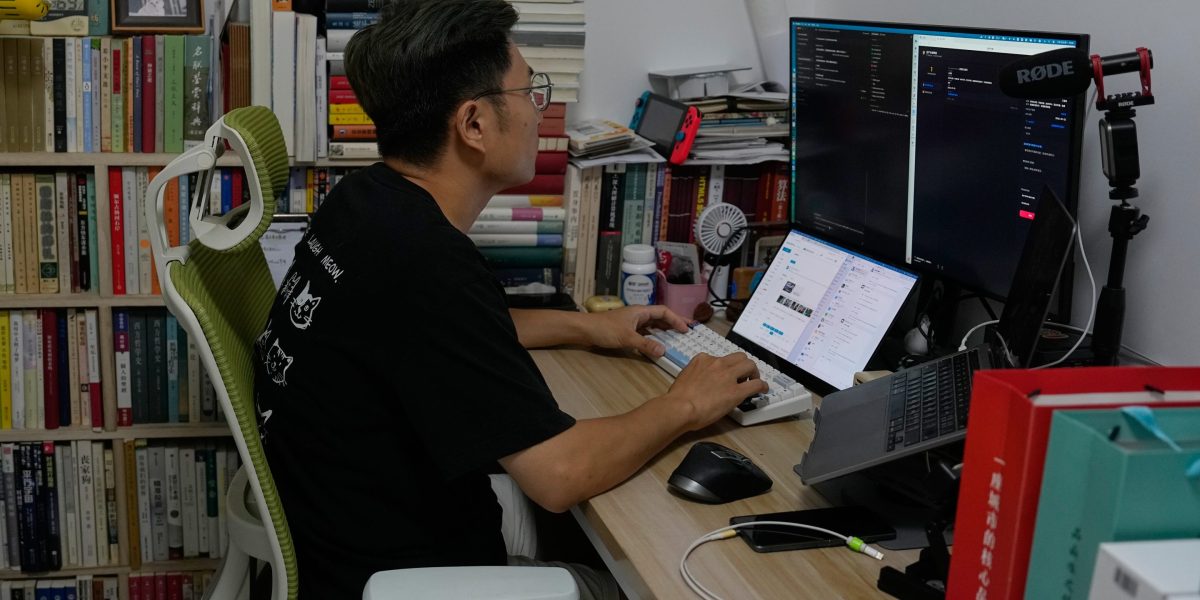
- Programmer Fei Zhaojun was laid off in Beijing with about 160 colleagues, two weeks after his boss asked whether AI could soon replace human coders.
- IDC says 47.5% of Chinese industrial enterprises reported using AI models and agents last year, against 9.6% in 2024.
- Chengdu part-time translator Du Qinchun says pay in his industry has been cut by more than half compared with years ago.
- Chinese media reports put the fall in live-action short and vertical mobile video series at about 75% in the first quarter, year on year.
- Beijing's AI Plus initiative and its five-year plan through 2030 push AI into industries as part of the technology contest with the U.S.
Why it matters
- constraint On Plenum's account of Chinese sentiment, the throttle on deployment is how convinced a manager is, not how much political cover the employer needs; there is no veto point in the reporting to slow...
- cost The one growth channel visible here, being paid to train the model that competes with you, is described as temporary by the worker doing it. That is a bridge, not a replacement income.
- exposure The reachable workers are the specialists, not the generalists: anyone whose role sits narrowly inside software or multimedia loses the training barrier that used to price their time.
- decision Students are already reallocating away from foreign-language degrees, which fixes the supply of that skill for years ahead before any single employer makes a hiring call.
What ended Fei Zhaojun's job was a manager's read rather than a benchmark. His bosses judged AI close enough for coding work while he still doubted it [1], and he has since come round on the substance, saying mid-level coders are essentially replaceable in most cases [2]. His reason for using the tools is not a claim about quality at all: even if it proves a disaster, he said, at this stage you have to use it because everyone else does [3]. Adoption driven by that logic does not pause for verification, and it does not unwind when the output disappoints.
The enterprise diffusion figure works out to a rise of roughly five times, 37.9 percentage points inside a single year [9]. It is also a survey of what firms say about themselves. The collapse in live-action short series reaches the report secondhand, through Chinese media, and sits next to generative AI moving into creation, production and distribution in that same industry [17]. Soft numbers, both of them. The price signal is harder: a rate cut of that depth means a translator has to at least double output to stand where he stood before [14], and the arithmetic holds whether or not any survey respondent is telling the truth.
Where the displaced land is the part the evidence cannot settle. Shujing He of Plenum describes people who have left traditional workplaces as eager to experiment with AI-enabled businesses and independent ventures [5]. Fei's version of that is vlog-style short videos about ordinary people's lives, which he says do not make him a living [13]. The same reporting carries economists who think displacement on this scale could eventually undermine the strength of the world's second-largest economy [15], and an International Labour Organization finding that women carry higher risk because their work concentrates in more automatable tasks such as electronics assembly [12]. Nothing in the material reconciles the optimistic absorption story with the demand-side warning.
For anyone pricing exposure to this, the distinction worth holding is between markets that adjust through headcount and markets that adjust through rate. Salaried work reprices in one afternoon and yields a number someone can count. Freelance and contract work reprices continuously and quietly, which is why the contract rate is the better instrument even though the layoff is the story. China is running this with the state pushing from one side and, on the reporting available, no organised resistance on the other, so it will produce readable numbers before anywhere else does.
What to watch
- Whether IDC's next survey converts self-reported adoption into measured output or headcount, since the current figure records intent as much as use.
Clarity's read
What the record supports and how the coverage leans. The claims behind it follow.
Reality
- Evidence52
- Adoption63
- Hype gap+14
- Incentives46
- Confidence55
Claim ledger
Ranked by verification strength, evidence, and original report placement.
- [1]
Until recently Fei had doubted AI could do programming work perfectly, even though his bosses thought it was close enough.
- [2]
Fei, 40, said mid-level coders' jobs are essentially replaceable in most cases.
- [3]
Fei said that even if it is a disaster that leads to replacing all humans, at this stage you just have to use it as everyone else is using it.
- [4]
The share of Chinese industrial enterprises saying they use AI models and agents jumped to 47.5% last year from 9.6% in 2024, according to market intelligence firm IDC.
- [5]
He said individuals who worry about being replaced, as well as those who have already left traditional workplaces, are often eager to experiment with AI-enabled businesses and independent ventures.
- [6]
Under China's 'AI Plus' initiative and its five-year plan through 2030, the government is pushing to infuse AI across many industries, aiming to gain an edge in the technology rivalry with the U.S.
- [7]
He said tasks that once required specialized training can now be performed by almost anyone with access to AI tools, particularly in software development and multimedia creation, so workers whose roles are narrowly concentrated in those areas may face greater displacement risk.
- [8]
Computer programmer Fei Zhaojun was laid off from his job in Beijing along with about 160 colleagues, two weeks after his boss asked him whether artificial intelligence could soon replace humans in coding jobs.
- [9]
IDC's figures imply industrial enterprise AI use rose about 4.9 times in a year, a gain of 37.9 percentage points.
- [10]
Du Qinchun, a part-time translator based in Chengdu, has been helping train an AI model to do translations, which has brought him more work, at least temporarily.
- [11]
Du said pay in the translation industry has been cut by more than half compared with what it was years ago.
- [12]
A report from the International Labour Organization found women face higher risks of losing employment due to AI use than men, as they tend to work in areas more suitable for automation, such as assembling electronics, and remain underrepresented in science and technology.
- [13]
Fei is now making vlog-style short videos about ordinary people's lives during a career break and is not making a living off them.
- [14]
If a translator's rate is cut by half, output must at least double to hold income flat.
- [15]
Some economists believe AI-driven displacement in China might eventually undermine the overall strength of the world's second largest economy.
- [16]
The number of live-action short and vertical video series designed for mobile phones fell about 75% in the first quarter of this year from a year earlier, according to Chinese media reports.
- [17]
Generative AI is increasingly used for creation, production and distribution in China's short drama industry.
- [18]
Shujing He, a Beijing-based senior analyst at advisory and research firm Plenum, said there appears to be far less anti-AI sentiment in China than elsewhere, with most people either positive, neutral or mildly interested in AI.
- [19]
Popular college programs in foreign languages have increasingly fallen out of favour in China as AI-powered translation tools have become more widespread.
Sources
1 independent publisher whose own reporting we read for this story.
Topics and entities
Follow any of these and your For You feed starts watching them — no settings page required.
Topics
- Freelance rate compressionFollow
- AI labour displacementFollow
- Enterprise AI AdoptionFollow
- Software engineering labour marketFollow
- Generative AI in media productionFollow
- China AI policyFollow
- Robotics and physical automationFollow