Invest2 publishers3 min readPublished Updated
Madrona finds 83% of enterprise AI buyers shipping under half their pilots
Madrona's survey of 150 senior enterprise buyers found 74% expanding AI budgets over the next 12 months while most of them converted fewer than half their pilots, which puts the brake on AI revenue inside the customer rather than the product.
The Investor · Invest desk
What happened
- Nearly half of the 150 senior enterprise decision-makers Madrona surveyed now carry a dedicated, net-new AI line item, which the firm reads as AI becoming a distinct spending category.
- More than a third of those enterprises converted fewer than one in four of their AI pilots into production over the past 12 months.
- Just 1% of the enterprises surveyed got more than three quarters of their pilots into production.
Compiled by The InvestorSomething wrong?How this is made
Why it matters
- cost Vendors charging per token collect against consumption that stalls in the buyer's compliance queue, so the pricing model buyers mostly encounter is the one that hands vendors the conversion risk.
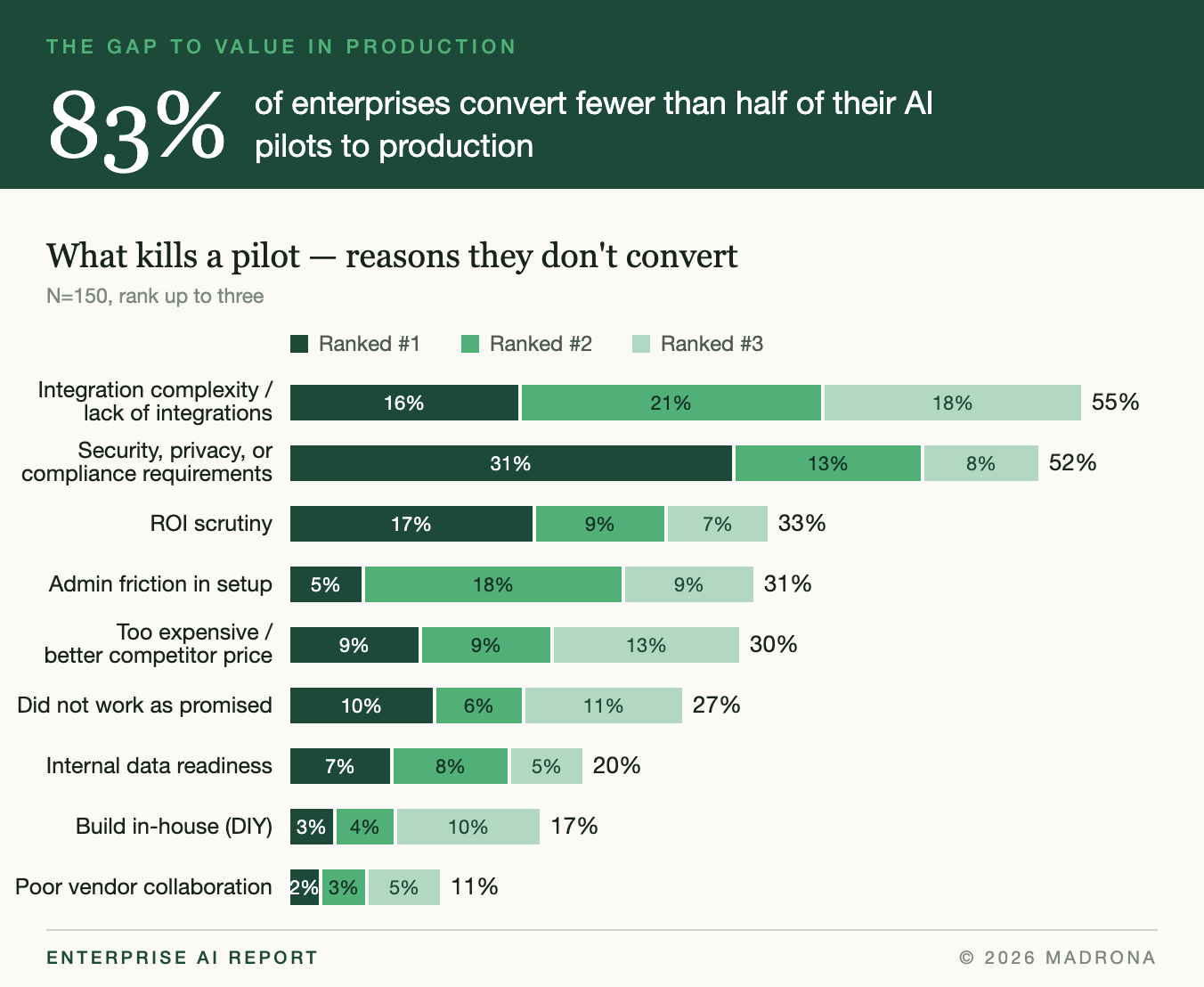
- constraint Because product failure ranks sixth among pilot killers, a better model does not lift the conversion rate; the fix sits in integration and procurement work the vendor does not own.
- exposure A signed contract now buys a review window roughly as long as the sales cycle that won it, which puts booked enterprise AI revenue back in play twice a year.
- decision With discovery running through internal tech teams, every dollar added to a field sales org is a dollar not spent on the deployment engineering that decides whether the pilot converts.
A panel where 83% shipped under half their pilots [3] and 74% are raising budgets [1] cannot keep those two groups apart, and the floor on the intersection is 74 plus 83 minus 100, so at least 57% of the sample, about 85 of the 150 respondents [7], are writing a bigger cheque this year against a pipeline they converted at under 50% last year [16].
The tail is thinner than the percentage makes it sound. One percent past three quarters [5] on a 150-person panel is one respondent, possibly two [17], which is a figure to quote gently; the sturdier shapes are the 16% sitting between half and three quarters [18] and the more than a third who converted fewer than one in four [4].
Where pilots die matters more than how many. Integration complexity ranks first among the reasons they fail to convert, security, privacy and compliance requirements second, ROI scrutiny third, and "didn't work as promised" only sixth [6], which means the binding constraint is the buyer's own stack and procurement queue, and a vendor that ships a materially better model next quarter has bought itself very little conversion. What tips a pilot in, on the same survey, is strong end-user adoption, ranked top three by 65% of buyers, slightly ahead of executive sponsorship and clean integration, with quantifiable ROI fourth [8]; Madrona reads that ordering as the formal ROI analysis ratifying a decision already taken informally [9].
Reading the gap as a valuation problem needs numbers this survey does not contain. The stated inputs are a buyer survey, a practitioner survey of engineering leaders from Madrona's builder community, and five years of IA40 list data [7], none of which measures vendor revenue or customer churn [20]. There is also an honest counter-read, or rather the more interesting version of it: a sub-50% conversion rate is roughly what a working options book looks like, since the point of running ten pilots is to kill six, and the failure reasons here are sequencing and plumbing rather than disappointed value [6].
The term I would negotiate on is price. Outcome-based pricing is the most preferred model among these buyers and the least commonly encountered, while nearly half primarily meet usage-based pricing and fewer prefer it [12][13], so a vendor billing per token has levered its revenue to precisely the conversion rate that fails for 83% of buyers [3]. Then the back end: 77% re-evaluate their AI vendors at least every six months, 29% on a rolling basis [10], and since 52% of deals sign in under six months from first meeting [15], the first review arrives inside a window no longer than the sale took [19]. Madrona's own reading is that the inertia moat of annual and multi-year contracts is gone [11], though the survey counts how often buyers look, not how often they leave.
Allocation follows from the discovery number. With 41% of enterprises primarily finding AI tools through internal tech-team research [14], a marginal dollar into field sales buys access to a room where the informal decision has already happened [9], and does not buy the integration and compliance engineering that the failure ranking says is doing the killing [6]. What would break this read: a repeat panel showing conversion above half, or a failure ranking in which "didn't work as promised" climbs toward the top, since that would put the problem back inside the product where vendors can fix it [6].
What to watch
- Any AI vendor disclosing gross dollar retention that can be set against a buyer base re-evaluating every six months.
- Outcome-based terms actually appearing in enterprise AI renewals, rather than staying the model buyers say they want and rarely see.
- Whether the dedicated, net-new AI line item survives the next budget cycle as a separate category or gets folded back into IT.