Science1 publisherNot yet confirmed elsewhere3 min readPublished
Paleodictyon burrow angles averaging 8.5 degrees off 120 point to an arthropod maker
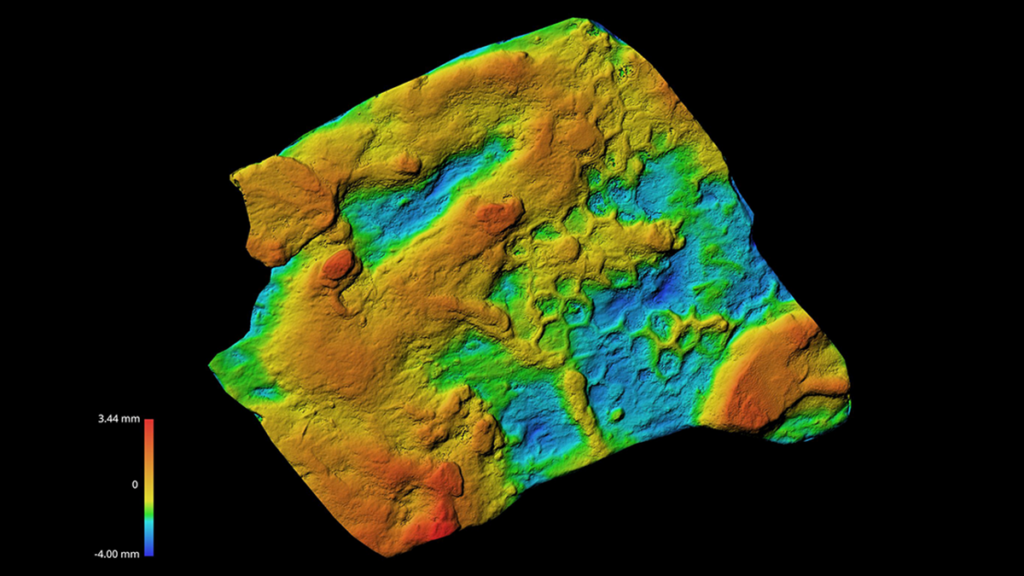
Andrea Baucon's team took more than 1,000 measurements of Paleodictyon burrows in Italy's Apennines and argues an unidentified marine arthropod made them. The case rests on tunnel geometry, because whatever builds similar mesh on today's seafloor has never been seen.
The Scientist · Science desk
Drafted by a language model from the sources cited here and checked against its claim ledger before publication. How we use AISend a correction
What happened
- Interior angles of the hexagons averaged 8.5 degrees off a perfect 120, and side lengths within a single structure varied by an average of 0.5 millimetre.
- The measured specimens came from collections at the University of Genoa and the Natural History Museum of Piacenza, plus new finds from Apennine outcrops.
- Small errors in side length and angle did not carry through the networks, and Baucon takes this as possible evidence that the builder corrected its own mistakes.
- Paleodictyon first appears in the fossil record in the early Cambrian, at a time when arthropods were becoming more abundant.
Compiled by The ScientistSomething wrong?How this is made
Why it matters
- constraint Matching geometry points to a kind of body, hard-shelled with jointed limbs. Whether one surviving lineage made the mesh, or several converged on it, is still open.
- decision Anyone searching the deep seafloor for the living builder can now concentrate on hard-bodied arthropods such as crustaceans, setting aside earlier candidates like worms, corals or algae.
- precedent With Hasiotis crediting the sample size and statistics, a rival worm or coral hypothesis will need its own comparable measurements to stay in contention.
An average miss of 8.5 degrees from a perfect 120 is an error of about 7 percent [19]. The cells are about a centimetre wide, and finding fresh ones meant days on hands and knees in the Apennines, said Baucon, a coauthor and paleontologist at the Universita degli Studi di Cagliari [18][10]. The Eos report does not describe a matched set of soft-bodied traces, such as worm burrows, measured the same way. So the precision figure is compared with an ideal hexagon, and the case against worms rests on how worms are known to move [3].
Worms and other soft-bodied animals tend to wander along the path of least resistance, Baucon said, while Paleodictyon's tunnels run straight and meet at sharp angles [3]. Those features are common in arthropod tracks and depend on a tough exoskeleton and jointed appendages [3]. "An arthropod can cut the substrate like a knife through butter," Baucon said [4]. On that basis the authors rank hard-bodied arthropods, with crustaceans a likely candidate, above worms, corals and foraminifera [2].
The error-correction argument is the one I find most interesting. If a deviation does not spread through the network, the builder has to be keeping track of the direction and distance it has travelled [16]. Baucon added that "the animal was able to reach such accuracy at 3,000 meters of depth in total darkness" [17]. The inference about the builder's cognition comes from tunnel geometry alone [16].
The timing argument is weaker. The Cambrian overlap between the first Paleodictyon and rising arthropod numbers [15] fits the hypothesis, but it is only a correlation in dates.
The furthest reach is the claim that an arthropod made these burrows on ancient seafloors and still makes them today [1]. Similar meshes have been seen on modern ocean floors, but their builders have not [6]. Stephen Hasiotis, a University of Kansas paleontologist not involved in the study [13], left the lineage question open. "This behavioral strategy of constructing this meshwork has survived, or been reinvented, or evolved in different lineages of animals, and continues to this day," Hasiotis said [14]. In my view the geometry makes a good case for a body plan, a hard-bodied animal with jointed limbs. It cannot by itself separate one lineage persisting since the Cambrian from several arriving at the same design.
Andrew Gooday, a marine biologist and emeritus fellow of the National Oceanography Centre in Southampton who was not involved, found the arthropod hypothesis very plausible. "The arguments in the paper are very convincing," Gooday said [12]. Hasiotis noted that others had proposed arthropods before, and credited the new paper for the rigor of its statistics and the number of samples measured [13].
What to watch
- Observation or capture of a living Paleodictyon builder on a modern seafloor, which would test the arthropod identification directly.
- The same angle, spacing and width measurements applied to modern seafloor Paleodictyon, to check whether today's meshes match the Apennine fossils' precision.
- Known worm burrows measured by the same method, to see how soft-bodied traces score against the 8.5-degree figure.