Science1 distinct publisher2 min readUpdated
A Nature Climate Change study finds the same warming that leaves Atlantic currents intact near 5.5C if reached slowly can tip them at 2C at today's emissions rate.
The Scientist · Science desk

Compiled by The ScientistSomething wrong?How this is made
Researchers at Utrecht University report that the Atlantic Meridional Overturning Circulation, the current system that includes the Gulf Stream and moves heat into the Northern Hemisphere, can survive far more warming when it arrives slowly than when it arrives fast [1][2]. The finding, published Aug. 13 in Nature Climate Change, reframes a risk that current policy treats as a single temperature threshold [3][4].
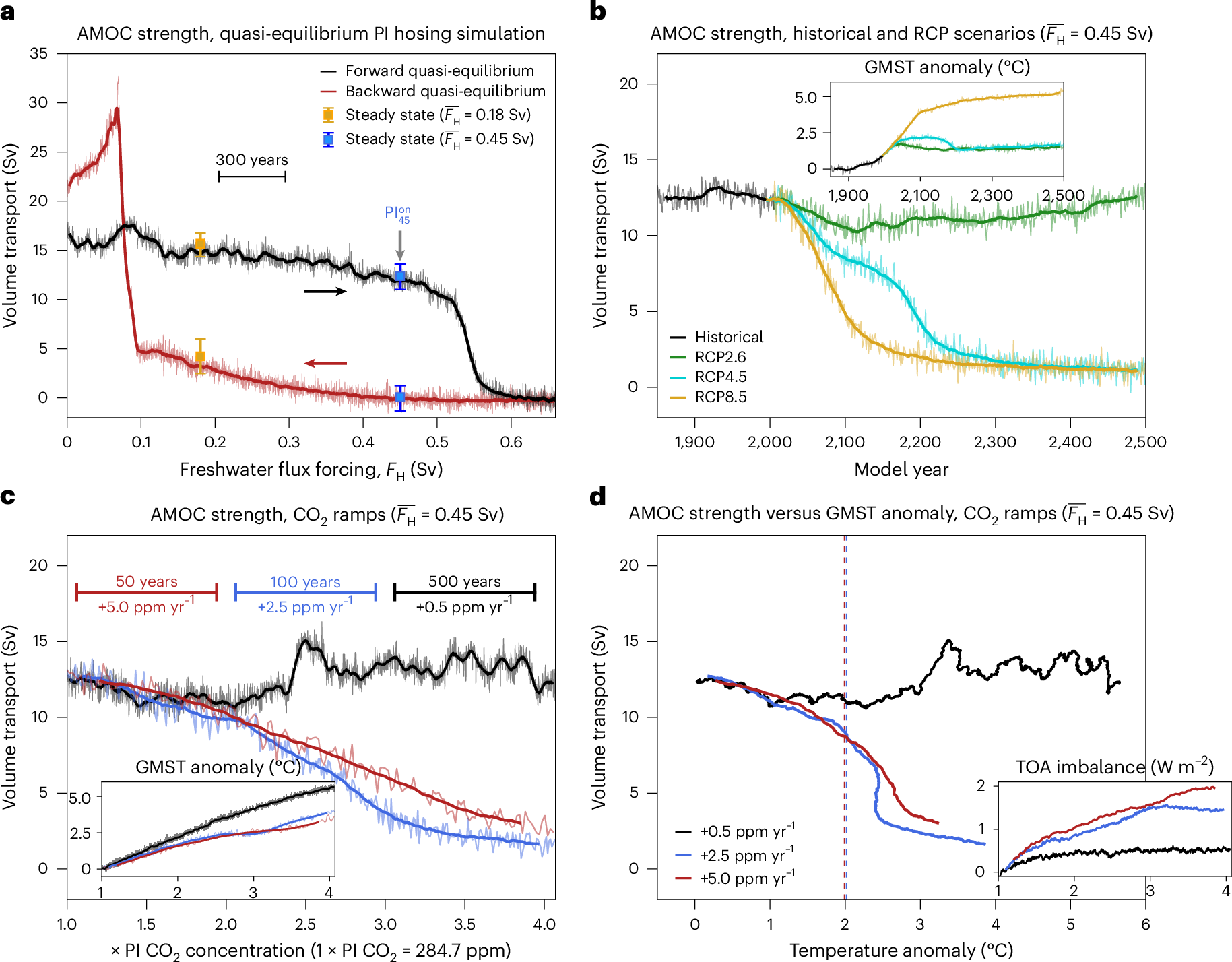
In climate model runs, slow warming let the currents hold their strength beyond 5C above preindustrial levels, collapsing only near 5.5C [6][5]. Warming at a pace equal to or above today's emissions tipped the same system at just 2C [7]. Co-author Henk Dijkstra said that under slow warming the entire ocean has time to reorganise and adapt, while under faster warming it simply cannot keep up [8].
The mechanism is density. The AMOC runs on North Atlantic surface water sinking to form the bottom currents that drive the loop, and that water sinks only when it is colder and saltier, and so denser, than the layers below [9]. Warming surface water and Arctic meltwater diluting its salt are both making that sinking less reliable than before [10]. Given time, two feedbacks push back: more evaporation strips fresh water and concentrates the remaining salt, and a warmer world delivers less Arctic meltwater once most of the ice has already melted [11]. Both changes only help if they happen slowly [12].
The design isolated rate from endpoint. The team ran one slow CO2 ramp at 0.5 ppm per year and two fast ramps at 2.5 and 5 ppm per year [13]. Co-author Reyk Borner said they deliberately chose a scenario much slower than today's to isolate the effect of the warming rate alone, independent of how warm it eventually gets [14]. Atmospheric CO2 is currently rising by 2.4 to 2.5 ppm per year [15], which puts the present trajectory at the slower of the two fast ramps [16] and roughly five times the rate that left the currents intact [17].
Previous work puts the AMOC at its weakest in more than 1,000 years [18], with an estimated shutdown threshold near 4C above preindustrial levels [19]. A weakened or collapsed AMOC has been linked to freezing weather in parts of Europe, faster sea level rise along the U.S. East Coast, and drought around the equator [20].
What to watch is whether the near-term emissions rate, rather than the century-end target, becomes the operative variable in tipping-point risk assessments [4]. This is one study of one system in models, and the rescue mechanisms it credits at 5C depend on decades that today's trajectory does not obviously allow [12][17].
Follow any of these and your For You feed starts watching them — no settings page required.
Ranked by verification strength, evidence, and original report placement.
The study suggests that the pace of warming, rather than the extra heat on its own, will determine whether the AMOC persists under climate change.
Co-author Henk Dijkstra, a professor of dynamical oceanography at Utrecht University, said that under slow warming the entire ocean has time to gradually reorganise and adapt, while under faster warming the ocean simply cannot keep up.
The research has implications for climate policy, as current targets and risk assessments are based on temperature thresholds.
In the slow CO2 ramp experiment, the AMOC remained strong until up to 5.5C (9.9F) of warming before the system collapsed.
Under slow warming from small year-over-year CO2 increases, evaporation and sea ice feedbacks maintain Atlantic currents' strength at temperatures exceeding 5C (9F) of warming above preindustrial levels.
Researchers ran one slow CO2 ramp with CO2 rising 0.5 ppm per year and two fast CO2 ramps rising 2.5 ppm and 5 ppm per year, respectively.
Evidence-backed comparisons of source perspectives and observed adoption signals. Read the methodology
Which Builder, Operator, and Investor concerns the observed source mix emphasized—not a truth score.
Evidence, demonstrated adoption, hype gap, incentives, and confidence are assessed independently, each on its own current evidence. How these are measured.
Peer-reviewed model study, one outlet, no uncertainty reporting
The claims trace to a named, dated Nature Climate Change paper with identified Utrecht University authors and explicitly stated experimental parameters, which is stronger than typical single-source science coverage. It is nevertheless one publisher reporting one modelling study, quantitative thresholds arrive without ensemble spread or uncertainty ranges, and the only independent voice says the work cannot yet establish bounds on a safe rate of CO2 increase.
No uptake evidence in supplied sources
The cluster contains no evidence of the finding being taken up anywhere - no policy body, assessment process, monitoring programme, or follow-on study is reported as adopting rate-based AMOC risk framing. The authors' recommendation that policy consider warming rate is an argument, not observed adoption, so this dimension is left unmeasured rather than inferred.
Framing outruns idealised simulations
The reported thresholds are internally consistent and attributed, but the article opens by asserting that pace of warming 'may cause the catastrophic collapse of these currents in the next few decades', a timing claim the reported results - warming-level collapse points in idealised CO2 ramps - do not establish. The 2C fast-ramp tipping figure is also presented against a prior 4C threshold without uncertainty ranges, while the one independent expert says the study cannot yet set bounds. That is a moderate overstatement of certainty and timing rather than a fabricated result.
University statement sourcing plus author policy advocacy
Every author quote in the cluster is explicitly taken from an institutional statement, so the framing reaching readers is shaped by Utrecht University communications rather than independent interrogation, and the authors are simultaneously advancing a policy position that rate of warming should enter targets and risk assessments. The outlet also runs newsletter and related-story promotion around the piece. These are ordinary, disclosed incentives rather than concealed conflicts, so the level is moderate.
Moderate: solid provenance, single-outlet and model-only basis
Provenance is clear and the numbers are specific and consistently reported, which supports moderate confidence in what the study says. Confidence in the underlying physical conclusion is capped by the single-publisher cluster, the absence of observational corroboration or uncertainty ranges, and the explicit statement from an uninvolved researcher that the exact rate limit remains unclear. Adoption is entirely unmeasured, which further limits how much of the picture is verified.
science
A weaker AMOC does not just move heat around. It adds to the total1 distinct publisher
science
Feeds are triaging patients by engagement, and the proposed defence is literacy, not moderation1 distinct publisher
science
Ancient DNA keeps changing the sex of the richest graves. The backlog is the story1 distinct publisher
science
IBM's bottleneck was cold volume, and its answer is an 8-foot box you can bolt to another one1 distinct publisher
Distinct publishers with included, body-backed reporting in this cluster.