Product1 publisher3 min readPublished
A magnetar may have caught empty space bending light, if its tilt is what the authors say
Astronomers report the first detection of vacuum birefringence, predicted in the 1930s. Outside commentators say the result stands or falls on one assumption about the star's geometry.
The Product Desk · Product desk
Drafted by a language model from the sources cited here and checked against its claim ledger before publication. How we use AISend a correction
What happened
- A recent paper published in Nature describes astronomers' observations of the star 1E 1547.0-5408, which appears to be demonstrating vacuum birefringence.
- 1E 1547.0-5408 is a magnetar, an isolated neutron star with extremely powerful magnetic fields and X-ray emissions.
- The magnetic field of 1E 1547.0-5408 is over a trillion times stronger than Earth's.
- Vacuum birefringence is a quantum phenomenon in which seemingly empty spaces alter the behaviour of light.
- If true, the observation represents the first-ever detection of vacuum birefringence, which was initially predicted by Werner Heisenberg and Hans Euler in the 1930s.
Compiled by The Product DeskSomething wrong?How this is made
Why it matters
Astronomers reporting in Nature say the magnetar 1E 1547.0-5408 is showing vacuum birefringence, the quantum electrodynamics effect that Werner Heisenberg and Hans Euler predicted in the 1930s [1][5]. If the interpretation survives, it is the first detection of something nobody has managed to demonstrate directly for nearly a century, according to an accompanying News and Views by Ekaterina Sokolova-Lapa and Joern Wilms of the University of Erlangen-Nuremberg, who were not involved in the work [9].
The reason the wait ran that long is a supply problem. Detecting the effect requires a magnetic field more than 100 million times stronger than any field ever produced on Earth, said co-author Marcus Lower, an astrophysicist at Swinburne University of Technology in Australia [6]. No plausible hardware programme closes that gap, so the apparatus has to be borrowed. Magnetars are isolated neutron stars with extremely powerful magnetic fields and X-ray emission [2], and this one's field is more than a trillion times Earth's [3]. Lower called them the perfect cosmic laboratories for the search [7], and lead author Rachel Stewart, a PhD candidate at George Washington University, described them to Physics World as a natural lab [10]. 1E 1547.0-5408 was chosen because its radio and X-ray emission was particularly bright [11].
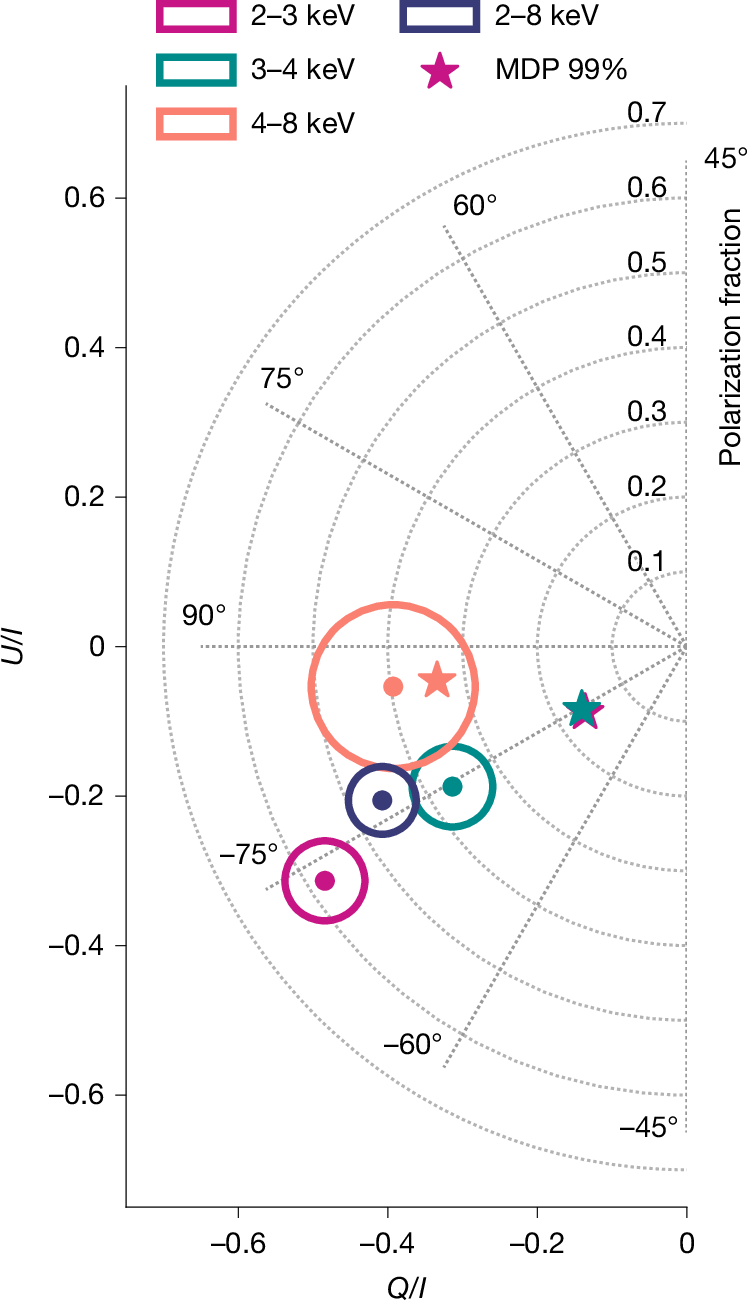
The mechanism, as NASA described the findings, is that a sufficiently strong magnetic field makes empty space behave like a lens or a prism, producing unusually high polarization [8]. Two features of the data point that way. The polarization measured was three times higher than expected from comparable sources [12]. And parts of the field where the geometry predicts zero polarization were not zero [13]. Lower said that tracking the direction in which the radio waves and X-rays oscillate as the star rotates showed that the alignment of its magnetic and rotational poles was ideal for detecting the effect, with virtual particles lining up along the field so that, to an outside observer, the vacuum appeared to twist the light [14][15].
That is also where the caution begins. Sokolova-Lapa and Wilms wrote that the validity of the interpretation hinges on whether the authors' proposed magnetar geometry is correct, since the star's tilt could make the radio and X-ray signals appear aligned when they are not [16]. Roberto Taverna of the University of Padova told Physics World it is not yet clear what the radio and X-ray observations are telling us about the true nature of the star [17]. The load-bearing element in this claim, then, is not the polarization excess but the geometric model invoked to explain it [19].
It is worth noting how fast the secondary accounts blur. The Gizmodo writeup credits the prediction to Heisenberg and Euler in the 1930s, then closes by saying confirmation is needed before declaring Heisenberg and Dirac correct [5][20]. Stewart, quoted in the NASA release, framed the result as clues about the nature of the fabric of reality [18], which is the kind of line that travels further than the caveat attached to it.
What to watch is narrow and specific: whether future investigations can pin the star's orientation independently of the birefringence interpretation, because that single assumption is what the whole result rests on [21][16]. Until then, the useful takeaway is structural rather than physical. A prediction that terrestrial magnets cannot reach by a factor of 100 million now has an observational test bed [6], and the constraint on progress moves from magnet engineering to how well anyone can model the geometry of a rotating neutron star.