InvestNot yet confirmed elsewhere1 publisher2 min readPublished Updated
Hanwha's Philly Shipyard can build one to 1.5 ships a year on a $5 billion pledge
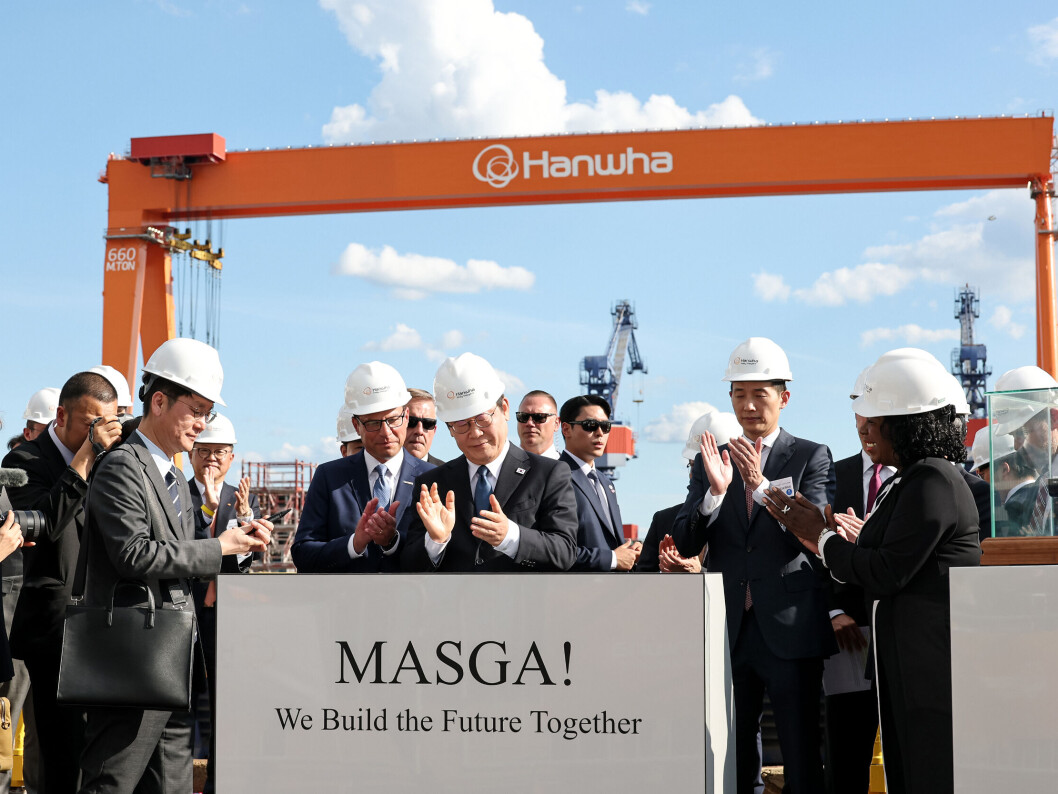
Hanwha's Philly Shipyard has no orders beyond its owner's except three Matson container ships, the WSJ reported, despite a $5 billion investment pledge. The centerpiece of Korea's $150 billion MASGA pledge has posted operating losses for six straight quarters.
The Investor · Invest desk
Key figures: revenue from the shipyard's new-build dock would take roughly 10 to 15 years to add up to the $5 billion pledge. Annual revenue at full capacity is $330 million to $495 million, at Matson's price of $330 million per ship.
| Figure | Value | Note | Claim |
|---|---|---|---|
| Years for revenue to reach the $5B pledge, roughly | 10 years | up to 15 years, at full capacity | 22 |
| Annual revenue at full capacity, at least | $330 million | up to $495 million a year | 21 |
| Matson price per ship | $330 million | 6 |
What happened
- Each of Matson's three container ships is priced at $330 million, roughly twice a comparable large vessel built in Korea or China, under contracts signed before Hanwha bought the yard.
- Only one of the yard's two dry docks builds new vessels, which limits output to roughly one to 1.5 ships a year.
- The second-quarter operating loss was about 19.2 billion won ($14.2 million), after seven straight loss-making years from 2018 to 2024.
- Hanwha has pushed its expected return to profitability from this year to next year.
- Hanwha Systems announced last month that it will sell its share of the yard, bought jointly with Hanwha Ocean in December 2024, to an affiliate of Hanwha Aerospace.
Why it matters
- constraint Matson's three ships equal two to three years of the one new-build dock's output, so a new customer would be bidding for berths that Hanwha's own vessels also need.
- cost At Matson's price and full capacity, revenue takes 10 to 15 years to add up to the $5 billion pledge, and the pledge is Hanwha's to carry.
- decision HD Hyundai Heavy and other Korean builders have yet to commit direct U.S. investment, and each quarter Philadelphia goes without an outside order makes waiting the cheaper choice.
Hanwha paid $100 million for the yard [4] and has pledged $5 billion to it [2], so the purchase price is 2% of the commitment [20]. A price that small says little; the value depends on what the $5 billion buys. On the article's figures it buys one new-build dock [11], and at the $330 million on each Matson ship [6] that dock's output is worth $330 million to $495 million a year in revenue [21]. Matson's is the only ship price in the Korea JoongAng Daily's account of the WSJ article [1], and it was set before Hanwha owned the yard [19]. The account does not say how much of the $5 billion has been spent or what Hanwha pays for its own vessels.
Cost is the first obstacle. Halving Matson's price, in line with the WSJ's roughly twofold gap [7], gives about $165 million for a comparable vessel from Korea or China [24]. The WSJ attributes the premium to high U.S. labor costs and a weak domestic supply chain [18]. "Getting the projects up and running will mean clearing many of the same hurdles that drove heavy industry out of the United States," the report said [17]. Basil Karatzas, head of Karatzas Marine Advisors, said to the WSJ: "It's hard to justify a high valuation multiple for a U.S. shipbuilder like Philly from a foreign buyer, based on pure economics." [16]
Labor is the second. Hanwha has doubled the workforce to about 2,500 in two years [9], but welding, pipe fitting and painting take extensive experience and training, so hiring alone does not close the skilled-labor gap [10]. The Matson contracts predate the takeover [19], so the backlog [8] holds no outside customer that Hanwha won.
We think the evidence supports a narrow conclusion: the yard's demand, as described, is its owner's, and its economics with outside customers are untested. That could turn out wrong in three ways. Hanwha's own vessels might fill the dock at prices that cover cost, in which case the missing outside customers matter less. Hanwha might put the second dock to new-build use and lift the one-to-1.5-ship ceiling [11]. Or losses might narrow on the timetable Hanwha now gives [14]. A single outside order at something near the Korean price would change our view, as would a profit in the year Hanwha now expects one.
What to watch
- Whether Philly Shipyard books any commercial order from a customer other than Hanwha, and at what price against Matson's contracts.
- Whether the yard's operating loss narrows in its next quarterly result and whether the break-even date moves again.
- Whether HD Hyundai Heavy commits to a direct U.S. yard investment, or Hanwha puts the second dry dock to new-build use.
Clarity's read
What the record supports and how the coverage leans. The claims behind it follow.
Reality
- Evidence58
- Adoption25
- Hype gap+55
- Incentives
- Insufficient
- Confidence55
Claim ledger
Ranked by verification strength, evidence, and original report placement.
- [1]
The Wall Street Journal reported Monday that the Philadelphia shipyard faces shortages of space and customers, raising questions about the viability of the Korea-U.S. MASGA initiative.
ReportedSupportedSource: Korea JoongAng Daily, summarizing a Wall Street Journal articleView cited source - [2]
Hanwha announced last year a commitment to invest $5 billion in expanding production capacity and modernizing operations at Philly Shipyard.
- [3]
Philly Shipyard has emerged as a centerpiece of Korea's $150 billion investment in the U.S. shipbuilding industry under the MASGA initiative.
- [4]
Hanwha Ocean and Hanwha Systems jointly acquired Philly Shipyard for $100 million in December 2024, the first acquisition of a U.S. shipyard by a Korean shipbuilder.
- [5]
Hanwha Systems announced last month that it will sell its share of Philly Shipyard to an affiliate of Hanwha Aerospace.
- [6]
Philly Shipyard holds contracts to build three container ships for Matson, each priced at $330 million.
- [7]
The $330 million Matson price per ship is roughly twice the cost of comparable large vessels built in Korea or China.
- [8]
Excluding vessels commissioned by Hanwha itself, the shipyard's entire commercial order backlog consists of the three ships ordered by Matson.
- [9]
Hanwha has doubled the shipyard's workforce over the past two years to approximately 2,500 employees.
- [10]
Key shipbuilding processes such as welding, pipe fitting and painting require extensive experience and training, so simply hiring more workers cannot resolve the shortage of skilled labor.
- [11]
Of the shipyard's two dry docks, only one is used to build new vessels, limiting annual production capacity to approximately one to 1.5 ships.
- [12]
The shipyard recorded losses for seven consecutive years from 2018 to 2024.
- [13]
The shipyard has posted operating losses for six consecutive quarters since Hanwha's acquisition, including an operating loss of approximately 19.2 billion won ($14.2 million) in the second quarter of this year.
- [14]
The company has pushed back its anticipated return to profitability from this year to next year.
- [15]
Other Korean shipbuilders, including HD Hyundai Heavy Industries, have yet to commit to direct investments in U.S. shipyards, taking a wait-and-see approach.
- [16]
"It's hard to justify a high valuation multiple for a U.S. shipbuilder like Philly from a foreign buyer, based on pure economics," said Basil Karatzas, head of consulting firm Karatzas Marine Advisors, to the WSJ.
ReportedSupportedSource: Basil Karatzas, head of Karatzas Marine Advisors, to the WSJView cited source - [17]
"Getting the projects up and running will mean clearing many of the same hurdles that drove heavy industry out of the United States," the WSJ report said.
- [18]
High U.S. labor costs and a weak domestic shipbuilding supply chain are driving up production expenses, according to the WSJ.
- [19]
The Matson contracts were signed before Hanwha acquired Philly Shipyard in 2024.
- [20]
The $100 million purchase price is 2% of the $5 billion pledge.
- [21]
At $330 million per ship and one to 1.5 ships a year, the new-build dock's output is worth $330 million to $495 million a year in revenue.
- [22]
At full capacity and Matson's price, annual revenue of $330 million to $495 million takes roughly 10 to 15 years to add up to the $5 billion pledge.
- [23]
Three ships at one to 1.5 ships a year equal two to three years of the single new-build dock's output.
- [24]
Halving the $330 million Matson price gives about $165 million for a comparable vessel built in Korea or China.
Sources
1 independent publisher whose own reporting we read for this story.
- koreajoongangdaily.comChoppy seas ahead for MASGA as Hanwha's Philly Shipyard struggles: WSJ
1 article · October 12, 2026
Topics and entities
Follow any of these and your For You feed starts watching them — no settings page required.