Product2 publishers2 min readPublished
Google's CC agent asks each of six household members separately what it may read
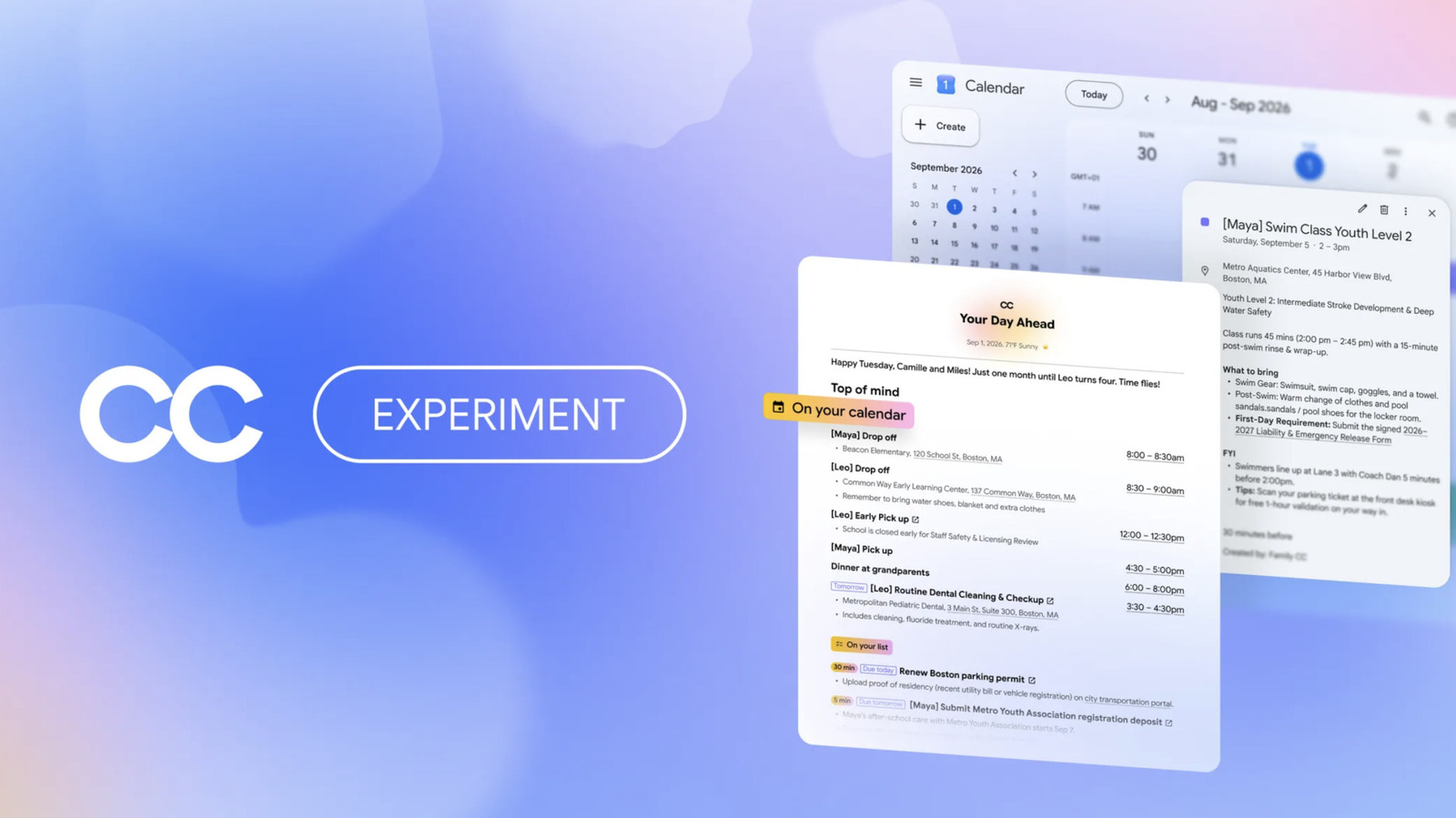
Google Labs opened CC to households of up to six people, each choosing what the agent may see. The agent holds its own verified Google account, and what it learns lands in either a shared household memory or a private one.
The Product Desk · Product desk
What happened
- Google opened its experimental AI agent CC to families, with as many as six people in one household able to share a single agent.
- CC has a verified Google account of its own, which Google Labs said gives the agent a distinct identity when it turns up in a member's inbox or a chat thread.
- A member can put a school or an airline on an auto-share list so everything from that sender routes to the agent, and one-off items can be forwarded by email or Google Chat.
- Google said CC responds only to group members and will not act outside the group or pass anything beyond it without permission.
- The household version is running on web and mobile in the U.S. for people 18 and older with a personal Google account.
Compiled by The Product DeskSomething wrong?How this is made
Why it matters
- decision A team weighing a shared agent has to choose between one that signs in as an employee and one that holds its own identity. Only the second version lets access be withdrawn one person at a time.
- constraint Approval is per sender and open-ended, so clearing a school for schedules clears it for everything else that address sends, and the correction arrives no sooner than the next weekly rundown.
- exposure All six members read the same morning brief, so a detail filed to the shared side reaches five other people before anyone reviews it, and the person exposed is not the one who made the sharing decision.
Say one member forwards the school thread and it has three unrelated things in it. This design turns on where those details land. Google said what the agent picks up goes into a shared household memory or a private one, depending on whether the item applies to everyone or to a single person [8]. Ars Technica reported that CC sees a member's email only when it has been explicitly shared [17].
In any shared agent, ask who granted the access and who can read what comes out. One grant with one reader gives you an ordinary personal assistant. Here, every member grants and every member reads. Private memory covers the six-grant, one-reader case [8]. That leaves one member granting while all six read, and Google's answer there is the classification into shared or private [8].
Tom Shane, senior product manager at Google Labs, wrote in the post announcing the change that "one of our top user requests was for CC to do more to help run a busy home" [9]. He said the coordination gets harder when the information is spread across separate accounts [10]. Google Labs said the agent's own account also gives it a clearer place to hold what each person has agreed to share [4]. An agent holding its own account can be granted access and cut off one member at a time, and an agent that signs in as somebody inherits whatever that person can reach.
Each CC runs on its own isolated cloud computer, built on Antigravity, Google's agentic harness for developers, and on the company's latest Gemini models [11]. The isolation is per household, not per person, so six people's pooled material sits inside one boundary.
CC started in December 2025 as a single-user product that emailed a briefing built from Gmail, Calendar and Drive, and moved into the Gemini app in May under the name Daily Brief [15][16]. The household version was announced on September 17, roughly nine months after the single-user one [19][18]. Existing users get an email about upgrading in the coming days, and everyone else joins a waitlist [14]. Google did not disclose a price [22].
The test I would apply before switching on a team agent is three columns for every source it reads: who granted it, who can read the output, and what ends the grant. CC answers the first two per member [2][8]. The third runs through a weekly list of new senders, one queue per member, which is six queues feeding one shared brief [20]. I would judge the model by how many senders a member still reviews in month three.
What to watch
- Whether Google adds a way for one member to see what the other five have shared with CC.
- Whether the waitlist opens outside the U.S. or to accounts held by under-18s, both excluded from the current release.
- Whether the same per-member grant pattern turns up in Google Workspace for shared mailboxes, where the agent's own account would carry the audit trail.