ProductWidely confirmed6 publishers3 min readPublished
Google Play opens a personal library for AI Studio apps that needs no paid developer account
Google now lets people 18 and older put AI Studio apps in a private Play library with only a Google account. The apps stay out of Play search and listings, and only their creator can use them.
The Product Desk
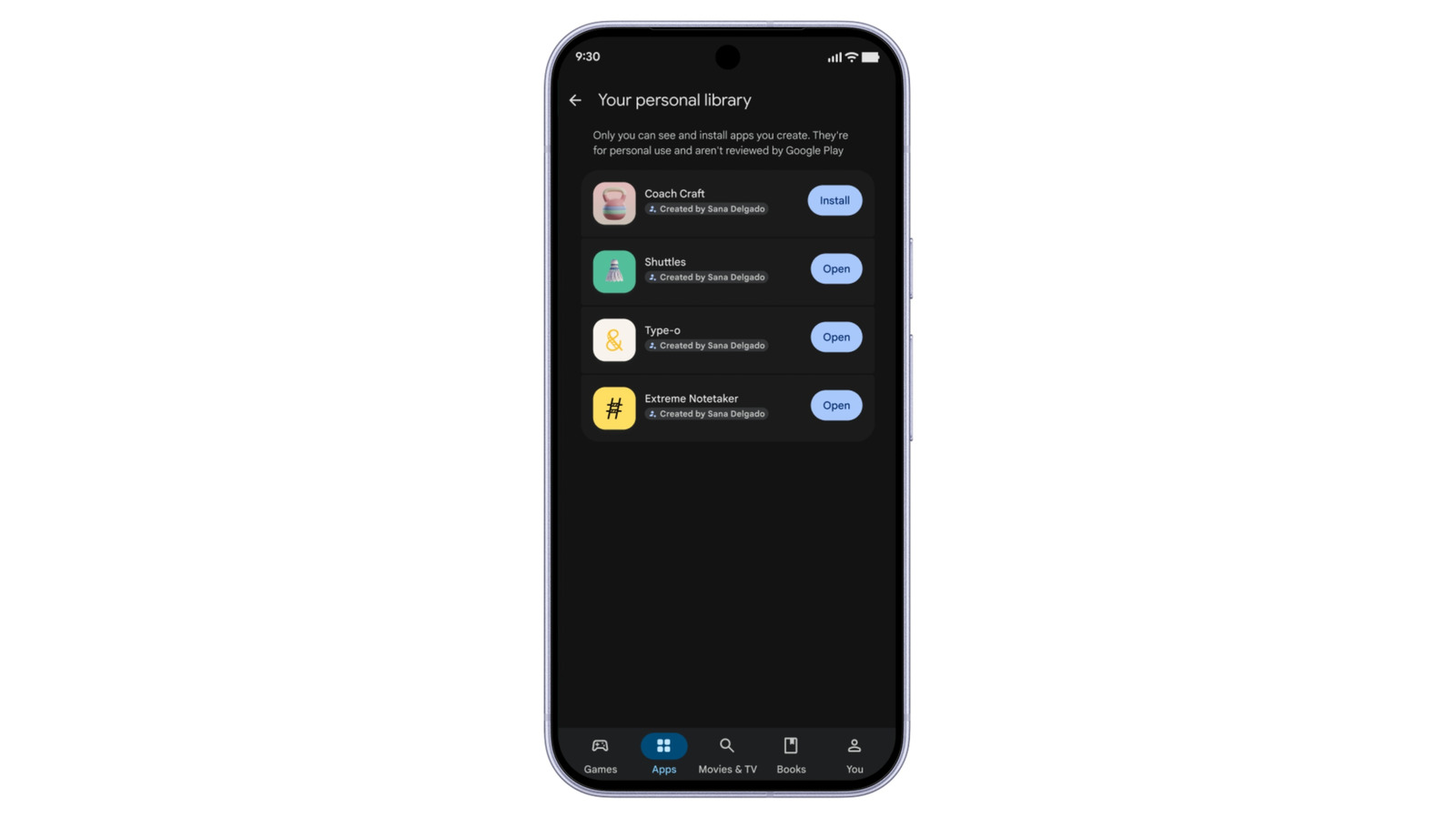
Before: using a vibe-coded app on your own device had meant publishing to Play's some 3 billion users. Now: open first to U.S. users 18 and up; apps reach no one but the creator, are kept out of Play search and listings, and follow Play policies. Later: sharing with trusted friends.
- precedent Vibe-coding builders, before Using an app on one's own device had meant publishing to Play's some 3 billion users, TechCrunch reports, claim 4
- capability U.S. users 18 and up TechCrunch reports the feature is initially available to them, claim 3
- constraint App creators Personal apps are shared with no one except the creator and don't show up in Play search or listings, claim 12
- constraint Personal app builders Personal apps must still comply with Google Play's existing policies, claim 14
- capability Trusted friends Google said users will be able to share their creations with them in the months ahead, claim 7
| Who | How | Kind | Claim |
|---|---|---|---|
| Vibe-coding builders, before | Using an app on one's own device had meant publishing to Play's some 3 billion users, TechCrunch reports | precedent | 4 |
| U.S. users 18 and up | TechCrunch reports the feature is initially available to them | capability | 3 |
| App creators | Personal apps are shared with no one except the creator and don't show up in Play search or listings | constraint | 12 |
| Personal app builders | Personal apps must still comply with Google Play's existing policies | constraint | 14 |
| Trusted friends | Google said users will be able to share their creations with them in the months ahead | capability | 7 |
What happened
- TechCrunch reports that running a vibe-coded app on your own Android phone had meant publishing it to Google Play and its some 3 billion users, so many builders stuck to web apps.
- 9to5Google notes that since May, AI Studio has let people deploy generated Android apps to their phone over ADB.
- The new "Your personal library" section lets users reach their apps across multiple devices for an easy restore and install.
- TechCrunch reports the private apps must still comply with Google Play's existing policies.
Why it matters
- contradiction Engadget's headline says people can distribute these apps with just a Google account. Its own text and the other reports describe a private library, so any change to volume or vetting waits for the sharing and graduation steps.
- constraint At launch the route is closed to anyone under 18 and to teams outside the launch markets, and TechCrunch limits the launch to the US. A student project or an overseas office cannot use it yet.
- decision A team choosing between a web app and a native Android build for a tool only one person uses now has a native option with no public listing. For anything colleagues share, the web app stays the simpler choice until sharing ships.
TechCrunch's example of a good use is an app for a child's T-ball league [8]. The builder describes it in a prompt to Gemini inside AI Studio and adjusts the result with more prompts or by editing the generated code [17]. Then the app opens from a personal library on the builder's own devices, a list that includes tablets and computers with access to the Play Store [2].
That T-ball app cannot reach the league yet. TechCrunch reports that sharing with a network of trusted friends is due in the months ahead [7], and 9to5Google adds that shared apps are meant for small-scale use and will go through a security review [9]. Reaching everyone else means graduating to a professional developer account with the same Trust & Safety reviews, in the wording 9to5Google quotes from Google [10].
The reports differ on how much is live. 9to5Google says the library is rolling out starting today in the US and select markets [11]. Ars Technica writes that the Play Store "will soon offer a way to privately host and share those creations" [13]. For a Monday rollout, the safe reading is that the library works for the builder now and anything involving a second person is still a promise.
Google describes the generated apps as kept "secure, private, and separate from the public store catalog," according to 9to5Google [15]. On that description the feature adds no apps to what strangers can find in Play, so the public catalog's volume and its vetting are where they were [18]. The reports do not say whether Google scans a personal app before it installs.
Sam Bright, Google's VP & GM for the Google Play and Developer Ecosystem, said the future of apps on Google Play is "personal, secure, and built by everyone" [16]. What teams tell themselves is that a lower bar means a flood of new listings. What the reports describe is one person running one app on their own devices.
Two questions sort any AI Studio app a team is thinking about putting on Play: who will run it, and does it hold anyone else's data. If only the builder runs it and it holds nobody else's data, the personal library is the case this launch covers. If only the builder runs it but it holds customer or colleague data, the lowered bar changes nothing, because the data rules are the same as for any app on a phone. If others will run it and it holds no one else's data, wait for the sharing step and its security review. If others will run it and it holds their data, plan on the professional developer account and the full review.
We'd put the team rule on the second question. The cost is that a harmless utility built for a colleague waits for the sharing step too.
What to watch
- Whether Google ships sharing with trusted friends inside the "months ahead" TechCrunch reports, and what its security review covers.
- Which markets beyond the US get the personal library, since TechCrunch says US only and Engadget and 9to5Google say select markets.
- Whether Google says how personal apps are checked against Play policies before they install.
Clarity's read
What the record supports and how the coverage leans. The claims behind it follow.
Reality
- Evidence68
- Adoption
- Insufficient
- Hype gap+15
- Incentives
- Insufficient
- Confidence70
Perspective Coverage
4 publishers- Builder
- Builder 49%
- Operator
- Operator 27%
- Investor
- Investor 24%
Claim ledger
Ranked by verification strength, evidence, and original report placement.
- [1]
Engadget's headline says Google will let people distribute vibe-coded Android apps with just a Google account.
ReportedSupportedSource: Engadget headline3 sources— create a free account to open themView cited source - [2]
Engadget reports the app will only be available on the user's own devices to start, including tablets and computers with access to the Play Store, in a new "personal library" section.
- [3]
TechCrunch reports the feature will initially be available to users in the U.S., age 18 and up.
- [4]
TechCrunch reports that using a vibe-coded app on one's own Android device had meant publishing to Google Play, making it accessible to the store's some 3 billion users, and that led many to limit their vibe-coding efforts to web apps.
- [5]
9to5Google notes that since May, Google AI Studio has allowed users to generate Android apps and deploy them to their phone using ADB.
- [6]
A "Your personal library" section lets users access apps across multiple devices for an easy restore and install experience.
- [7]
In the months ahead, Google said users will be able to share their vibe-coded creations with a network of trusted friends.
ReportedSupportedSource: TechCrunch, citing Google3 sources— create a free account to open themView cited source - [8]
TechCrunch's examples of sharing include apps built for family or friends, or maybe a child's T-ball league, used with a small group of people.
- [9]
9to5Google reports that private sharing is intended for small-scale sharing, with these apps going through a security review.
- [10]
In the future, Google Play will let users "graduate to a professional developer account with the same Trust & Safety reviews and high-quality standards."
ReportedSupportedSource: 9to5Google, quoting Google3 sources— create a free account to open themView cited source - [11]
9to5Google reports the personal library is rolling out starting today in the US and other select markets.
- [12]
Personal apps won't show up in Google Play's search or listing pages and won't be shared with anyone except the app's creator.
- [13]
Ars Technica writes that the Play Store "will soon offer a way to privately host and share those creations."
- [14]
The personal apps are still required to comply with Google Play's existing policies.
- [15]
9to5Google reports that the generated Android apps are kept "secure, private, and separate from the public store catalog."
ReportedSupportedSource: 9to5Google, quoting Google2 sources— create a free account to open themView cited source - [16]
Sam Bright, Google's VP & GM for the Google Play and Developer Ecosystem, said the future of apps on Google Play is "personal, secure, and built by everyone."
ReportedSupportedSource: Sam Bright, Google, in a press briefing reported by TechCrunch2 sources— create a free account to open themView cited source - [17]
Google AI Studio can generate apps from a written prompt to Gemini, and users can adjust results with more prompts or by directly editing the generated code.
- [18]
On Google's description, the personal-library feature adds no apps to the public Play catalog's listings or search results, so public catalog volume and vetting are unchanged by this feature.
Sources
6 independent publishers whose own reporting we read for this story.
- 9to5google.comGoogle Play adding ‘personal library’ to access your vibe-coded Android apps
1 article · October 13, 2026
- arstechnica.comGoogle wants to host your personal vibe-coded apps in the Play Store
1 article · October 13, 2026
- engadget.comGoogle will let you distribute vibe-coded Android apps with just a Google account
1 article · October 13, 2026
- techcrunch.comGoogle Play now supports private, vibe-coded apps built just for you
1 article · October 13, 2026
- theverge.comGoogle makes it easier to launch your vibe-coded apps
1 article · October 13, 2026
- zdnet.comGoogle lets you make personal Android apps for free now – with just prompts
1 article · October 13, 2026
Topics and entities
Follow any of these and your For You feed starts watching them — no settings page required.
Topics
- Google Play StoreFollow
- Android app distributionFollow
- Vibe CodingFollow