Google's opt-in Messages setting has Gemini judge what unknown senders want
Google will roll out an opt-in Android Messages setting in the coming weeks that has Gemini assess the intent of unknown senders. It adds a cloud check on top of existing on-device detection, so the new layer reaches only people who switch it on.
The Product Desk
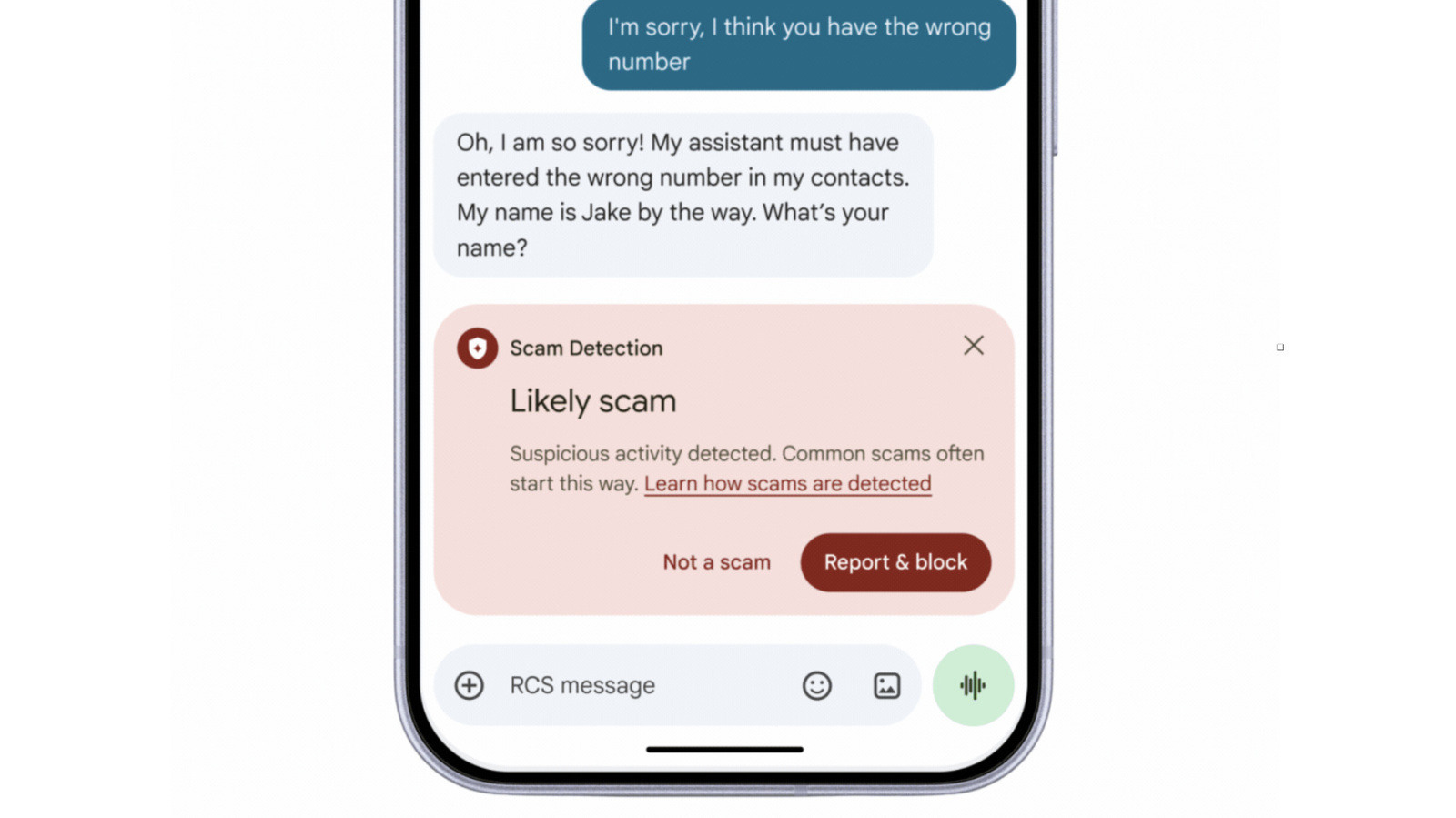
Opt-in users: cloud Gemini models judge unrecognized senders' intent. Messages: encrypted in Private AI Compute, inaccessible even to Google. Pixel 10+ and other select devices: Gemini Nano checks links before a tap. Honor, Oppo, Xiaomi and more: notification scam detection expands.
- capability Users who opt in Cloud-based Gemini models evaluate a potential scammer's intent in chats with an unrecognized sender, claim 2
- exposure Messages Android analyzes Encrypted and processed in Private AI Compute, inaccessible to anybody else, even Google, claim 4
- capability Owners of select devices On Pixel 10+, Galaxy S26 series, Z Flip and Fold 8, among others, Gemini Nano checks links before a tap, claim 5
- capability Honor, Oppo, Xiaomi and more Notification scam detection expands to their devices, for hundreds of millions of additional users later this year, claim 9
| Who | How | Kind | Claim |
|---|---|---|---|
| Users who opt in | Cloud-based Gemini models evaluate a potential scammer's intent in chats with an unrecognized sender | capability | 2 |
| Messages Android analyzes | Encrypted and processed in Private AI Compute, inaccessible to anybody else, even Google | exposure | 4 |
| Owners of select devices | On Pixel 10+, Galaxy S26 series, Z Flip and Fold 8, among others, Gemini Nano checks links before a tap | capability | 5 |
| Honor, Oppo, Xiaomi and more | Notification scam detection expands to their devices, for hundreds of millions of additional users later this year | capability | 9 |
What happened
- Google says messages are analyzed in Private AI Compute, which encrypts them and processes them in a secure space that nobody else, even Google, can access.
- Gemini Nano checks links in Messages on the device before a tap, on Pixel 10+, the Galaxy S26 series, Galaxy Z Flip and Galaxy Fold 8, among other select devices.
- Google also redesigned its warnings to give more context and extra time before a person taps a link from a number outside their contacts.
- Notification scam detection, introduced on Pixel last year, is expanding to Honor, Motorola, Oppo, OnePlus, Realme, Tecno, Vivo and Xiaomi, with hundreds of millions more users targeted later this year.
Why it matters
- decision Switching it on moves a group's conversations with unfamiliar numbers into Google's cloud, so someone has to decide, group by group, whether Google's own privacy description is enough.
- constraint The setting is opt-in and the on-device link checks are listed for newer phones, so protection will differ from handset to handset inside one team or household.
- capability Slow-burn conversations with strangers are now in scope for detection, and Google says that is what the cloud step is for.
In the example Google used, a text from an unknown sender pretends to show the recipient a photo of them with their dog. Told it has the wrong number, the sender tries to keep the exchange going and asks the recipient's name [3]. As Engadget describes it, the exchange has no link and no request for money [3].
The new Messages setting is built to read threads like that one. "Scammers often disguise their true motives behind slow-burn conversations," Google said in its update announcement [7]. According to The Verge, the setting sends conversations with an unrecognized sender to cloud-based Gemini models that evaluate the sender's intentions [2].
Google describes the cloud step as an addition. In the same statement it said: "This secure cloud analysis augments and extends our existing on-device detection, allowing us to identify novel and sophisticated attacks, actively uncovering and stopping abusers who try to hide their tracks." [8] Intent reading is a second layer over the existing detection. Because the setting is opt-in [1], anyone who never opens it stays on the first layer alone.
The pitch is software that understands what a stranger wants. The thing being done is a toggle that a person has to find and switch on [1]. The Verge reports that the same mode also runs the Gemini Nano check of unfamiliar URLs before they are opened, so the link check comes with the cloud step [11].
The one usage figure in either report belongs to a different feature. Google said Android has blocked over three million fake calls since launching its bank-call verification in June, built with banks in Brazil [12]. The reports do not include an accuracy or false-positive rate for the message analysis, or say whether an administrator can set the toggle on managed phones.
We'd turn it on for any group of phones that regularly hears from numbers outside the contacts list, and accept that those threads go to Google's cloud on the strength of Google's own privacy description. Two questions sort every group of phones: how often it hears from unknown numbers, and whether your rules allow its messages to be processed in Google's cloud.
- Frequent unknown senders, cloud processing allowed: switch it on, and ask users to report what it flags and what it gets wrong. - Frequent unknown senders, cloud processing not allowed: leave it off and rely on the existing on-device detection. There is no Gemini check to substitute. - Rare unknown senders, cloud processing allowed: little to gain, so switch it on only if the group asks. - Rare unknown senders, cloud processing not allowed: leave it off.
What to watch
- Whether Google publishes accuracy or false-positive rates for the message analysis once the setting reaches users in the coming weeks.
- Whether Honor, Motorola, Oppo, OnePlus and the other makers actually enable notification scam detection later this year, as Google and Engadget say they are expected to.
- Whether the Brazil bank-call verification reaches the US, which Engadget says is unclear.
Clarity's read
What the record supports and how the coverage leans. The claims behind it follow.
Reality
- Evidence35
- Adoption
- Insufficient
- Hype gap+15
- Incentives
- Insufficient
- Confidence70
Claim ledger
Ranked by verification strength, evidence, and original report placement.
- [1]
Google announced an opt-in setting in its Messages app that enables Scam Detection using Gemini models to evaluate the sender's intent and warn the user if messages could be coming from a bad actor.
- [2]
A new opt-in enhanced protection setting, rolling out in the coming weeks, taps cloud-based Gemini AI models to evaluate a potential scammer's intentions in conversations with an unrecognized sender.
- [3]
In Google's example, the sender pretended to show the recipient a photo of them with their dog; upon being told they had the wrong number, the sender tried to engage and asked the recipient their name.
- [4]
Android analyzes messages in Private AI Compute, which encrypts them and processes them in a secure space inaccessible to anybody else, even Google.
- [5]
Gemini Nano does on-device analysis of links in Messages before the user taps them; this will be available on Google Pixel 10+, the Samsung Galaxy S26 series, Galaxy Z Flip and Galaxy Fold 8, among other select devices.
- [6]
Google redesigned its scam warnings to give more context and extra time before tapping on links sent from numbers not in the contacts list.
- [7]
"Scammers often disguise their true motives behind slow-burn conversations," Google said in its update announcement.
- [8]
"This secure cloud analysis augments and extends our existing on-device detection, allowing us to identify novel and sophisticated attacks, actively uncovering and stopping abusers who try to hide their tracks."
- [9]
The scam detection feature for chat notifications that Google introduced on Pixel phones last year is expanding to devices from Honor, Motorola, Oppo, OnePlus, Realme, Tecno, Vivo, Xiaomi and more; Google says it plans to bring it to "hundreds of millions of additional users later this year."
- [10]
Device makers including Honor, Motorola, OPPO, OnePlus, realme, vivo and Xiaomi are expected to enable the notification scam detection feature later this year.
- [11]
The enhanced protection mode also uses on-device Gemini Nano to inspect real-time web signals in unfamiliar URLs sent to the user before they are opened, to determine if the links are malicious.
- [12]
Google teamed up with banks in Brazil to combat bank impersonation, with Android verifying incoming calls; Google said Android has already blocked over three million fake calls since launching the feature in June.
Get this ledger inside ChatGPT. Ask about any of our stories and the answer brings its figure, each claim’s verdict and the sources. Free, no account.
Sources
2 independent publishers whose own reporting we read for this story.
- engadget.comAndroid will use Gemini to warn you about scammy messages
1 article · October 14, 2026
- theverge.comAndroid is using AI to suss out scammers in Google Messages
1 article · October 14, 2026
Topics and entities
Follow any of these and your For You feed starts watching them — no settings page required.
Topics
- AndroidFollow
- On-Device AIFollow
- Mobile scam protectionFollow