ProductNot yet confirmed elsewhere1 publisher3 min readPublished
Goldman Sachs CIO says AI's next job at the bank is making money
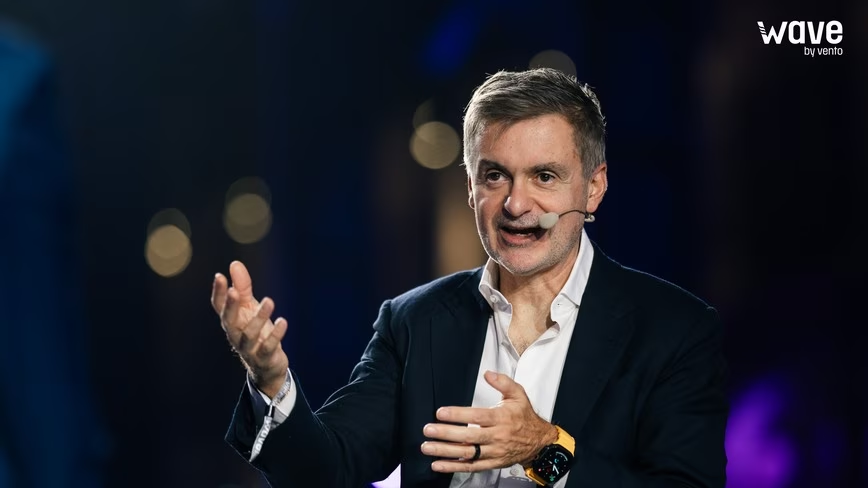
Goldman Sachs CIO Marco Argenti says the bank's AI goal is moving from saving money to making it. For leaders planning their own rollout, the part worth copying is how he now measures progress, by finished and funded work.
The Product Desk
What happened
- Argenti counts Goldman's more than 12,000 developers, out of roughly 47,000 staff, as the first wave, for whom working with AI is already the norm.
- The second wave questions whether each workflow step should exist at all, aiming for large processes that run end to end with no human step.
- Argenti said developers now hand work to AI agents and supervise it, and since agents can create sub-agents, a developer becomes a manager of managers.
- Goldman limits where its AI agents run and what they can access, an approach the bank calls zero trust and defence in depth.
Compiled by The Product DeskSomething wrong?How this is made
Why it matters
- decision A rollout plan has to name its success measure before launch, because Goldman spent its first wave on activity proxies it later had to replace with delivery results.
- constraint Argenti's case for keeping engineers depends on the business wanting to grow; if funded backlog stops expanding, the month saved per project becomes a headcount question.
- exposure A developer supervising agents that spawn sub-agents answers for work several layers removed from anything they wrote, so access limits and model cross-checks become part of the developer's job.
At Goldman Sachs, a workday once began when the first email arrived. Today it might begin with a query to the bank's in-house assistant, or with an agent, according to chief information officer Marco Argenti, who said AI touches pretty much everyone at the firm [5]. He joined Goldman in 2019 from Amazon Web Services, where he was vice president of technology [4].
Goldman counted usage first. It measured AI through proxies such as how often developers committed code, and nobody could trace those to dollars, Argenti said [9]. What the tools actually changed shows up in delivery time. A three-month project finished in two months takes a third less time [17]. Over a year of work, that is 1.5 projects delivered in the time one used to take [18].
Argenti spoke with Bloomberg's Tom Mackenzie at Wave by Vento in Turin on Friday and framed the third phase as a change of goal [2]. "How do you make money because of AI, not only how do you save money because of AI?" he said [3]. He also said the growth wave is "emerging right now," and described it as AI helping the company grow as well as become more efficient [8]. The money evidence he gave is a budgeting result: projects that fell below the line in zero-based budgeting now fund themselves [10]. His account does not include a revenue figure tied to AI.
Developers are the group the model is built for first, and they are about a quarter of Goldman's staff [19]. Argenti said their job now is to spell out what a good result looks like and to run resources and priorities, much as an entrepreneur would [13]. On whether that means a smaller workforce, he said the option could be open to the bank. But any engineering backlog contains far more work than each planning cycle pays for, and as long as there is appetite to grow, there will be plenty of work first, he said [11].
Goldman assumes its models will make errors, as people do, because a statistical machine will not give the same result every time [14]. Argenti compared the setup to a kindergarten, where you remove the sharp edges instead of handing each child a safety policy [14]. The bank also reads a model's chain of thought and uses other AI models to challenge its work [16].
Goldman's waves turn into a test with one pass condition each. For developers, it is retiring activity measures like commit counts and tracking delivery time on funded work [9]. In the process wave, the test is whether a workflow step can be deleted outright, the question Argenti said to ask of every step; speeding up the same step does not pass [7]. The growth wave passes when a project that missed the budget line gets funded from its own results [10]. By Argenti's account, Goldman is entering the third while still rethinking its processes in the second [2][7].
What to watch
- Whether Goldman attributes revenue or client business to AI, which would test the growth-phase claim beyond delivery speed and budget lines.
- Whether Goldman's developer headcount holds once backlogs shrink, since Argenti tied staffing to the bank's appetite to grow.
- Any disclosure of large Goldman processes running end to end with no human step, the stated aim of the second wave.
Clarity's read
What the record supports and how the coverage leans. The claims behind it follow.
Reality
- Evidence35
- Adoption55
- Hype gap+30
- Incentives65
- Confidence40
Claim ledger
Ranked by verification strength, evidence, and original report placement.
- [1]
In the last six months or so, outcomes have changed: teams finish a three-month project in two months.
ReportedSupportedSource: Marco Argenti, as reported by The Next Web2 sources— create a free account to open themView cited source - [2]
Goldman Sachs is entering a third phase of AI adoption in which the goal moves from saving money to making it, chief information officer Marco Argenti said, speaking with Bloomberg anchor Tom Mackenzie at Wave by Vento in Turin on Friday.
ReportedSupportedSource: Marco Argenti, Goldman Sachs CIO, as reported by The Next WebView cited source - [3]
"How do you make money because of AI, not only how do you save money because of AI?"
- [4]
Argenti joined Goldman in 2019 from Amazon Web Services, where he was vice president of technology.
- [5]
AI now touches pretty much everyone at Goldman; the working day used to start with the first email and now may start with a question to the bank's internal assistant, or with an agent.
- [6]
The first wave of adoption was developers, more than 12,000 of Goldman's roughly 47,000 staff, for whom working with AI is already the norm.
- [7]
The second wave rethinks the bank's processes, questioning every step of a workflow and whether it should exist at all instead of doing the same thing faster, with the aim of straight-through processing: large processes that run end to end with no human step.
- [8]
The third wave, "emerging right now", is about using AI to help the company grow, as well as to be more efficient.
- [9]
Goldman used to measure AI through proxies such as how often developers committed code, and nobody could trace those to dollars.
- [10]
Projects that fell below the line in zero-based budgeting now fund themselves.
- [11]
Asked whether the gains mean fewer people, Argenti said the bank might have that option, but every engineering backlog holds far more work than gets funded in each planning cycle, and as long as there is appetite to grow there will be plenty of work first.
- [12]
Developers now explain what needs doing, delegate it to AI agents and supervise their work; agents can now create their own sub-agents, so a developer becomes a manager of managers.
- [13]
The developer's job is to describe clearly what a good outcome looks like, and to manage resources and priorities, almost like an entrepreneur.
- [14]
Because AI is a statistical machine that will not give the same result every time, Goldman assumes its models will make errors, like humans, and builds an environment that stops them doing harm; Argenti compared it to a kindergarten where you remove the sharp edges instead of handing each child a safety policy.
- [15]
Goldman secures where agents run and what they can access, an approach the bank calls zero trust and defence in depth.
- [16]
Goldman's approach also means reading a model's chain of thought and using other AI models to challenge its work.
- [17]
Finishing a three-month project in two months cuts its duration by a third, about 33%.
- [18]
At two months per project instead of three, a team delivers 1.5 projects in the time one used to take.
- [19]
Developers are about a quarter of Goldman's staff.
Sources
1 independent publisher whose own reporting we read for this story.
- thenextweb.comGoldman’s Marco Argenti says AI turns developers into managers of managers
1 article · October 9, 2026
Topics and entities
Follow any of these and your For You feed starts watching them — no settings page required.
Topics
Entities
- Goldman SachsFollow
- Marco ArgentiFollow
- Amazon Web ServicesFollow
- BloombergFollow
- Tom MackenzieFollow
- Wave by VentoFollow