Science1 publisherNot yet confirmed elsewhere3 min readPublished
Bite marks, not body size: crocodylians ran the large-prey trade in Miocene Colombia
A new study reads trophic rank off damage on herbivore bone rather than off predator dimensions, and the answer is a caiman relative rather than a saber-toothed mammal.
The Scientist · Science desk
Drafted by a language model from the sources cited here and checked against its claim ledger before publication. How we use AISend a correction
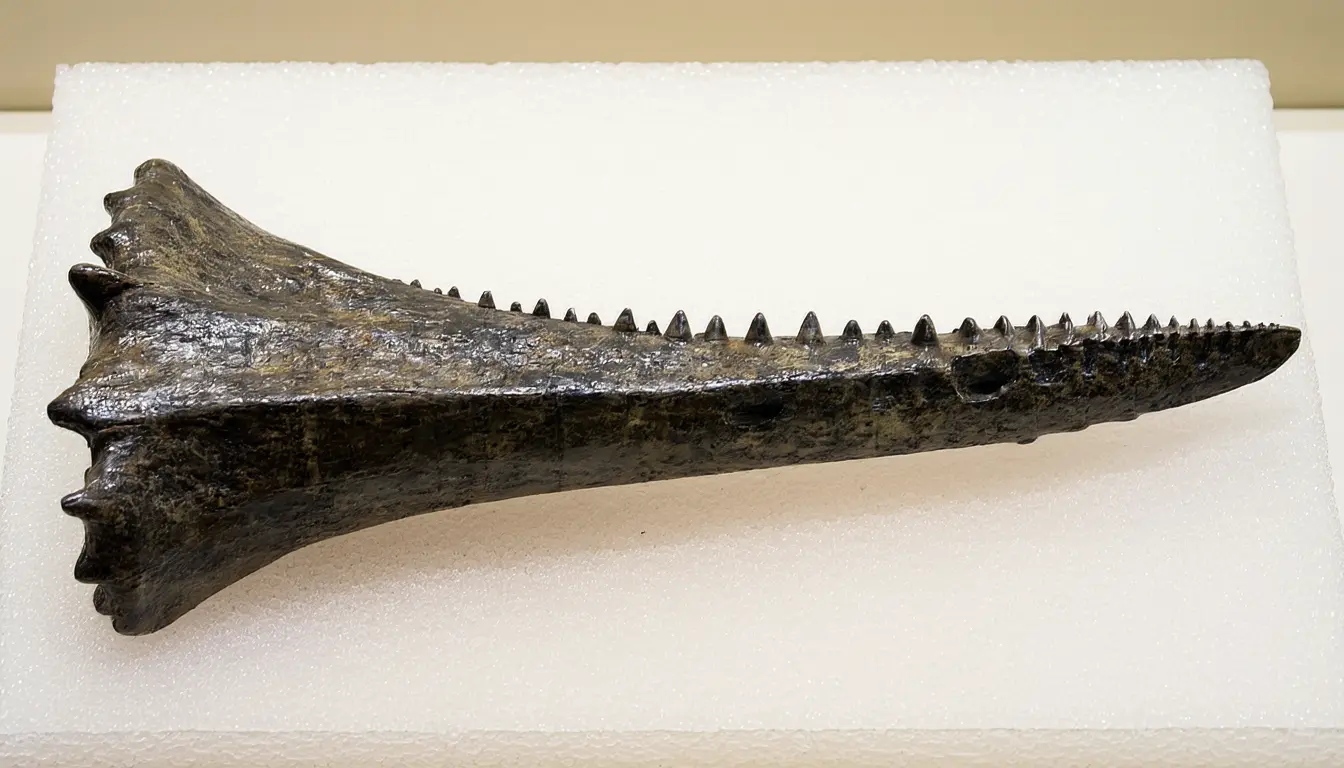
What happened
- The study "Physical evidence of crocodylian predation on ungulates in the Middle Miocene of Colombia" was published in the Journal of Vertebrate Paleontology (2026), DOI 10.1080/02724634.2026.2701154.
- The study shows that crocodylians were the most significant group of predators in this habitat.
- A wide range of predators hunted on the lake's shores, including anacondas, saber-toothed mammals, flightless terror birds, and sebecids, terrestrial relatives of crocodylians.
- More than 10 million years ago, a vast lake covered much of South America, home to giant turtles and crocodylians.
- Oscar Wilson, a postdoctoral researcher at the University of Helsinki: "Our new study shows that crocodylians in particular were the region's most important predators, especially when it came to hunting large prey."
Compiled by The ScientistSomething wrong?How this is made
Why it matters
A paper in the Journal of Vertebrate Paleontology reports physical evidence of crocodylian predation on ungulates in the Middle Miocene of Colombia [1]. On the authors' reading, that makes crocodylians the most significant predator group in the habitat, ahead of the saber-toothed mammals and flightless terror birds working the same shoreline [2][3].
The setting deserves stating plainly, because it is what makes the result interesting. More than 10 million years ago a vast lake covered much of South America, holding giant turtles and crocodylians [4]. The shore supported anacondas, saber-toothed mammals, terror birds and sebecids, the terrestrial relatives of crocodylians [3]. The herbivore list is equally crowded: giant ground sloths, glyptodonts, and several ungulate groups including astrapotheres and toxodontids [7], animals that could weigh well over a tonne [8]. The largest predator of the period was Purussaurus neivensis, a relative of modern caimans measuring 7 metres and weighing 1,800 kilograms [9].
The method is the part operators should note. The work is an analysis of fossils already sitting in museum collections [11], and the evidence class is bite and tooth marks on herbivore bone, which the researchers describe as the only direct evidence of interactions between species [12]. The examined material spans 10.5 million to 16 million years [13], a window of 5.5 million years [15]. That is a slow, cheap, retrospective read on food-web structure, and it does something body-size inference cannot.
Consider what size alone would have delivered here. A 1,800-kilogram predator against prey of a tonne or more is a margin under roughly 1.8 to 1 [16], which is not a decisive gap, and the summary account of the study gives no body masses at all for the mammalian carnivores in the same system [17]. Ranking that cast by dimensions would have been an argument rather than a measurement. Damage on bone, by contrast, is an observable: something bit this animal, and the marks carry the geometry of the mouth that made them.
Oscar Wilson of the University of Helsinki, a postdoctoral researcher on the study, frames the ecological logic as one of surplus: "There was so much prey available that mammalian predators couldn't have eaten it all" [6]. He puts the conclusion as crocodylians being the region's most important predators, "especially when it came to hunting large prey" [5]. The study further suggests Purussaurus sat at the top of the chain and may have influenced the size of herbivore populations [10].
The hedges are in the researchers' own wording. Wilson refers to "the frequency of marks likely made by Purussaurus" [14], which is an attribution of probability, not an identification, and the summary account describes that frequency qualitatively without giving counts of marked specimens [17].
What to watch: whether the published counts in the paper are large enough to carry the word "most" [14], whether the same collections yield comparably frequent marks attributable to sebecids, terror birds or saber-toothed mammals [3], and whether anyone repeats the exercise on museum material outside Colombia [11]. The transferable result is procedural. If trophic rank can be read from tooth traces across a 5.5 million-year window of shelved fossils [13][15], other apex-predator assignments made from body size are open to the same audit.