Science1 publisher3 min readPublished
Two cloned beagles were edited so they cannot make the main dog allergen
Alfie and Bailey carry a CRISPR knockout of Can f 1 and shed no detectable allergen. The edit was made for human comfort, in animals whose long-term health is unknown.
The Scientist · Science desk
Drafted by a language model from the sources cited here and checked against its claim ledger before publication. How we use AISend a correction
What happened
- Researchers used CRISPR-Cas9 to make a precise cut in the Can f 1 gene in dog skin cells (fibroblasts) taken from a beagle and inserted a single extra DNA building block at the site, scrambling the gene's instructions so it could no longer produce the Can f 1 protein. The study was published in The CRISPR Journal.
- The team used somatic cell nuclear transfer: original genetic material was removed from mature eggs from donor beagles and replaced with genetic material from the Can f 1-mutant cells. Twenty-five embryos were transferred to a surrogate mother dog.
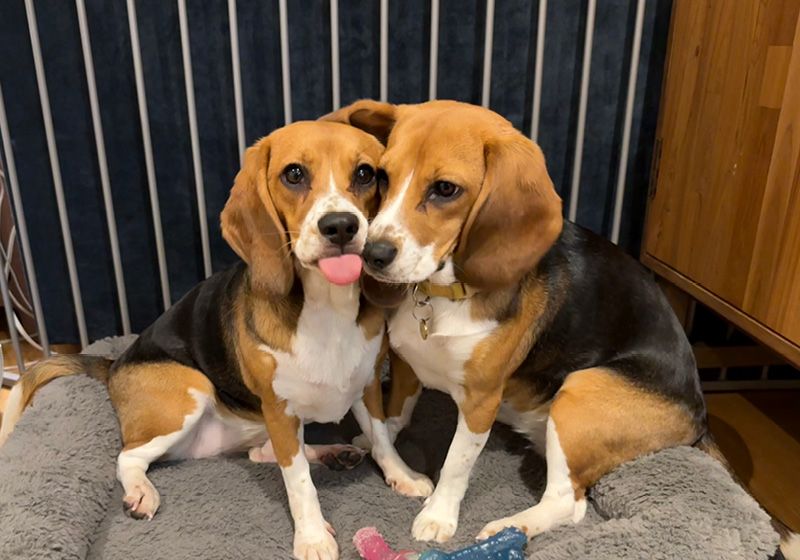
- The result was two female beagle puppies, Alfie and Bailey, born from cloned embryos.
- When researchers tested the puppies' saliva, hair and dander, they found no detectable trace of the Can f 1 allergen protein.
- About 15% of the world's population lives with a dog allergy, which can increase the risk of hay fever and asthma.
Compiled by The ScientistSomething wrong?How this is made
Why it matters
Researchers writing in The CRISPR Journal disabled the Can f 1 gene in beagle skin cells with CRISPR-Cas9, inserting a single extra DNA base to scramble the gene's instructions, then used somatic cell nuclear transfer to turn those edited cells into two live puppies [1][2][3]. Saliva, hair and dander from the pups, Alfie and Bailey, contained no detectable Can f 1, the protein that is the main cause of dog allergy and is found mainly in dog saliva [4][6].
The stated problem is a human one. About 15% of the world's population lives with a dog allergy, which raises the risk of hay fever and asthma, and symptoms can escalate to attacks requiring medical attention [5][15]. The existing options are avoidance or immunotherapy shots and tablets, and avoidance is difficult because the allergens persist on furniture, clothing and in the air [7][16]. What this work changes is not the patient but the animal.
The evidence base is a demonstration, not a trial. Twenty-five cloned embryos were transferred to a surrogate mother dog to produce the two puppies, a yield of about 8%, or roughly twelve and a half transferred embryos per live pup [2][13]. Biochemical tests compared the edited dogs against a normal beagle, a standard poodle and a goldendoodle; the allergen was easy to detect in all three conventional dogs, including the two breeds marketed as hypoallergenic, and absent in the edited pair [8]. The functional test was a skin prick on the arm of one volunteer, who developed allergic bumps from the normal beagle and the supposedly hypoallergenic breeds but not from the edited dogs [9]. One human subject establishes that the extract behaves differently. It does not establish that a household of allergic people can live with such a dog.
The regulatory weight sits in the method. Because the animals were built by nuclear transfer from an edited cell, the knockout is present in every cell they have, germ cells included, and would be passed to any offspring [14]. Whole-genome and targeted sequencing found no unintended genetic damage in the puppies [10]. But the authors describe this as proof of concept and say they cannot be certain the change has no negative effects on the dogs' health, which is why the pups have been kept under strict veterinary observation from birth [11]. That is a candid admission: the trait was installed to prevent a reaction in humans, and the animal carries whatever residual risk exists.
So the near-term commercial object is a heritable edit in a companion animal for a non-therapeutic, convenience trait, and the authors themselves list what is missing before that is possible: long-term safety data, careful animal welfare oversight, and satisfaction of regulatory requirements [12]. None of those three is a formality, and the third has no settled answer for a pet whose edit is neither a medicine nor a food.
Watch whether Can f 1 stays undetectable as the two dogs mature, and whether a litter from them shows the same absence, which is the only real test of heritability. Watch the cloning arithmetic if anyone tries to scale this, because roughly a dozen transferred embryos per live puppy means many surrogate pregnancies per animal sold [13]. And watch which authority claims jurisdiction over a non-therapeutic germline edit in a dog, given that the researchers list regulatory compliance as unfinished business rather than a cleared step [12].