Gaza's truckers' union disputes Israel's account of a two-day halt to commercial goods
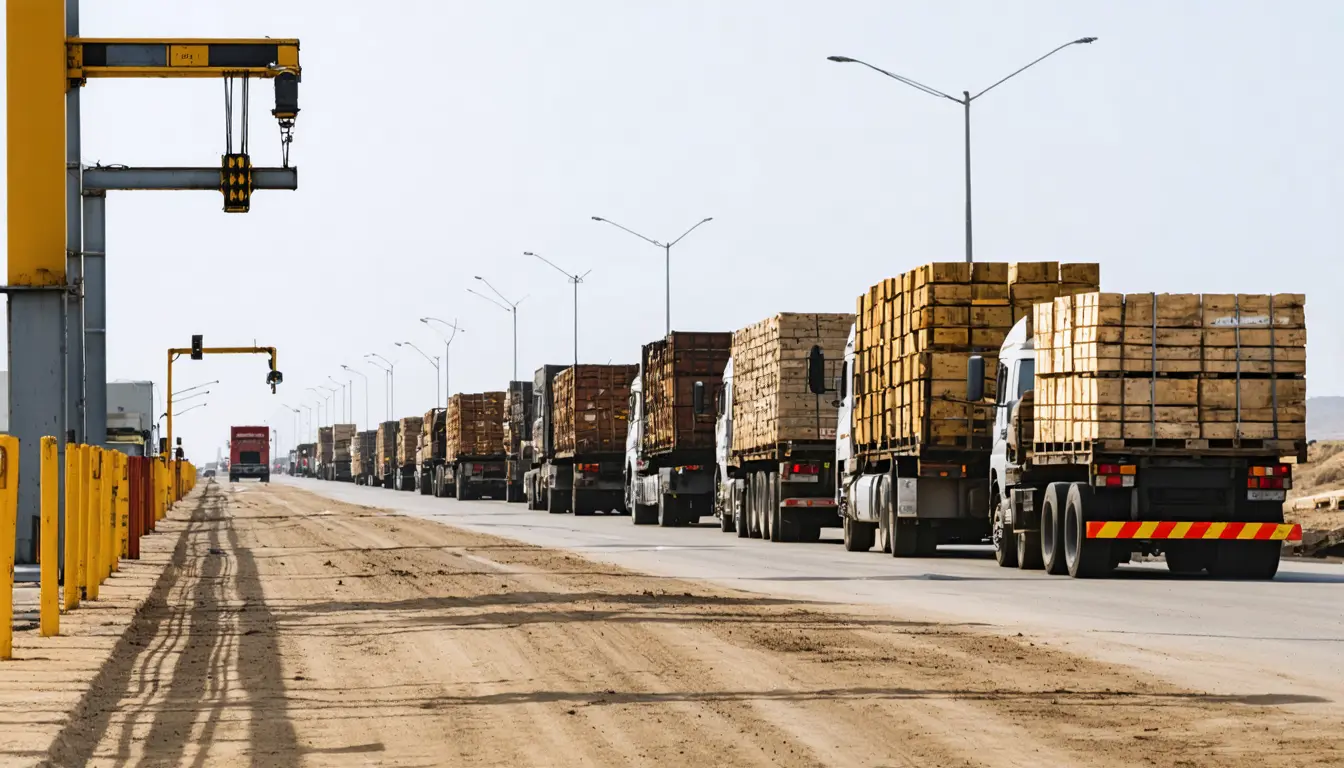
Israeli authorities said Thursday that no commercial goods have entered Gaza for two days, blaming merchants angry at Hamas taxes. The territory is completely reliant on goods Israel allows through its border crossings.
The Board Room · Leadership desk
Bar comparison of trucks of goods a day into Gaza. COGAT claims Gaza needs approximately 250 truckloads a day. The ceasefire brokered by the U.S. a year ago stipulates a minimum of 600 trucks a day.
Trucks of goods into Gaza each day, per COGAT and the ceasefire In trucks a day
| Item | Value | Claim |
|---|---|---|
| COGAT's claimed need, approx. | 250 trucks a day | 6 |
| Ceasefire minimum | 600 trucks a day | 6 |
What happened
- COGAT announced the suspension on Wednesday, and its deputy spokesperson said the agency was acting on a merchants' decision from a day earlier that it could reverse at their behest.
- The halted shipments include fruit and winter clothing, and fears are growing about getting supplies through the winter.
- Union head Nahed Sheheiber said Gaza's Ministry of Economy had asked merchants for 10,000 shekels per truck; its undersecretary told the union it was a donation for civil servants' pay, not a tax.
- COGAT claimed Gaza's roughly 2 million people need about 250 truckloads a day, below the 600-truck minimum set in the ceasefire brokered a year ago.
Why it matters
- Who's exposed exposure Prices are the first risk: humanitarian workers say aid and a working commercial market together keep prices under control, and commercial imports are now paused.
- What it limits constraint Aid deliveries are built around staples such as flour, so the perishable foods merchants import, fruit and meat, have no obvious replacement channel in the aid pipeline.
- What doesn't add up contradiction If merchants made the decision, a restart needs them to resume coordination; if Israel imposed it, a restart needs Israel to lift it. The sources do not let a reader say which.
- Who has to decide decision Aid agencies and donors must decide whether to plan for added deliveries before COGAT says whether it will allow them.
Both accounts turn on the same fee and assign the decision to different actors. "We were prepared to coordinate the entry of their trucks as usual," said Lt. Daniel Kantorovich, COGAT's deputy spokesperson. "But the vendors informed us that they were cancelling the coordination due to Hamas's taxation mechanism and threats against them." [14] Nahed Sheheiber heads Gaza's private truckers union. "The Israeli coordinator is claiming that Gaza's merchants are responsible," he said, "but the truth is that the Israelis are the ones who imposed the restrictions." [16] After COGAT's announcement, his union met the Ministry of Economy and told it that Israel was citing the ministry's fees as a pretext to cut off commercial goods [19].
Israel has long accused Hamas of levying fees on imports to fund its operations [18]. Merchants in Gaza coordinate directly with vendors outside the territory, and Israel's military examines those shipments before they enter [8]. COGAT said no private-sector vendors had tried to import goods since the merchants alerted Israel on Tuesday [15]. In our view a count of zero attempts fits either account, so it cannot settle who stopped the trucks.
COGAT's own estimate of need, 250 truckloads a day, is about 42% of the 600-truck minimum in the ceasefire [11]. The size of the gap matters because aid cannot be scaled to cover it alone. Shaina Low, a spokesperson for the Norwegian Refugee Council, said: "The humanitarian sector on its own cannot meet the needs of all the people." [4] She added: "The markets need to be functioning." [9]
Food security was fragile before the halt. A report earlier this year from what ABC News calls the world's leading authority on food insecurity found conditions better than when famine was declared in August 2025. They were still at crisis levels, with most families not getting nearly enough to eat [7]. The same report warned that "even small disruptions to humanitarian access could rapidly reverse recent gains." [10] The record covers two days. The sources do not say how long COGAT expects the suspension to last.
What to watch
- Whether merchants resume coordinating trucks with COGAT, and whether the Ministry of Economy changes its 10,000-shekel request.
- Whether COGAT lets aid groups raise truck counts to offset the loss, and how daily entries compare with the 250 and 600 figures.
- Any follow-up from the food-insecurity monitor on whether conditions slipped after the halt.
Clarity's read
What the record supports and how the coverage leans. The claims behind it follow.
Reality
- Evidence45
- Adoption
- Not scored
- Hype gap
- Not scored
- Incentives70
- Confidence50
Claim ledger
Ranked by verification strength, evidence, and original report placement.
- [1]
The halt to commercial shipments, including fruit and winter clothing, cuts off a key source of food and other critical supplies, as fears grow about procuring supplies needed to get through winter.
- [2]
Gaza is completely reliant on whatever goods Israel allows in through border crossings.
- [3]
Aid groups generally bring in staples such as flour, while merchants import more perishable foods like fruits and meat, according to data released earlier this year by COGAT.
- [4]
Shaina Low, a spokesperson for the Norwegian Refugee Council, said: "The humanitarian sector on its own cannot meet the needs of all the people."
- [5]
It was not clear from the COGAT announcement whether aid agencies would be allowed to increase shipments into Gaza to compensate for the loss in commercial goods.
- [6]
COGAT claimed Gaza's population of roughly 2 million requires approximately 250 truckloads of goods each day, far below the minimum of 600 trucks a day stipulated by a ceasefire brokered by the U.S. a year ago.
- [7]
A report earlier this year from what ABC News calls the world's leading authority on food insecurity said conditions in Gaza had improved since famine was declared in August 2025 but were still at crisis levels, with most families not getting nearly enough to eat.
- [8]
Merchants in Gaza coordinate directly with vendors outside the territory, whose shipments are examined by Israel's military before entering Gaza.
- [9]
Low also said: "The markets need to be functioning."; humanitarian workers say a combination of aid and a robust commercial market is needed to keep prices under control.
- [10]
The food-insecurity report said "even small disruptions to humanitarian access could rapidly reverse recent gains."
- [11]
COGAT's estimated need of about 250 truckloads a day is roughly 42% of the 600-truck daily minimum in the ceasefire.
- [12]
Israeli authorities said Thursday that no commercial goods have entered the Gaza Strip for two days, blaming the suspension on merchants angered by taxes imposed by Hamas; Palestinian importers deny the claim.
- [13]
COGAT, the Israeli military body that oversees humanitarian affairs in Gaza, announced the suspension of commercial shipments Wednesday; deputy spokesperson Lt. Daniel Kantorovich said the agency was acting on a decision made by Palestinian merchants a day earlier and could reverse it at their behest.
- [14]
Kantorovich said: "We were prepared to coordinate the entry of their trucks as usual, but the vendors informed us that they were cancelling the coordination due to Hamas's taxation mechanism and threats against them."
- [15]
COGAT said no private-sector vendors had attempted to import goods to Gaza since the merchants alerted Israel on Tuesday.
- [16]
Nahed Sheheiber, head of Gaza's private truckers union, said: "The Israeli coordinator is claiming that Gaza's merchants are responsible, but the truth is that the Israelis are the ones who imposed the restrictions."
- [17]
Sheheiber said the Ministry of Economy had been asking merchants to pay 10,000 shekels per truck entering Gaza; ministry Undersecretary Khaled Al-Raqab told the union the amount was not a tax but a donation sought to help pay civil servants in the strip.
- [18]
Israel has long accused Hamas of levying fees on imports to fund its operations.
- [19]
After COGAT's announcement, Sheheiber's union met Gaza's Ministry of Economy to express concern and say Israel was citing fees levied by the ministry as a pretext to cut off commercial goods.
Get this ledger inside ChatGPT. Ask about any of our stories and the answer brings its figure, each claim’s verdict and the sources. Free, no account.
Sources
1 independent publisher whose own reporting we read for this story.
- abcnews.comCommercial goods are no longer entering Gaza, raising fears of worsening shortages in the territory
1 article · October 15, 2026
Topics and entities
Follow any of these and your For You feed starts watching them — no settings page required.