Science1 publisher3 min readPublished
Earth's dragged spacetime is now measured to 0.1%, and quintessence models feel it
Laser ranging to LARES-2 and LAGEOS has pinned frame dragging to roughly one part in a thousand, an order of magnitude better than earlier Solar System tests.
The Scientist · Science desk
Drafted by a language model from the sources cited here and checked against its claim ledger before publication. How we use AISend a correction
What happened
- A laser-ranging technique measured Earth's frame dragging with an uncertainty approaching one part in a thousand, the highest precision yet for this parameter.
- The result provides one of the most stringent confirmations of general relativity in the near-Earth environment to date and sets stronger constraints on some alternative theories put forward to explain the universe's accelerated expansion.
- Frame dragging, or the dragging of inertial frames, is a general relativity prediction in which a massive rotating object not only curves spacetime but drags it around as it rotates.
- The effect is very large around huge objects such as black holes but much smaller around Earth, where it can be detected by monitoring the motion of certain satellites in orbit, appearing as a very tiny shift of the orbital plane.
- Ignazio Ciufolini of the Chinese Academy of Sciences, who led the study, says measuring the predicted tiny orbital-plane shift is difficult because the Earth is not a spherically symmetrical body.
Compiled by The ScientistSomething wrong?How this is made
Why it matters
A satellite laser-ranging campaign has measured the frame dragging produced by Earth's rotation with an uncertainty approaching one part in a thousand, the highest precision yet reported for that parameter [1]. That moves a historically marginal general relativity test into the range where it does real work: according to the team, the result is both one of the most stringent near-Earth confirmations of general relativity and a stronger constraint on alternative theories proposed to explain the accelerated expansion of the universe [2].
Frame dragging is the prediction that a massive rotating body does not merely curve spacetime but drags it around as it spins [3]. Around black holes the effect is large; around Earth it shows up as a very small shift in the orbital plane of a suitable satellite, which is why the measurement is done by tracking orbits rather than in a laboratory [4]. The obstacle is that Earth is not spherically symmetric, and the resulting structure in its gravity field swamps the relativistic signal, as Ignazio Ciufolini of the Chinese Academy of Sciences, who led the study, explains [5].
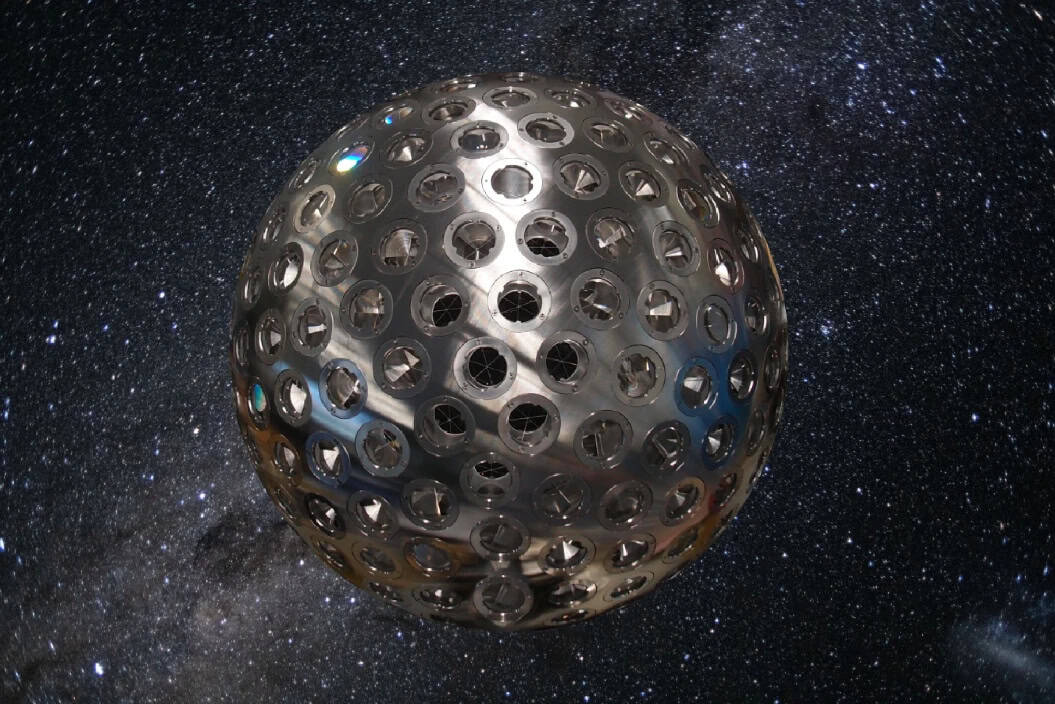
The work combines orbit data from LARES-2, developed by the Italian Space Agency, with data from its predecessor LAGEOS [6]. Taken together the two orbits behave like one large gyroscope [7], and their positions are fixed by timing laser pulses reflected from retroreflectors on the satellite surfaces [8].
The hardware is deliberately dull, which is the point. LARES-2 has a radius of 0.212 m and a mass of nearly 295 kg [9], which works out to a sphere about 42 cm across [10] with a bulk density near 7,400 kg per cubic metre [11]. Ciufolini says that mass-to-area ratio means the orbit is perturbed almost entirely by Earth's gravitation, and only slightly by non-gravitational pushes such as photon pressure from the Sun and the Earth [12]. The remaining hard part was geophysical rather than optical: removing the lunisolar tides, and in particular the K1 tide, which biases the frame-dragging precision [13].
The constraint on alternative gravity is narrow but sharp. Ciufolini describes the measurement as an order of magnitude better than previous Solar System measurements [14], which puts the prior state of the art near one part in a hundred [15]. He notes that some of the theories in question reproduce the same post-Newtonian weak-field effects as general relativity while predicting a different frame-dragging effect [16], and that some of them involve something possibly related to quintessence, a time-dependent scalar field [17]. If the static weak-field terms are degenerate, the rotational term is the discriminator, and a factor of ten there is a factor of ten in surviving parameter space.
Two things to watch. First, the error budget is dominated by tide modelling by the team's own account [13], so the value of an independent reanalysis of the K1 term is high; the paper is in Nature [18]. Second, the precision should improve without new launches. LAGEOS was put up by NASA in 1976 [19], laser-ranged satellites stay in orbit for decades [20], and Ciufolini expects more observing time to sharpen frame-dragging and other tests [21], with byproducts in Earth tide and centre-of-mass determinations that matter for GPS [22]. The arc is already about half a century long [23], which is the sort of baseline that quietly beats cleverness.