Science1 publisher2 min readPublished
Cavity-amplified vacuum fluctuations lift a thin superconductor's transition temperature by up to 5.4%
Physicists at the University of Science and Technology of China lifted six-layer NbSe2's transition temperature by up to 5.4% inside a terahertz dark cavity. The Nature paper suggests a superconductor can be tuned through its surroundings alone, so far shown in one ultrathin compound.
The Scientist · Science desk
Drafted by a language model from the sources cited here and checked against its claim ledger before publication. How we use AISend a correction
What happened
- Critical current and critical magnetic field also rose significantly near the superconducting transition, according to Guanghui Cheng, who co-led the work.
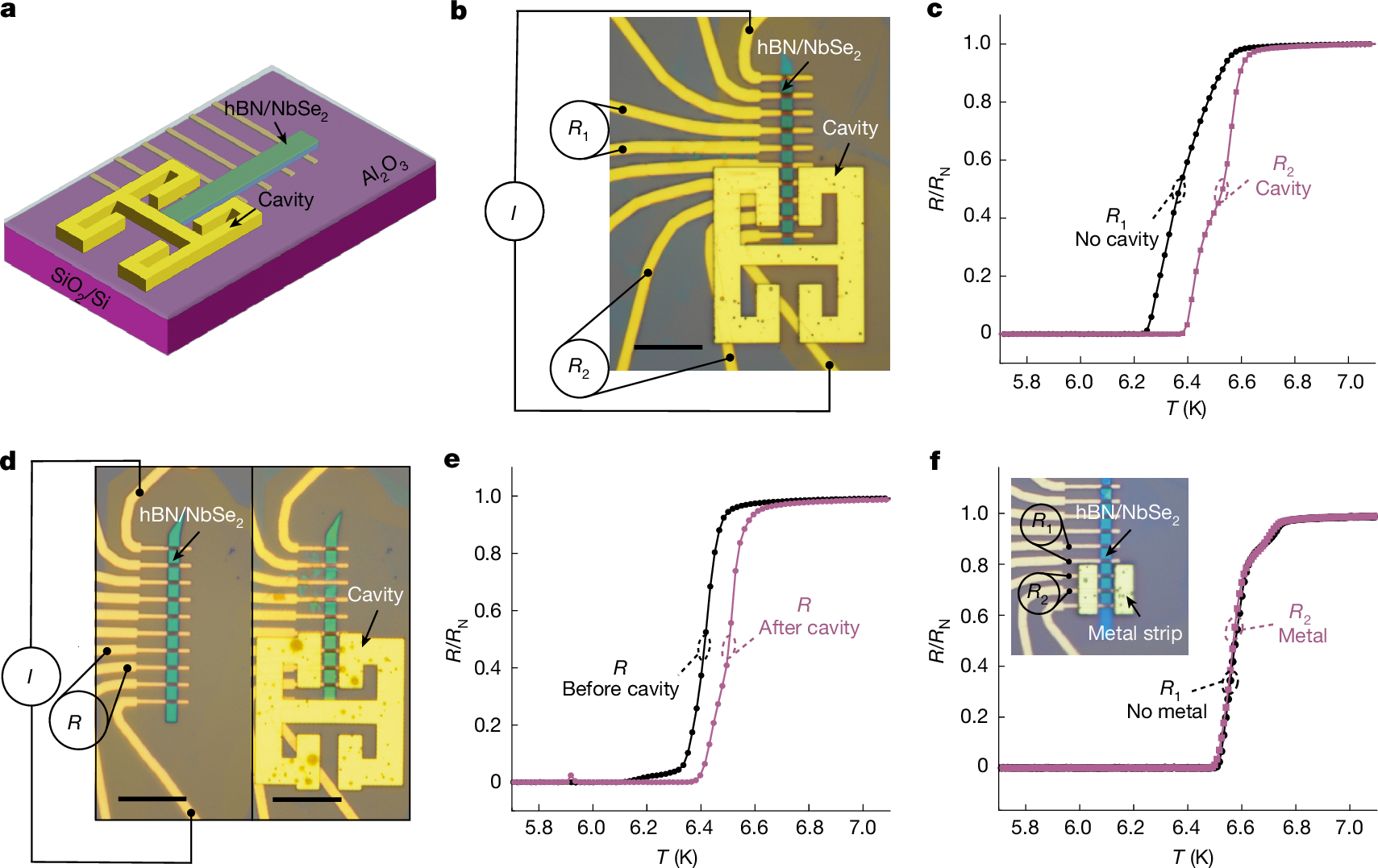
- The cavity is a terahertz split-ring resonator, which Zeng said reshapes the electromagnetic environment and substantially amplifies vacuum fluctuations.
- Theory for the effect came from Qingdong Jiang's group at Shanghai Jiao Tong University, which calls control of electrons and photons by designed vacuum environments 'vacuumronics'.
- The same experimental groups earlier used a magnetic field to switch the Casimir force reversibly between attraction and repulsion.
Compiled by The ScientistSomething wrong?How this is made
Why it matters
- capability If the effect holds up, a resonator's geometry and frequency become settings for a superconductor's transition temperature, applied with no external drive.
- constraint The 5.4% ceiling can be turned into kelvin, or into a success rate across devices, only once the paper's baseline temperatures and device counts are examined.
- decision Labs measuring thin-film superconductors now have reason to report and control the electromagnetic structures around a sample, since a nearby resonator was enough to move a transition here.
"Vacuum fluctuations in free space are generally too weak to produce observable effects in macroscopic condensed-matter systems," said Changgan Zeng of the University of Science and Technology of China, who led the Nature study with Guanghui Cheng [1][6]. The fluctuations themselves are established physics, with effects seen in the Lamb shift, spontaneous emission and the Casimir effect [14]. What the team reports is a solid responding to them. Cheng called it "the first experimental observation of vacuum-fluctuation-enhanced superconductivity" [5]. That priority claim is the team's own.
The 5.4% is a ceiling. Cheng gave it as an "up to" figure from a single six-layer device [4]. The thing this doesn't tell you is how big the shift is in kelvin. The release does not give the baseline transition temperature, the number of devices measured, the spread between them, or what the other thicknesses the team tried produced [8].
Strain, material degradation, inhomogeneity and metallic screening could each move a transition temperature with no help from the vacuum. The team changed the cavity geometry, its characteristic frequency, the material thickness, the dielectric materials and the metallic strips, and says the results exclude all four [8]. One of the strongest clues, according to the release, is how the enhancement relates to the cavity's characteristic frequency. The enhancement did not change smoothly as that frequency changed [9]. I think that is the result to lean on, because strain or a degraded flake has no evident reason to track how a resonator is tuned [8][9].
The release's summary says engineered vacuum environments could control quantum materials "without direct contact or external driving" [12]. The second half fits the experiment as described. The cavity is a dark one, and the effect came from placing the material inside it and comparing with measurements outside [3][7]. "Without direct contact" needs a condition attached. The flake sits within a fabricated structure that includes dielectric materials and metallic strips, and the team had to vary both to rule out screening [8]. What gets tuned is the material's surroundings, and so far the material is an ultrathin flake six layers thick [4][13].
What to watch
- The Nature paper's baseline transition temperatures and device-to-device spread, the figures needed to express the 5.4% ceiling in kelvin.
- An independent group reproducing the non-smooth dependence on cavity frequency with its own resonator.
- Results in other superconductors or in thicker NbSe2, showing whether the effect is confined to ultrathin flakes.