InvestNot yet confirmed elsewhere1 publisher2 min readPublished
Flock's $8.3B rests on data rights its biggest customers are now redlining
The company says it is past $500 million in recurring revenue at roughly 16.6 times that figure. What the multiple buys is written into contracts cities have started reopening.
The Investor · Invest desk
What happened
- Flock says it has raised $500 million at an $8.3 billion valuation and passed $500 million in annual recurring revenue in the first half of this year.
- a16z led a $275 million round at a $7.5 billion valuation in March 2025, joined by Founders Fund, Kleiner Perkins, Greenoaks, Sands Capital, Tiger Global and Y Combinator.
- Boston, Flagstaff and Santa Clara dropped Flock in March after a viral Ring Super Bowl ad, and Ring then pulled its Flock integration.
- The LAPD said in July it was renegotiating its Flock agreement over who owns the collected data.
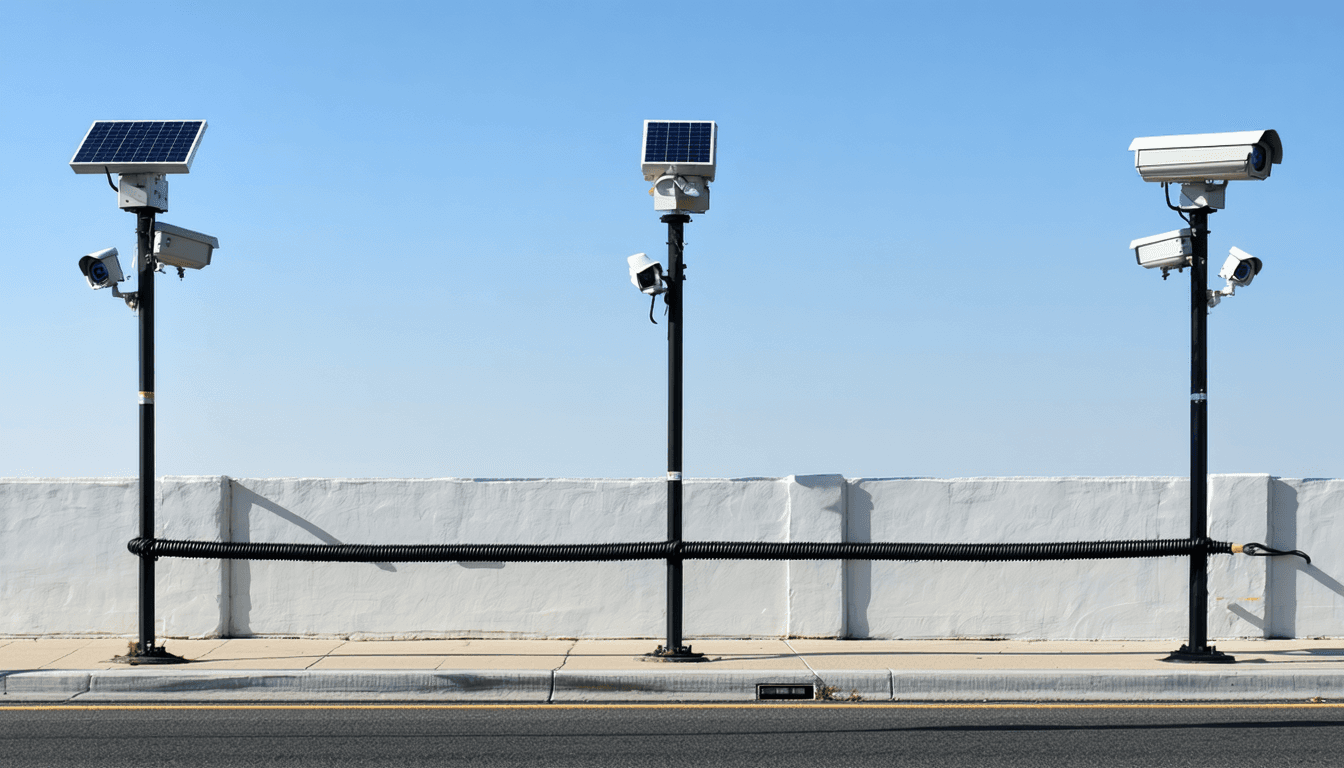
- Attacks on the cameras, including paint, vehicle ramming and chain saws, have been documented in at least 36 states.
Why it matters
- constraint Every contract rewritten to bar Flock from using collected data narrows the pool the machine learning is fed from, even while the deployed base keeps growing.
- precedent Because two attorneys found the same clause pattern in Flock contracts outside Los Angeles, one city's redline becomes a form letter any of the other customers can send.
- exposure The vendor now absorbs the legal and reputational weight of what thousands of separate agencies do with pooled data, conduct it does not supervise.
Flock's own figures put more than 5,000 communities behind $500 million of recurring revenue [1][9], which caps the average customer at about $100,000 a year [16]. Law enforcement contracts dominate the business now, after homeowners associations seeded it [11]. A vendor with that shape does not lose on any one account. It loses when the reason to reopen an account spreads, because public buyers copy each other's paperwork.
At $8.3 billion, the company is held near 16.6 times recurring revenue [15]. That is not a price for cameras. It is a price for the pooled cross-jurisdictional database that experts warn can be searched nationally by agencies including ICE [23], and for the AI search layer that sits on top of it alongside video, gunshot detection and drones [10]. Flock's position is that its customers own the collected data and set their own retention periods [19]. Privacy experts say the contracts reserve Flock the right to keep some of it for model training [20]. Los Angeles's Inspector General settled the argument in one direction by publishing the operative words: one agreement lets Flock "retain the right to use the foregoing for any purpose in Flock's sole discretion," while a separate one grants rights to anonymized footage for "training of machine learning algorithms" [14].
a16z's David Ulevitch and David George called Flock an "n of 1," effectively the only game in town, when the firm led the Series D in 2021 [2]. The privacy lawyers Fortune interviewed describe a market with substitutes: cities that cancelled went on to sign competitors, some of them less transparent about what they collect [22]. If a cancelled contract can be re-let inside one budget cycle, scarcity does not live in the product. It lives in the installed footprint and the data rights attached to it, and those rights are the thing under negotiation [7].
Cameras have been painted over, rammed with cars and cut down with chain saws in at least 36 states [13], roughly three quarters of the states where Flock operates [17]. Read that as a count of places where the product is contested in public rather than as a maintenance line.
The price itself is the last thing worth pricing. The $8.3 billion is a company-supplied number [1], about 11 percent above the last round a16z led [18]. That is a modest step for a business that has since crossed half a billion in recurring revenue, and a step that gets revisited downward if renewals wobble.
What to watch
- Whether the guardrails Flock announced last week are written into customer contracts or held as company policy.
- Whether the LAPD renegotiation ends with data-use rights removed, and how many other large departments copy the wording.
- Whether the next priced round holds above $8.3 billion once renewal rates across municipal customers are visible.
Clarity's read
What the record supports and how the coverage leans. The claims behind it follow.
Reality
- Evidence58
- Adoption79
- Hype gap+22
- Incentives74
- Confidence56
Claim ledger
Ranked by verification strength, evidence, and original report placement.
- [1]
Flock told Fortune the company has raised $500 million at an $8.3 billion valuation and crossed $500 million in annual recurring revenue in the first half of this year.
ReportedSupportedSource: Flock, via Fortune2 sources— create a free account to open themView cited source - [2]
Andreessen Horowitz was an early backer and led Flock's Series D in 2021, with general partners David Ulevitch and David George calling the company an "n of 1" startup, "effectively the only game in town."
- [3]
Privacy experts and civil liberties groups allege officers used Flock cameras to stalk people, including exes, and that departments shared data across jurisdictions, including with ICE and in violation of state law.
ReportedSupportedSource: privacy experts and civil liberties groups, via Fortune2 sources— create a free account to open themView cited source - [4]
In March, Boston, Flagstaff and Santa Clara all dropped Flock following a now-viral Super Bowl ad from Amazon's Ring, which subsequently pulled its Flock integration.
- [5]
Ring never blamed the Super Bowl ad, but said the integration with Flock would require more resources than anticipated.
- [6]
In July the LAPD said it was renegotiating its Flock agreement over data-ownership concerns.
- [7]
The LAPD, like many other Flock customers, is renegotiating its contracts to include language barring the company from using collected data.
- [8]
Flock last week set out a new set of guardrails intended to curb the practices at issue.
- [9]
Flock operates in more than 5,000 communities across 49 states.
- [10]
Flock started as a simple license-plate camera and has expanded to include video, gunshot detection, drones and AI-powered search software.
- [11]
Homeowners associations were Flock's earliest customers, before law enforcement contracts came to dominate the business.
- [12]
By March 2025 Flock raised $275 million at a $7.5 billion valuation in a round led again by a16z, with participation from Greenoaks, Sands Capital, Founders Fund, Kleiner Perkins, Tiger Global and Y Combinator.
- [13]
Vandalism of Flock cameras has increased, with people dousing them in paint, ramming them with cars, smearing substances on them and chopping them down with chain saws, documented in at least 36 states.
- [14]
The Los Angeles Inspector General audited the LAPD's Flock contracts this summer and quoted the signed language: one agreement lets Flock "retain the right to use the foregoing for any purpose in Flock's sole discretion," while a separate agreement grants the company rights to use anonymized footage for "training of machine learning algorithms."
- [15]
An $8.3 billion valuation on $500 million of annual recurring revenue is a multiple of about 16.6 times ARR.
- [16]
Spread over more than 5,000 communities, $500 million of ARR averages no more than about $100,000 per community per year.
- [17]
Vandalism documented in at least 36 states covers about 73 percent of the 49 states where Flock operates.
- [18]
The $8.3 billion figure is about 11 percent above the $7.5 billion valuation of the March 2025 round led by a16z.
- [19]
Flock says its customers own the data it collects: the police departments, HOAs and private customers who hold it for a period at customer discretion.
- [20]
Privacy experts say Flock's contracts allow the company to retain certain data to train its models.
ReportedContestedSource: privacy experts, via Fortune2 sources— create a free account to open themView cited source - [21]
Two privacy attorneys Fortune interviewed each independently described the same contract pattern from their own review of Flock's contracts elsewhere.
ReportedContestedSource: two privacy attorneys, via Fortune2 sources— create a free account to open themView cited source - [22]
Experts pointed to cities that had pulled their contract with Flock only to sign on with one of its competitors, some of which are even less transparent regarding data collection.
ReportedInsufficientSource: privacy experts, via Fortune2 sources— create a free account to open themView cited source - [23]
Experts warn that once one department's data is pooled with other agencies' data, the result is a nationwide network that agencies such as ICE can search, even in violation of state law or beyond the parameters of the initial contract.
ReportedInsufficientSource: privacy experts, via Fortune2 sources— create a free account to open themView cited source
Sources
1 independent publisher whose own reporting we read for this story.
- fortune.comFlock Safety has been a venture darling. Will data privacy controversies halt its rise?
1 article · August 24, 2026
Topics and entities
Follow any of these and your For You feed starts watching them — no settings page required.
Topics
- Data Retention and MinimizationFollow
- Venture ValuationsFollow
- Data Rights in Vendor ContractsFollow
- Privacy and Civil LibertiesFollow
- Surveillance TechnologyFollow
- Government Technology ProcurementFollow
- AI Training Data ProvenanceFollow