Product4 distinct publishers3 min readUpdated
WIRED says it pulled 69 prewritten police prompts and 45 tool definitions off Flock's own website. The procurement lesson: a vendor's "cannot" describes this build, not the next one.
The Product Desk · Product desk

Compiled by The Product DeskSomething wrong?How this is made
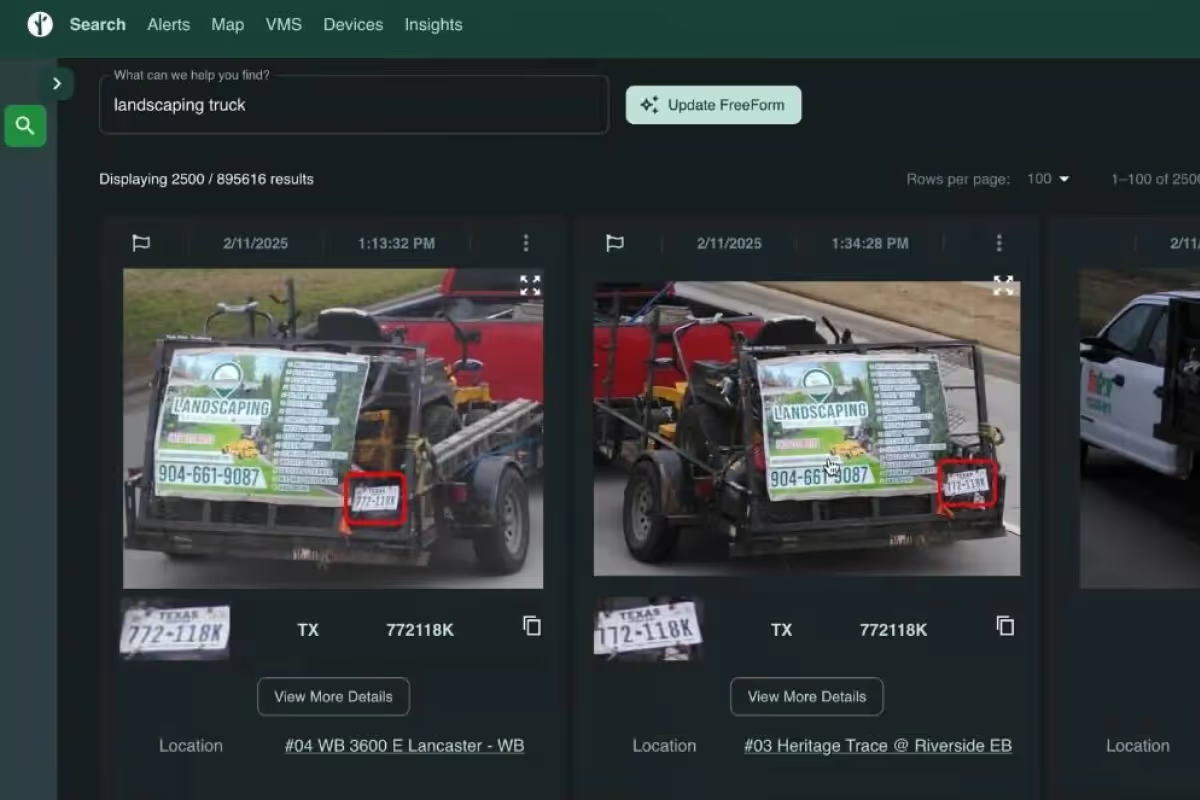
Flock Safety, whose cameras log driver movements in more than 6,000 communities, has told the public for years that its technology "cannot recognize, identify, or track individuals" [1][3]. WIRED reports the company has now built an AI tool for police that does both, identifying drivers and tracking vehicles by their movement patterns alone [2].
The evidence is unusually concrete. According to WIRED, the prompts and code sat in a cache of more than 450 files on Flock's own website, served by its login pages to anyone who loaded them [8]. The software, originally called Nightshift and more recently OS Investigate, ships with 69 prewritten prompts an officer can select, review or edit, and submit; officers can also write their own [7]. The code describes 45 tools available to the model, with access to plate scans and camera metadata, arrest records, case files, dispatch logs, ballistics results, and commercial databases holding Social Security numbers, dates of birth, phone numbers, email addresses, relatives and associates [9].
That inventory is the whole argument. Flock's original transaction was narrow: photograph a plate, convert it to text, check it against a list of vehicles police want, ignore the rest [13]. WIRED describes the preloaded prompts as an inversion of that deal, in which the officer supplies a place, a window of time and a behavior, and the system returns the people who fit, with no plate, name or crime to start from [14]. One prompt asks for witnesses based on the vehicles most often seen in a neighborhood over the last 14 days during a daily time window, excluding whitelisted vehicles; the output is a list of plates that other tools convert into names and home addresses [15]. Another lists everyone arrested more than twice in two years for any offense except narcotics, maps where those people live, pulls the calls for service at their homes, and instructs the system to "do a workup on the top 3 individuals" [16]. A workup is a one-command background check that starts from a name and date of birth and returns vehicles, prior suspect listings, then relatives, phone numbers and online accounts [17]. Nineteen of the prompts hunt for patterns rather than look up a record, and fourteen require no plate, name or description at all [18], roughly a fifth of the menu [20]. The system can also search for people inside an area drawn on a map using nothing but a physical description [6].
Flock says the product is in testing with a small group of law enforcement partners, is still in development, and may not ship with these capabilities [10]. Take that at face value and the procurement problem gets worse, not better. "Cannot identify individuals" was a true description of a hotlist match and a worthless constraint on a roadmap. A negative capability claim from a vendor has a shelf life equal to the next release; the sentence stayed the same while the product moved. Any policy, contract or council authorization that leans on it is authorizing whatever the vendor builds next. Privacy and legal experts already argue Flock's existing tools raise constitutional problems by giving police broad, often warrantless access to a vast movement record [12].
Watch whether Flock's public "cannot" language survives, and which of the 69 prompts appear in the shipping build [7][10]. Watch whether agencies rewrite policy around enumerated capabilities and audit logs rather than vendor assurances, as bipartisan pressure, documented officer misuse and camera vandalism accumulate [11]. And watch the file exposure itself: a company serving 450 internal files off its login pages is a separate control failure from the one being debated [8].
Follow any of these and your For You feed starts watching them — no settings page required.
Ranked by verification strength, evidence, and original report placement.
Flock has built an artificial intelligence tool for police that can identify drivers and track vehicles by their patterns of movement alone, WIRED reported.
Flock Safety has told the public for years that its technology "cannot recognize, identify, or track individuals."
Flock says it is testing the product with a small group of law enforcement partners and describes it as still in development, with capabilities that may not reflect what it eventually sells.
The tool arrives as Flock faces bipartisan political pressure, a growing record of officers caught misusing its platform, and a wave of vandalism that has left cameras sawed off and lenses painted over in cities across the country.
Flock operates a network of cameras that logs the movements of drivers in more than 6,000 communities.
The software, originally called Nightshift and more recently renamed OS Investigate, ships with 69 prewritten prompts that officers can select, review, or edit and then submit to the AI; officers can also input prompts of their own.
Evidence-backed comparisons of source perspectives and observed adoption signals. Read the methodology
Which Builder, Operator, and Investor concerns the observed source mix emphasized—not a truth score.
Evidence, demonstrated adoption, hype gap, incentives, and confidence are assessed independently, each on its own current evidence. How these are measured.
Primary artifacts, single reporting origin
The core factual base is strong for a capability story: WIRED worked from Flock's own exposed files and quotes prompt text verbatim, gives countable figures (69 prompts, 45 tools, 19 pattern prompts, 14 identifier-free prompts), and the vendor declined to dispute the described capabilities. Two constraints hold the score below the high band. First, all four publishers trace to one investigation, so agreement across the cluster is not independent corroboration. Second, TNW notes the reconstruction never exposed the model's underlying instructions or the checks applied on Flock's servers, so what was documented is the client-side prompt and tool surface rather than the enforced behaviour of the deployed system.
Wide camera base, pre-general-availability tool
Two very different adoption pictures sit in the same story. The underlying camera network is large and operational in more than 6,000 communities, and the 13 August safeguards plus the documented misuse cases show a platform in heavy real-world use. The AI tool itself is not adopted in any meaningful sense: Flock describes it as in development with an unnamed small group of pilot partners, no agency has disclosed operational use, no pricing or contract terms appear, and adoption is moving in the other direction in some jurisdictions with cancelled contracts and removed cameras. The score reflects a mature installed base carrying an unproven, unreleased capability layer.
Slight overstatement of present capability
Coverage is closely anchored to documented artifacts, so the gap is small. It is positive rather than zero mainly on framing: headlines and ledes describe a tool that identifies and tracks drivers as an accomplished fact, whereas the evidence establishes a prompt catalogue and tool manifest in a pre-release build, with server-side enforcement unobserved and outputs that TNW correctly labels leads rather than proof. Engadget and Gizmodo carry the vendor's development caveat but subordinate it to capability language. Countervailing pressure keeps the number low: Flock did not dispute the capabilities, the numeric claims are checkable, and the story arguably understates the procurement angle, since the durable finding is that a vendor's public 'cannot' describes one build and not the roadmap.
Strong and visible on both sides
Incentives are unusually legible here. Flock has a direct commercial interest in maintaining that its technology cannot identify individuals while building capability that does, and its 'separate product, may change before broader release' framing preserves both positions; the funding and valuation trajectory and expansion into drones, video and 911 software raise the stakes on that narrative. Law-enforcement customers have an operational incentive to adopt broad search, captured in the anonymous officer's remark about using every available tool. On the other side, WIRED has an investigative-scoop incentive and three downstream outlets have aggregation incentives to lead with the strongest capability framing, while the ACLU is an advocacy source with an interest in the alarming reading. All of these are disclosed in the sources rather than inferred.
Facts solid, forward path uncertain
Confidence is high on what exists: the prompt library, tool manifest, prompt taxonomy and the exposure itself are documented from vendor-served files, cross-summarised by three publishers and undisputed by Flock. Confidence is materially lower on consequence. The cluster cannot say what server-side guardrails apply, which agencies are piloting, whether the shipped product will retain the identifier-free searches, whether the exposed cache has been remediated, or what accuracy the pattern searches achieve. Single-origin reporting and pre-release product status both argue against a higher number.
build
Flock's OS Investigate starts the search before there is a suspect1 distinct publisher
product
Flock's case-number rule is an honour system, and the company says it never checks2 distinct publishers
build
Flock cut retention to seven days and published the number that made 30 indefensible1 distinct publisher
leadership
Longmont dropped Flock and kept the cameras: vendor churn is not surveillance policy1 distinct publisher
Distinct publishers with included, body-backed reporting in this cluster.
engadget.com
1 article · August 19, 2026
gizmodo.com
1 article · August 19, 2026
thenextweb.com
1 article · August 19, 2026
wired.com
1 article · August 19, 2026