Product3 publishers3 min readPublished
Ban Flock Act would tie federal grants to states and cities banning license plate readers
Bernie Sanders' Ban Flock Act would strip local governments of grants from five federal departments unless they ban license plate readers. For the city officials who sign camera renewals, that turns a police tool into a grant-budget question while Congress waits out the midterms.
The Product Desk · Product desk
What happened
- Federal agencies would be barred from using automatic license plate readers or pulling data from readers run by local police and private companies.
- Despite its name, the bill's text never mentions Flock and would apply to every automatic license plate reader system.
- Americans could sue the federal government over violations, and state attorneys general could enforce the law.
- Sen. Josh Hawley, a Missouri Republican, announced his own Stop Flock Abuse Act on Wednesday.
Compiled by The Product DeskSomething wrong?How this is made
Why it matters
- cost The grant penalty would reach every ALPR vendor's local government sales, since an agency keeping any company's readers would forfeit its Justice and Homeland Security grants.
- constraint Flock's current product default would not meet the retention rule for future federal uses, so selling to federal buyers would require a separate, shorter-retention configuration.
- contradiction Gizmodo says the data ban covers cameras not directly owned by governments, while TechCrunch says it covers police-run readers, so a city that owns its cameras cannot tell from the coverage whether federal access to its data would end.
A former Milwaukee police officer searched Flock's system for his then-partner and her ex 179 times and listed the reason as "investigation" [15]. He pleaded guilty to misconduct [15].
A reason field assumes that local policy governs use. Flock CEO Garrett Langley had previously said as much, that how police use the cameras is up to local agencies [13]. What one user actually did was type the word the box expected and keep going [15].
Flock's response has come through the settings screen. In August, Langley announced a default data retention period of seven days, down from 30 [12], a cut of about 77 percent [1]. Customers must now use an audit tool that locks an officer out pending review when it flags an unusual search [14]. On a podcast, investor Jason Calacanis suggested a "double-key" system in which two people approve a search, and Langley said the idea is "on the whiteboard" [16]. The changes came as communities canceled contracts at an escalating rate [11].
The bill sets a tighter line. Its only exceptions are toll collection and uses Congress approves in later legislation, and those would have to keep data no longer than 48 hours [6]. Flock's new default is 168 hours, 3.5 times that cap [2].
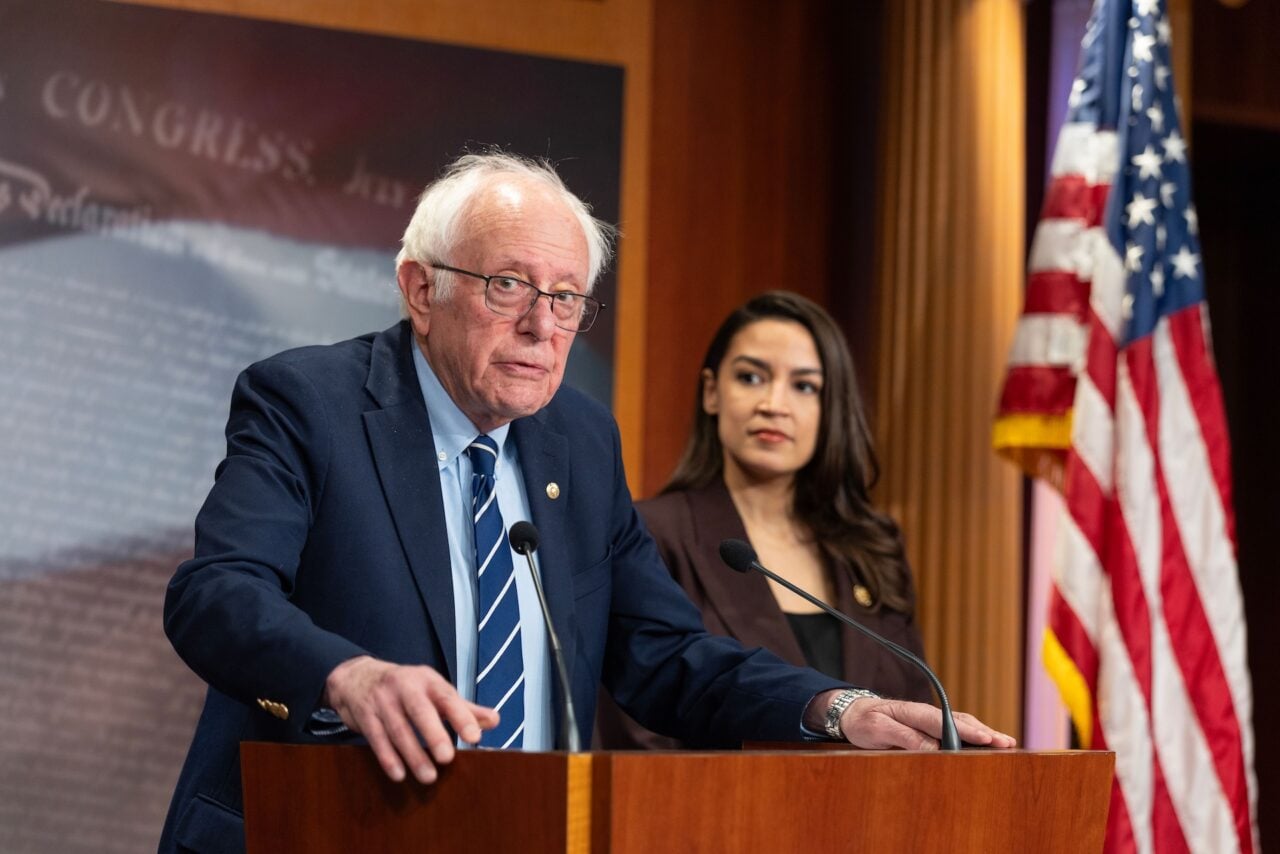
Sanders introduced the bill Friday with Sen. Jeff Merkley as a co-sponsor, and Rep. Alexandria Ocasio-Cortez is carrying it in the House [1][2]. "Flock is eviscerating the very notion of privacy by installing tens of thousands of cameras in communities across America without their consent," Sanders said [22]. He calls Flock the largest ALPR vendor in the U.S., with more than 120,000 cameras [9]. In a February blog post, the company said its network processes more than 20 billion vehicle reads a month [10].
The bill is far from law. Gizmodo called it "extremely unlikely to pass anytime soon" [20], and TechCrunch wrote that it faces long odds [21]. Gizmodo expects all the Flock bills to wait until after the November midterms [18].
For the official who signs a city's camera renewal, the grant penalty is the clause to read. It would begin in the first fiscal year after enactment and covers Justice Department and Homeland Security grants among others [7]. I'd read it before the federal-use ban.
Two axes sort a deployment. One is federal dependence: how much of the program rests on those grants, or on sharing reads with federal agencies [7][3]. The other is retention tolerance: whether the program still does its job on 48 hours of data with searches reviewed [6].
A program with little federal money that works on short retention is barely touched by the bill. Where federal money is heavy but 48 hours is workable, the decision moves to the finance office. Long retention with no federal money puts the risk in local politics, where the cancellations are already happening [11]. The contract where termination terms matter most is the one that needs both the federal money and the long retention.
What to watch
- Langley's interview at TechCrunch Disrupt, October 13-15 in San Francisco, the next public account of Flock's search controls.
- Which party controls Congress after November; Gizmodo wrote that without Democratic control the surveillance bills are unlikely to go anywhere.
- The text of Hawley's Stop Flock Abuse Act, and whether a Republican bill carries a grant penalty or a retention cap.