Invest2 publishersIndependently confirmed3 min readPublished
Bitcoin with exposed public keys grows 3.5 times faster than new supply
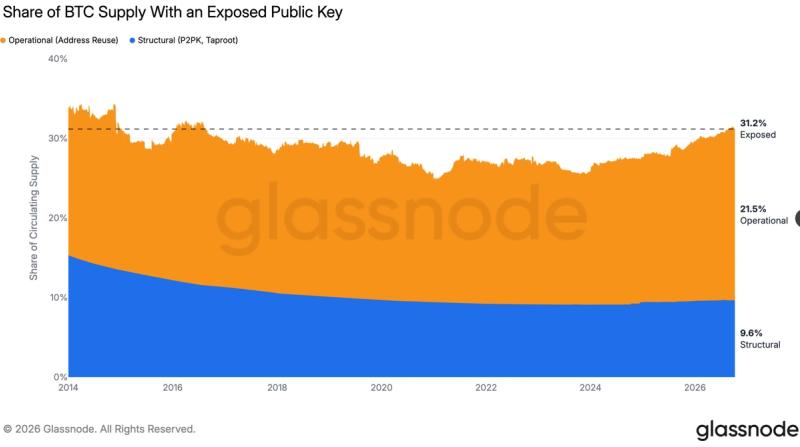
Glassnode's Rafael Schultze-Kraft counts 31.2% of circulating Bitcoin behind exposed public keys, up 222,000 BTC since May while supply grew 64,000 BTC. Exchanges supplied most of that rise, and a venue can cut its share by moving reserves to fresh addresses.
The Investor · Invest desk
What happened
- Fidelity holds about 375,000 BTC with 2% exposed, while Grayscale sits at 49%, Revolut at 99% and Robinhood at 100%.
- The 31.2% share is roughly 5 to 6 percentage points above the 2023 low, according to CoinDesk's account of Glassnode data.
- Ethereum researcher Justin Drake urged the industry to prepare for "bunker mode" against a possible AI shortcut to breaking wallet cryptography.
Compiled by The InvestorSomething wrong?How this is made
Why it matters
- decision Binance, Revolut and Robinhood each have to decide whether to move reserves to fresh addresses, work Crypto Briefing calls operational and needing no protocol change.
- exposure Where a customer keeps coins sets their exposure: a Binance balance sits in a book about eight times more exposed than a Coinbase one.
- constraint Coins whose owners lost keys or went inactive cannot be migrated by anyone else, so part of the 4.47 million exposed BTC outside exchanges stays put whatever custodians do.
- contradiction CoinDesk treats the count as address usage with no demonstrated attack while Drake warns of an AI shortcut within months, so the same 31.2% supports both a hygiene reading and an urgent one.
Divide 222,000 newly exposed BTC by 64,000 BTC of new issuance and the ratio comes out near 3.5 to one [3][14]. New coins cannot account for that. Coins already in circulation are moving into addresses whose public keys sit on the ledger. Many address formats keep the public key behind a hash until the owner spends, and once revealed it stays visible permanently [10]. Exchanges supplied 123,000 BTC of the increase [4], about 55% [15]. That is a majority, and a thin one. The other 99,000 BTC came from everyone else, and that remainder alone outran new supply by roughly one and a half times [16].
The rates differ more than the amounts. Exchange balances behind visible keys grew about 7.4% in the five months since May, from roughly 1.67 million to 1.79 million BTC [2][17]. The roughly 4.47 million exposed BTC held elsewhere grew about 2% [18]. Exchanges hold about 29% of the exposed total [19] and are adding to it at more than three times the pace of the rest [23].
Across custodians the exposed share runs from 2% to 100%. Coinbase keeps 10% of its holdings behind exposed keys and Binance 83% [5], a gap of about eight times [21]. In the figures CoinDesk reported, Fidelity holds about 375,000 BTC with 2% exposed, or roughly 7,500 BTC [6][20], while Grayscale is at 49%, Revolut at 99% and Robinhood at 100% [6]. US, UK and El Salvador government holdings show no exposure under Glassnode's method [11]. Keys become visible through address reuse or directly in some output types, including early pay-to-public-key outputs and Taproot [9]. The sources do not split the 123,000 BTC exchange increase by cause. A venue reusing deposit addresses and one that moved reserves into Taproot outputs count the same in this metric.
CoinDesk notes that the figures measure address usage, not immediate security risk, and that no practical attack on bitcoin or ether wallet keys has been demonstrated [8]. On that reading the climb costs holders nothing until a capable quantum computer or a mathematical breakthrough exists [9]. Ethereum researcher Justin Drake puts the clock closer. He urged the industry to prepare for "bunker mode" and said that in a worst case AI could uncover a shortcut to breaking wallet cryptography "in months, not years," before quantum computers arrive [12].
I think the exchange slice is a decision being deferred. Crypto Briefing describes migrating reserves to fresh addresses as an operational task, not a protocol overhaul [13], so Binance's 83% could fall without any change to Bitcoin itself, and until a venue does that work its customers carry the exposure. The counter-thesis is that exchange hygiene treats the smaller pile. About 4.47 million exposed BTC sit outside exchanges [18], and Crypto Briefing notes that a meaningful share may belong to owners who will never move them because keys are lost or holders are inactive, coins no one else can migrate [24].
The view fails if exchange exposure falls and the total share still climbs past 31.2% [1]. That share has risen 1 percentage point since May, out of the 5 to 6 points it has gained since the 2023 low [22].
What to watch
- Whether the non-exchange exposed balance, about 4.47 million BTC, keeps growing faster than new supply in Glassnode's next update.
- Any reserve migration to fresh addresses at Binance (83% exposed), Revolut (99%) or Robinhood (100%).
- A demonstrated practical attack on Bitcoin wallet keys; CoinDesk reports none so far, and Drake's worst case puts an AI shortcut months away.
Clarity's read
What the record supports and how the coverage leans. The claims behind it follow.
Reality
- Evidence62
- Adoption
- Insufficient
- Hype gap+15
- Incentives
- Insufficient
- Confidence58
Claim ledger
Ranked by verification strength, evidence, and original report placement.
- [1]
On October 8, 2026, Glassnode co-founder Rafael Schultze-Kraft put Bitcoin behind exposed public keys at more than 6.26 million BTC, or 31.2% of circulating supply.
ReportedSupportedSource: Rafael Schultze-Kraft, Glassnode, via Crypto Briefing2 sources— create a free account to open themView cited source - [2]
In May 2026 the exposed-key metric stood at 6.04 million BTC, equal to 30.2% of supply; five months later the exposed balance is 222,000 BTC larger.
ReportedSupportedSource: Crypto Briefing, citing Glassnode data2 sources— create a free account to open themView cited source - [3]
Schultze-Kraft said exposed supply has increased by 222,000 BTC since Glassnode's May report, while total bitcoin supply grew by just 64,000 BTC.
ReportedSupportedSource: Rafael Schultze-Kraft, via CoinDesk (also reported by Crypto Briefing)2 sources— create a free account to open themView cited source - [4]
Exchanges accounted for 123,000 BTC of the increase and now hold 1.79 million BTC behind visible public keys.
ReportedSupportedSource: Glassnode data via CoinDesk (also reported by Crypto Briefing)2 sources— create a free account to open themView cited source - [5]
Coinbase's exposed share stands at 10%, compared with 83% at Binance.
ReportedSupportedSource: Glassnode data via CoinDesk2 sources— create a free account to open themView cited source - [6]
Fidelity holds approximately 375,000 BTC with 2% exposed; Grayscale's exposed share is 49%, Revolut's 99% and Robinhood's 100%.
ReportedSupportedSource: Glassnode data via CoinDesk2 sources— create a free account to open themView cited source - [7]
The 31.2% share is roughly 5 to 6 percentage points above the low reached in 2023.
ReportedSupportedSource: CoinDesk, citing Glassnode data2 sources— create a free account to open themView cited source - [8]
The figures measure address usage, not immediate security risk; no practical attack on bitcoin or ether wallet keys has been demonstrated.
- [9]
Public keys can become visible through address reuse or appear directly in certain bitcoin output types, including early pay-to-public-key outputs and Taproot; a sufficiently capable quantum computer or a hypothetical mathematical breakthrough could potentially allow an attacker to derive the private keys.
- [10]
Many address formats keep the public key hidden behind a hash until the owner spends from that address; once revealed, the key stays on the public ledger permanently.
ReportedSupportedSource: Crypto Briefing2 sources— create a free account to open themView cited source - [11]
U.S., U.K. and El Salvador government holdings show no exposure under this methodology.
- [12]
Ethereum researcher Justin Drake urged the industry to prepare for "bunker mode" and argued that AI could potentially uncover a shortcut to breaking wallet cryptography "in months, not years" in a worst-case scenario, before quantum computers arrive.
- [13]
Migrating reserves to fresh addresses is an operational task, not a protocol overhaul, so platforms with high exposure have a relatively clear path to lowering their numbers if they choose to.
- [14]
Exposed Bitcoin grew about 3.5 times as fast as new supply since May.
- [15]
Exchanges supplied about 55% of the increase in exposed Bitcoin since May.
- [16]
Non-exchange holders added about 99,000 BTC of newly exposed coins, roughly 1.5 times the 64,000 BTC of new supply.
- [17]
Exchange balances behind exposed keys were about 1.67 million BTC in May and grew about 7.4% to 1.79 million BTC.
- [18]
Exposed Bitcoin outside exchanges is about 4.47 million BTC, up roughly 2% from about 4.37 million in May.
- [19]
Exchanges hold about 29% of all Bitcoin behind exposed public keys.
- [20]
Fidelity's exposed holdings are roughly 7,500 BTC.
- [21]
Binance's exposed share is about eight times Coinbase's.
- [22]
The exposed share rose 1 percentage point since May, out of a 5 to 6 point rise since the 2023 low, implying a 2023 low of roughly 25% to 26% of supply.
- [23]
Exchange exposed balances grew more than three times as fast in percentage terms as exposed balances held elsewhere.
- [24]
A meaningful share of exposed coins may belong to owners who will never move them, because keys are lost or holders are inactive; those coins cannot be migrated to safer addresses by anyone except their owners.
Sources
2 independent publishers whose own reporting we read for this story.
- coindesk.comOver 6 million bitcoin sit behind exposed public keys as AI warnings mount
1 article · October 8, 2026
- cryptobriefing.comGlassnode co-founder counts 6.26 million BTC with exposed public keys
1 article · October 8, 2026
Topics and entities
Follow any of these and your For You feed starts watching them — no settings page required.
Topics
- On-chain analyticsFollow
- Quantum risk to cryptocurrencyFollow
- Institutional Crypto CustodyFollow