ScienceNot yet confirmed elsewhere1 publisher2 min readPublished
Soil at fresh elephant carcasses in Kruger holds up to 3,000 times more nitrogen
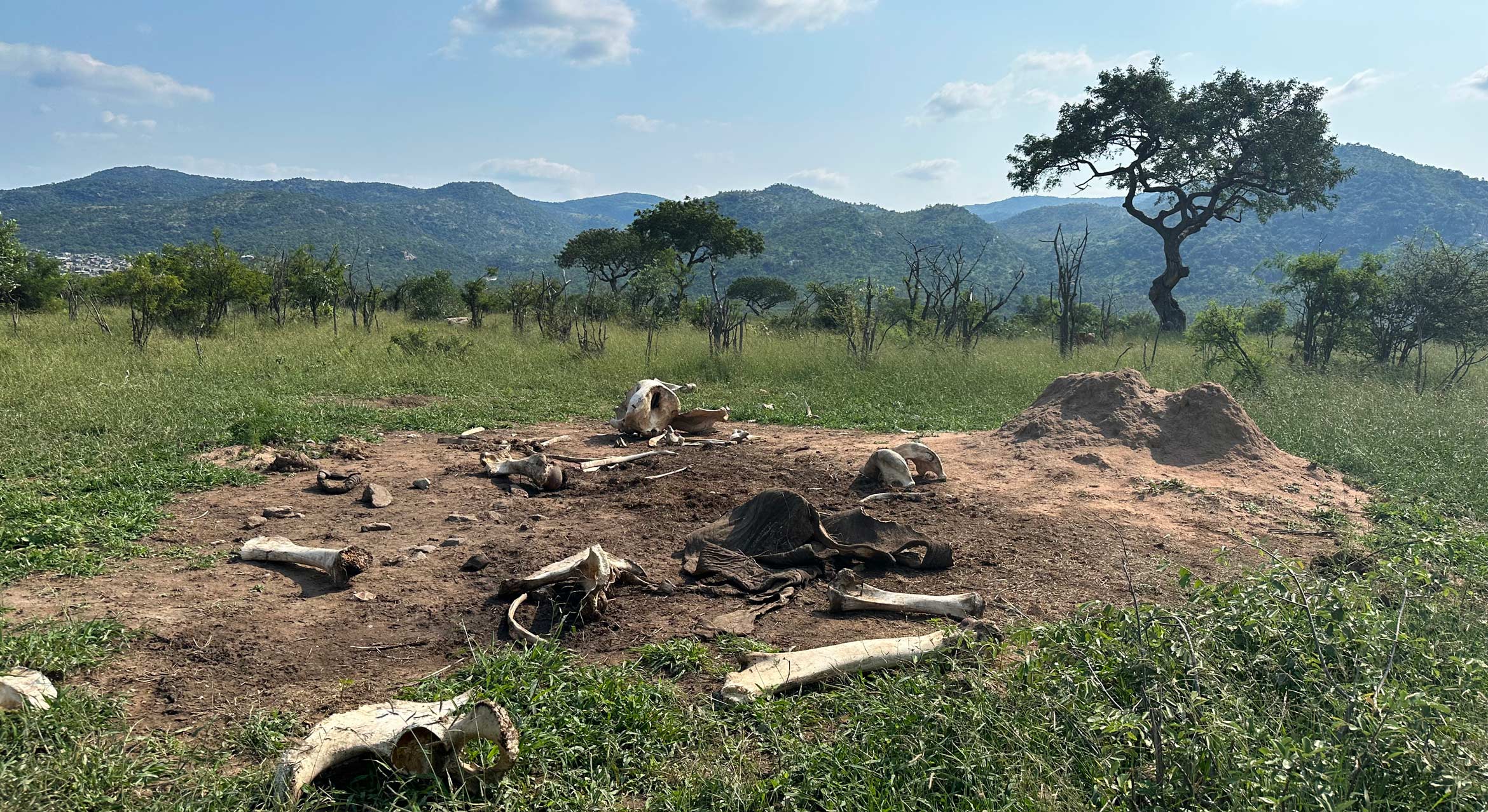
Elephant carcasses in Kruger National Park leave nutrient hotspots that persist for years, possibly decades, according to a PNAS paper. Plant diversity stayed depressed for at least eight years after a death; decades is stated only as a possibility.
The Scientist · Science desk
What happened
- The team documented soil chemistry, microbiology, biodiversity and animal grazing around elephant remains in South Africa's Kruger National Park.
- Lead author Courtney Reed said soil nitrogen concentrations at really fresh carcass sites can be up to 3,000 times higher.
- Ammonium and similar compounds cause nutrient toxicity that initially prevents plants from growing back.
- Microbes at the sites were more active but less diverse, likely because a few fast-growing species came to dominate.
- The nutrient flush draws herbivores to the site long after the visual signs of the elephant have disappeared.
Why it matters
- precedent Lead author Courtney Reed said that until now "we haven't really understood how those impacts continue after they die". Accounts of elephant impact that stop at death leave out a patch effect lasting years.
- contradiction The colonizing plants are especially nutritious, yet plant and microbe communities there are less diverse.
- constraint The nitrogen figure is stated as "up to" 3,000 times for really fresh sites, so it is a ceiling. Older sites are described only as mellowing, and no typical value is given.
The site passes through stages. A large animal's bulk flattens the vegetation where it falls, and scavengers scrape the surrounding ground bare [7]. Senior author Deron Burkepile, a professor of ecology, evolution and marine biology, said "It essentially resets the plant communities to zero" [8]. Recovery starts only once the soil chemistry mellows, and what returns is a patch dominated by a handful of fast-growing species [9].
The project began with one carcass. In 2009 a great tusker called Alexander died of natural causes just off a main road that Dave Thompson, a biodiversity scientist at the South African Environmental Observation Network, travelled often for another project [10]. "Watching the decomposition of that carcass over just a couple of months got me curious," Thompson said [11]. He shared his observations with Burkepile at UC Santa Barbara, and the pair later enlisted Kruger's rangers to find sites [12].
Co-author Izak Smit, a senior scientist at South African National Parks, had expected a short-lived effect. "My intuition was that, since the carcass was only physically present for a relatively short period, its effect would also be rather muted and transient," he said [13]. Then the lab results arrived. "However, a very different picture emerged when the lab results came back," Smit said [14].
That reversal is the most useful thing in the account, because the starting hypothesis was a reasonable one: a brief physical presence should leave a brief mark.
The coverage does not give the number of carcasses sampled, the soil that the 3,000-fold comparison uses as its baseline, or how far the effect extends beyond the bare patch.
What to watch
- Whether follow-up sampling extends the plant record past eight years, which is what 'possibly decades' would need.
- Whether the PNAS paper's methods report the number of carcasses sampled and the baseline soils behind the 3,000-fold figure.
- Whether the grazing data quantify how strongly herbivores favor carcass patches over surrounding savanna.
Clarity's read
What the record supports and how the coverage leans. The claims behind it follow.
Reality
- Evidence55
- Adoption
- Insufficient
- Hype gap+10
- Incentives
- Insufficient
- Confidence50
Claim ledger
Ranked by verification strength, evidence, and original report placement.
- [1]
An international team of researchers studied the sites of elephant carcasses in South Africa's Kruger National Park, documenting soil chemistry, microbiology, biodiversity and animal grazing around the remains.
- [2]
The plant biodiversity coldspot dominated by a handful of fast-growing species persisted for at least eight years after an elephant's death.
- [3]
"At really fresh carcass sites, soil nitrogen concentrations can be up to 3,000 times higher," lead author Courtney Reed said.
- [4]
The influx of compounds like ammonium causes nutrient toxicity, initially preventing plants from growing back.
- [5]
Microbial activity at the carcass sites was up while diversity was down, likely because just a few fast-growing species had become dominant.
- [6]
The plants that are able to colonize the site are especially nutritious.
- [7]
A large animal's immense size flattens vegetation, and the activity of throngs of scavengers scrapes the surrounding ground bare.
- [8]
"It essentially resets the plant communities to zero," said senior author Deron Burkepile, a professor of ecology, evolution and marine biology.
- [9]
Once the soil chemistry mellowed, the plant community followed a similar pattern to the microbes: a biodiversity coldspot dominated by just a handful of fast-growing species.
- [10]
In 2009 a great tusker, a large lone bull elephant called Alexander, died of natural causes in Kruger National Park, his body lying just off a main road that senior author Dave Thompson, a biodiversity scientist at the South African Environmental Observation Network, frequently travelled for another project.
- [11]
"Watching the decomposition of that carcass over just a couple of months got me curious," Thompson said.
- [12]
Thompson shared his observations with UC Santa Barbara's Deron Burkepile, and the two developed hypotheses and enlisted the help of Kruger's rangers to find sites.
- [13]
"My intuition was that, since the carcass was only physically present for a relatively short period, its effect would also be rather muted and transient," said co-author Izak Smit, a senior scientist at South African National Parks.
- [14]
"However, a very different picture emerged when the lab results came back," Smit said.
- [15]
Lead author Courtney Reed, a former UC Santa Barbara postdoc now at Princeton, said "until now we haven't really understood how those impacts continue after they die" when describing megafauna effects on ecosystems; the paper was published in the Proceedings of the National Academy of Sciences.
- [16]
The study was published in the Proceedings of the National Academy of Sciences.
- [17]
Decomposition creates nutrient hotspots that can persist on the landscape for years, possibly decades.
- [18]
The nutrient flush attracts herbivores to the site long after the visual signs of the elephant have disappeared.
Sources
1 independent publisher whose own reporting we read for this story.
- phys.orgElephants continue to shape the savanna even after death
1 article · October 12, 2026
Topics and entities
Follow any of these and your For You feed starts watching them — no settings page required.
Entities
- Kruger National ParkFollow
- Proceedings of the National Academy of SciencesFollow
- University of California, Santa BarbaraFollow
- Courtney ReedFollow
- Deron BurkepileFollow
- Dave ThompsonFollow