Product1 publisher3 min readPublished
Illinois team builds the charge into the extraction molecule, and the reagent bill drops
A gold recovery demonstration on e-waste leachate cut chemical consumption by one to two orders of magnitude. The economics case still rests on numbers the write-up does not give.
The Product Desk · Product desk
Drafted by a language model from the sources cited here and checked against its claim ledger before publication. How we use AISend a correction
What happened
- Researchers at the University of Illinois Urbana-Champaign have developed a molecule that uses electricity to drive metal extraction, potentially reducing the chemical reagents needed to recover valuable metals from electronic waste, mining streams and industrial waste.
- The molecule combines three functions in one structure: it can selectively bind metal ions, carries a permanent electrical charge, and remains soluble in the organic liquid used during extraction.
- The built-in charge allows electricity to directly control the molecule during separation; instead of relying on additional chemical reagents to trigger capture and release of metals, the researchers can use an electrical signal.
- The team demonstrated the approach by selectively recovering gold from electronic-waste leachates.
- The publisher's headline states that the electricity-driven molecule cuts chemicals 100x and recovers 89% gold from e-waste.
Compiled by The Product DeskSomething wrong?How this is made
Why it matters
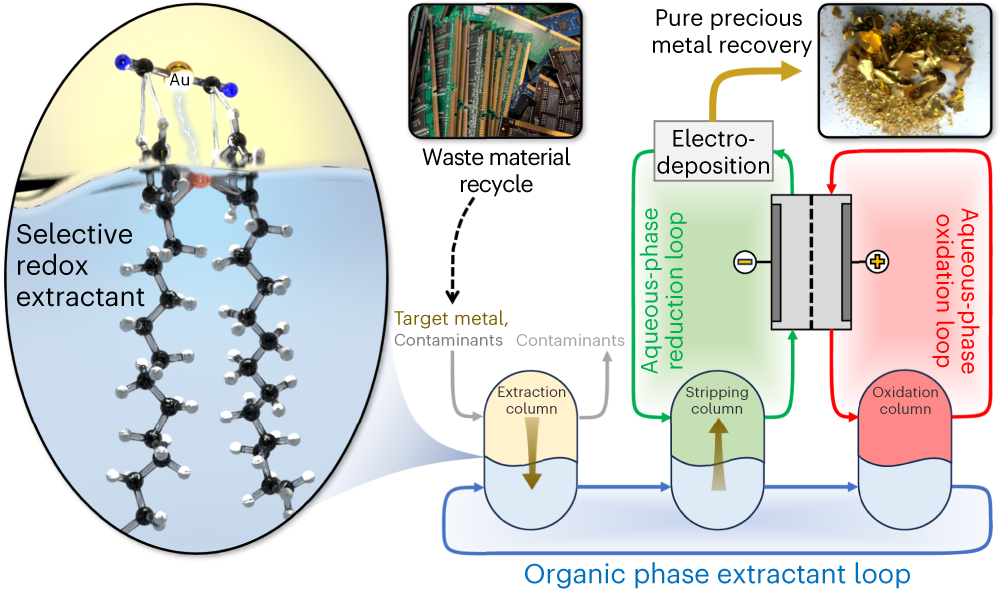
Researchers at the University of Illinois Urbana-Champaign have moved the electrical charge inside the extraction molecule itself, so that an electrical signal rather than added chemical reagents triggers the capture and release of metal ions [1][3]. They demonstrated it by selectively recovering gold from electronic-waste leachates, and report chemical consumption falling by one to two orders of magnitude [4][9].
The interesting part is where the change was made. The same group published a continuous electrochemically mediated liquid-liquid extraction system, or e-LLE, in 2024, which used electricity to replace many of the acids and bases in conventional metal extraction but still required additional chemical reagents to complete the cycle [6]. This work removes that remaining step by changing the extraction molecule rather than the hardware around it [18].
The molecule does three jobs at once: it selectively binds metal ions, carries a permanent electrical charge, and stays soluble in the organic liquid used during extraction [2]. "The new molecule has a permanent built-in charge that acts as electrolyte, letting the liquid conduct electric current," postdoctoral researcher and co-author Deborah Schmitt said. "That's what allows the redox reactions to be driven by electricity instead of chemicals" [7]. In operation, the molecule is electrically activated, binds the target metal, carries it into the organic phase, and releases it when its electrical state changes [8].
On the numbers, be precise about what was claimed. One to two orders of magnitude is a range from roughly 10x to 100x, so the 100x figure is the optimistic end of the researchers' own band, not a single measured result [9][10]. The 89 percent gold recovery figure appears in the publisher's headline; the body of the report does not restate it [5][19].
The portability claim matters more than the gold. According to graduate student and co-author Aderiyike Aguda, the same platform could be adapted to platinum-group metals from spent automotive catalysts and potentially other critical elements from mine tailings and complex feedstocks, because the electrochemical platform stays largely the same while the extractant chemistry is tailored to the target [11][12]. Su, the researcher quoted throughout the report, framed the contribution as fundamentals: "Basically, this work unlocked the fundamentals behind it - how to think about it" [13].
What is absent is everything an operator would need to price this. The report gives no cost per gram recovered, no throughput, no cell voltage or current efficiency, no molecule lifetime or degradation rate, and no indication of the volume processed in the demonstration [16]. It also does not name the journal or publication date of the paper [17]. A reagent cut of 10x to 100x changes the input side of a recycling operation's bill, but electrified separations trade consumables for electricity, capital and cycle life, and none of those three appear here [9][16].
Watch for the scale-up work: the team says it is now designing new molecules, studying how the process could be scaled industrially, and using computational modeling and artificial intelligence to speed up extractant discovery [14]. The test of the tunability claim will be a second metal, ideally platinum-group material from real spent catalyst, run on the same cell with the extractant swapped [11][12]. Su's own stated bar is scalable, minimal-waste separations [15]; the demonstration so far is a bench recovery of one metal from one leachate [4].