Science1 publisher2 min readPublished
X-ray tomography at Berkeley Lab records spacecraft ablators decomposing in 3D at up to 900 C
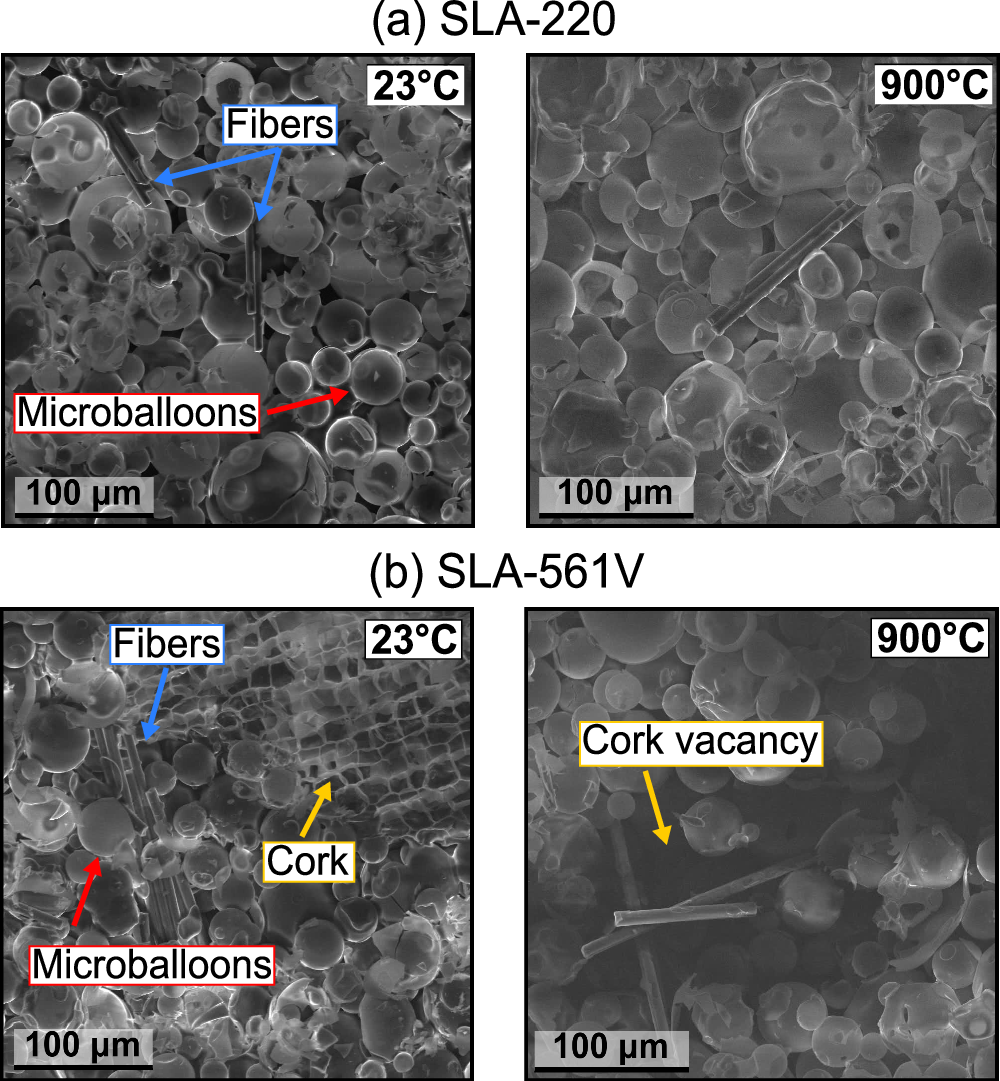
Illinois and NASA researchers imaged two spacecraft ablators decomposing in 3D at up to 900 C, using X-ray tomography at Berkeley Lab. Modellers now have a real decomposition sequence to test against, though the heating stayed at least 750 C below reentry surface temperatures.
The Scientist · Science desk
What happened
- A University of Illinois and NASA team scanned two commercial superlight ablators, SLA-220 and SLA-561V, which sit on different parts of NASA spacecraft backshells.
- Samples were heated to 900 C, the top of the range where these materials begin to decompose, and imaged in 3D at micrometre scale at several time points.
- The work used a sample chamber on an X-ray tomography instrument at Berkeley Lab's Advanced Light Source that sets temperature, pressure and gas mixture independently.
- The study, carried out partly at the Advanced Light Source, appears in the journal npj Materials Degradation.
Compiled by The ScientistSomething wrong?How this is made
Why it matters
- capability Modellers can test predicted porosity and decomposition against a time series from one sample under known conditions, where before they had to infer the path from two end states.
- constraint Any model check drawn from this data is limited to the onset of decomposition; behaviour at the outer surface, 750 C or more hotter, needs a hotter test.
- exposure Fine pore structure in the images comes partly from a generative network, so a model validated against them carries any reconstruction error with it.
Ablators protect a vehicle by absorbing heat as they degrade, giving up their outer layers [2]. According to Berkeley Lab's account, engineers have built their models of that process mostly from samples examined before and after a test, because watching the degradation at microscopic scale while it happened was too hard [3]. Two end states leave the path between them to inference. The in situ scans follow porosity and multiphase chemical decomposition through time in the same sample [8].
For anyone testing a model, the most useful part of the design is the chamber's independent control of temperature, pressure and gas mixture [4]. One condition can change while the others hold. That lets a prediction be checked against one variable at a time.
The heating range needs a footnote. The 900 C ceiling is at the upper end of the band in which these materials begin to decompose [7]. During reentry a shield's outer surface sees more than 1,650 C [1], at least 750 C hotter than anything the chamber reached [14]. These data cover the onset of decomposition. The hottest outer layer was outside the tested range.
Imaging forced a second compromise. Quick scans of large, representative volumes come at lower resolution, and fine structural detail needs slower high-resolution imaging [10]. The team used a super-resolution method built on generative adversarial networks to recover fine detail from the faster scans [10]. A generative network is built to produce plausible structure. Before trusting pore-by-pore comparisons with a model, I'd want the reconstructed pores checked against true high-resolution scans of the same volume.
NASA's interest traces to Artemis. "After the first Artemis mission, where heat shields didn't perform as NASA expected from computational methods, they used the ALS to examine materials from these shields to better understand how the internal structure evolves over time," said Liz Clark, an ALS scientist [11]. Vishnu Oruganti was a postdoctoral fellow at the University of Illinois Urbana-Champaign during the study and is now a researcher at NASA's Johnson Space Center [13]. "Nearly every major NASA ablative heat shield material has been studied with this technique at the Advanced Light Source, including those relevant to the Artemis and Mars entry missions," he said [12].
The two materials in this paper are backshell ablators [6]. Berkeley Lab says the measurements provide data for developing and validating predictive models [9]. The published account does not include a comparison between any model's prediction and the decomposition the scans recorded.
What to watch
- A published comparison between an ablation model's predicted porosity evolution and these time-resolved scans of SLA-220 or SLA-561V.
- Runs in the same chamber above 900 C, or on the forebody heat shield material implicated in the Artemis I shortfall.
- A check of the GAN super-resolution output against full high-resolution scans of the same sample volume.