Science1 publisher2 min readPublished Updated
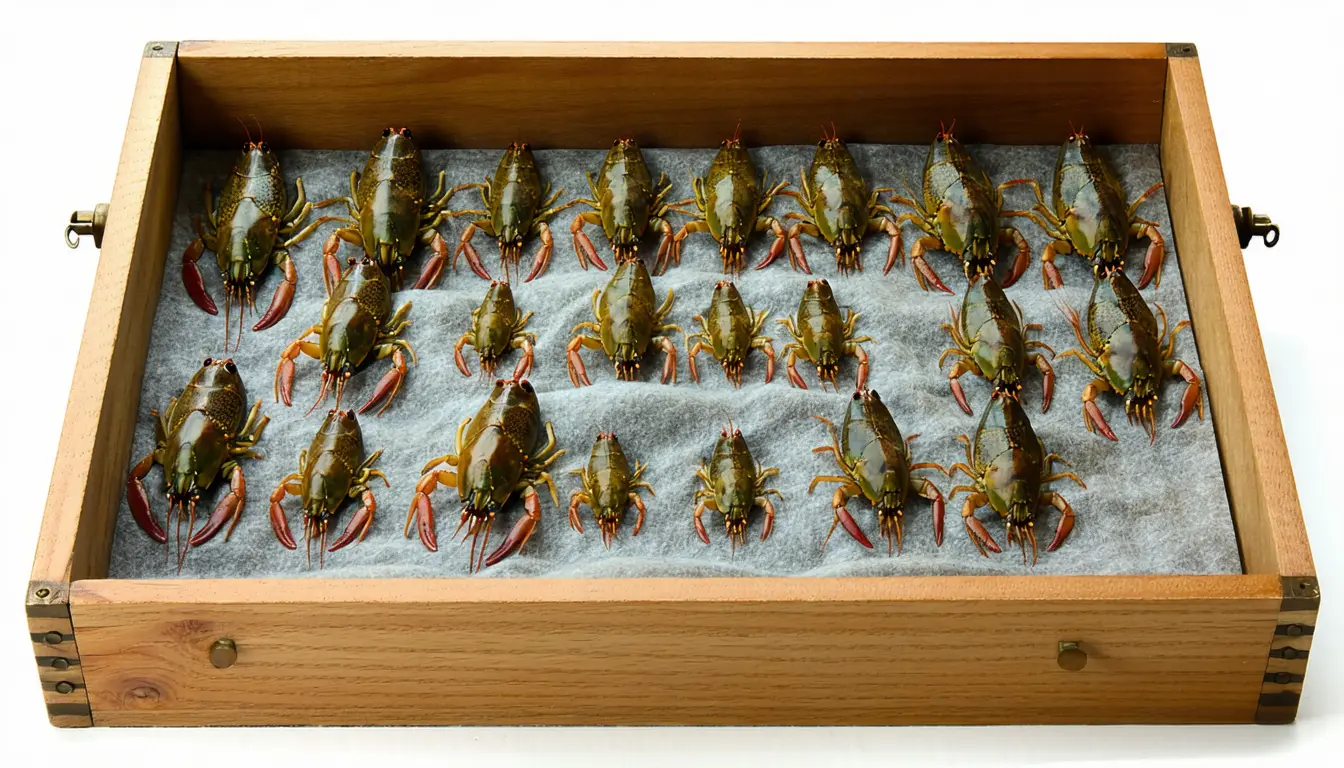
Twenty museum specimens put North America's crayfish size ceiling near 80 mm
Biologists with calipers went through museum drawers to compile some of the first upper size thresholds for the group. None of the environmental variables the team tested predicted which animals got big.
The Scientist · Science desk
What happened
- Caitlin Bloomer of the University of Illinois Urbana-Champaign pulled a crayfish called the Crawzilla crawdad out of the muck during a Kentucky survey and was convinced it was the largest ever recorded.
- She then recruited biologists and museum curators around the country to measure their biggest specimens with calipers, and the resulting ranking of 20 individuals across 18 species was published in Ecology.
- Zackary Graham, the West Liberty biologist who keeps the collection, said he had not known his drawers held the two largest specimens recorded from North America.
- Across the 20 animals, latitude, oxygen availability and habitat type showed no relationship with how large a species or individual grew.
Compiled by The ScientistSomething wrong?How this is made
Why it matters
- capability A claimed record can now be checked against a measured list instead of a colleague's memory, because upper size thresholds for the group exist in print for the first time.
- constraint The environmental tests came up empty, so the physiological explanation the authors prefer needs live animals and lab work that a drawer of preserved specimens cannot supply.
- decision The cost of answering a basic descriptive question about a familiar animal fell on institutions that pay to keep and curate old specimens, not on new fieldwork.
A record specimen in a museum drawer is the largest animal somebody collected and kept, which is not the same quantity as the largest animal alive. The geography of the top 20 shows why that distinction matters here. Ten of the 20 came from two institutions, six from the Illinois Natural History Survey and four from the Smithsonian Institution's National Museum of Natural History [7][16]. A list of maxima cannot separate where the big animals are from where the collecting was hardest.
The specimens bunched up near the same figure. "They all seemed to max out around that 80-millimeter (3.1-inch) mark, but we weren't sure why," Bloomer said [8]. The Tennessee record sits about 8 percent above that mark [17].
The null result on environment is what pushes the interpretation toward physiology. Bloomer's group checked latitude, oxygen availability and habitat type against size and saw no patterns [9]. It rests on 20 individuals drawn from 18 species, so at most two species appear on the list more than once [3][18]. A sample that size will pick up a strong environmental correlate and miss a weak one, and the alternative explanation the team favours, exoskeleton composition or musculature, has not been tested [10]. "We think that it could really be worthwhile to look at the physiology of crayfish to see if something there is influencing their body size," Bloomer said [11].
The record animal has a provenance. Zackary Graham, assistant professor of biology at West Liberty University, said the collection's "record-holder, a Tennessee bottlebrush crayfish collected by Dr. Zac Loughman and West Liberty students back in 2011, shows just how amazing and diverse crayfish can be" [5]. On its scale he was more concrete: "Its carapace alone is about the length of a credit card, and with the tail and claws, it stretches nearly the width of a sheet of notebook paper" [6].
Bloomer's Kentucky animal did not win. "Mine was not the biggest, but it did make the top 20, so I'm super proud of it," she said, and it was the only burrowing crayfish on the list [13]. She said the team could address the question only by mining museum collections [12]. The paper is "North American crayfish: A quest for the biggest catch", in Ecology [15].
What to watch
- Whether the full Ecology paper reports how the latitude, oxygen and habitat tests were specified and at what sample size.
- Whether anyone designs a physiology experiment on exoskeleton composition or muscle to test the proposed internal size ceiling.
- Whether another collection, now measuring against a published threshold, turns up a carapace longer than 86.6 mm.