Invest1 publisher2 min readPublished
Korea and ASEAN aim their FTA rewrite at origin checks and critical minerals
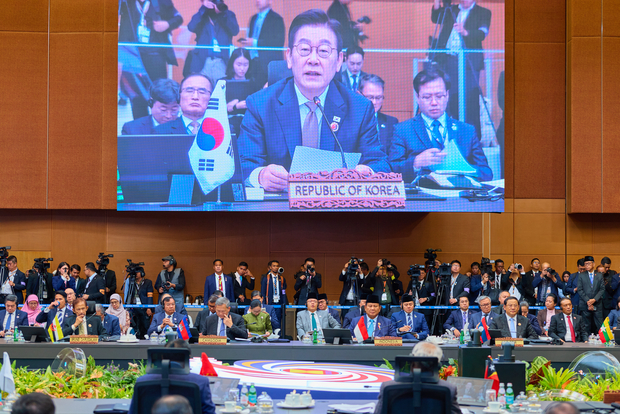
Korea and ASEAN open a second round in Singapore to rewrite their 2007 goods-only FTA across 13 working groups. Companies sourcing through Southeast Asia should expect revised origin checks and minerals rules to arrive before any tariff cut.
The Investor · Invest desk
What happened
- Park Keun-oh of the trade ministry leads Korea's delegation and Alpana Roy of Singapore's Ministry of Trade and Industry leads ASEAN's, with talks running through October 1.
- The goods-focused agreement took effect in 2007, and the two sides held their first round of upgrade talks in June.
- Trade Minister Kim Jung-kwan signed a cooperation initiative with Mexican Economy Minister Marcelo Ebrard on September 24, setting up a joint committee on minerals and the business environment.
- Korea and Mexico agreed to a joint benefits study of the potential gains and ripple effects of a trade agreement.
Compiled by The InvestorSomething wrong?How this is made
Why it matters
- cost Sourcing teams on the Korea-ASEAN lane bear the first cost of the upgrade in compliance work, because a revised origin-verification procedure touches every preferential claim while the published agenda sets no tariff cut against it.
- decision A Korea-ASEAN rulebook above the RCEP standard would give exporters two overlapping agreements with different requirements on the same lane, so they will have to pick which one to claim under.
- exposure Korean manufacturers in Mexico stay exposed to Mexico's higher tariffs on non-FTA countries for the length of a benefits study plus any negotiation that follows it.
- contradiction The ministry calls the Mexico outcome a launch of trade agreement talks, yet the only concrete commitment is a joint benefits study, a step that comes before any negotiation.
The ministry named four subject areas for the 13 groups: critical minerals and supply chains, digital trade, intellectual property rights and rules-of-origin verification procedures [4]. That leaves roughly nine groups the announcement did not describe [2], and it does not mention tariff cuts. The stated aim is a set of trade rules at a higher standard than the Regional Comprehensive Economic Partnership, which Korea and ASEAN both already belong to [5].
"Through these negotiations, we will do our utmost to reflect the latest rules that match a changing trade environment, including digital trade, and to strengthen supply chain cooperation in areas such as critical minerals, so as to build an institutional foundation that allows our companies to expand new business opportunities in the ASEAN market," said Park Keun-oh, director general for trade agreement policy at the ministry [6].
For a company moving parts between Korea and Southeast Asia, origin verification is the group to read first. A change to verification procedure reaches every shipment that claims the agreement's preferential rate, whether or not any duty moves. The second round runs from September 28, about three months after the first [1][4].
Should the undescribed groups include goods market access, duty changes would arrive alongside the new rules. The rules chapters might instead close first, leaving exporters with a revised verification procedure attached to the preferential rates they already claim. Slow talks would leave companies on the 2007 agreement and RCEP as they stand [3]. I think the second outcome is the likeliest on what the ministry has published, since origin verification is on the named list and market access is not [4]. A post-round statement listing a tariff or market-access group among the 13 would prove that wrong.
Mexico is further back. Kim Jung-kwan told Mexican Economy Minister Marcelo Ebrard that Mexico's recent tariff increases on countries without free trade agreements have hurt Korean companies and reduced incentives for additional investment in Mexico, according to the ministry [8]. Korean firms are selling into the market anyway. At a Korean Products Exhibition run by the ministry and KOTRA in Mexico City, 59 Korean companies, or 82 counting online participants, held 730 business meetings with 123 buyers [11]. That is about six meetings per buyer [3].
Investment is moving on memorandums for now. HS Hyosung Advanced Materials signed an MOU with the Mexican state of San Luis Potosi on investment in a production base for industrial products, one of four signed at a business forum attended by about 300 business leaders [12].
What to watch
- A post-round statement from Seoul or Singapore naming the remaining working groups, in particular any covering goods market access or tariff schedules.
- Draft language from the rules-of-origin verification group showing who must hold origin documents, for how long, and who can be audited.
- Findings of the Korea-Mexico joint benefits study and a date for a first formal negotiating round.