Dyna chief scientist says its models folded restaurant napkins at 99.4% success over 24 hours
Dyna Robotics says its Dyna-2.1 robot agent folded restaurant napkins at a 99.4% success rate for 24 straight hours. The figure comes from a podcast's summary of a conference talk, with no napkin count or definition of success attached.
The Engineer · Build desk
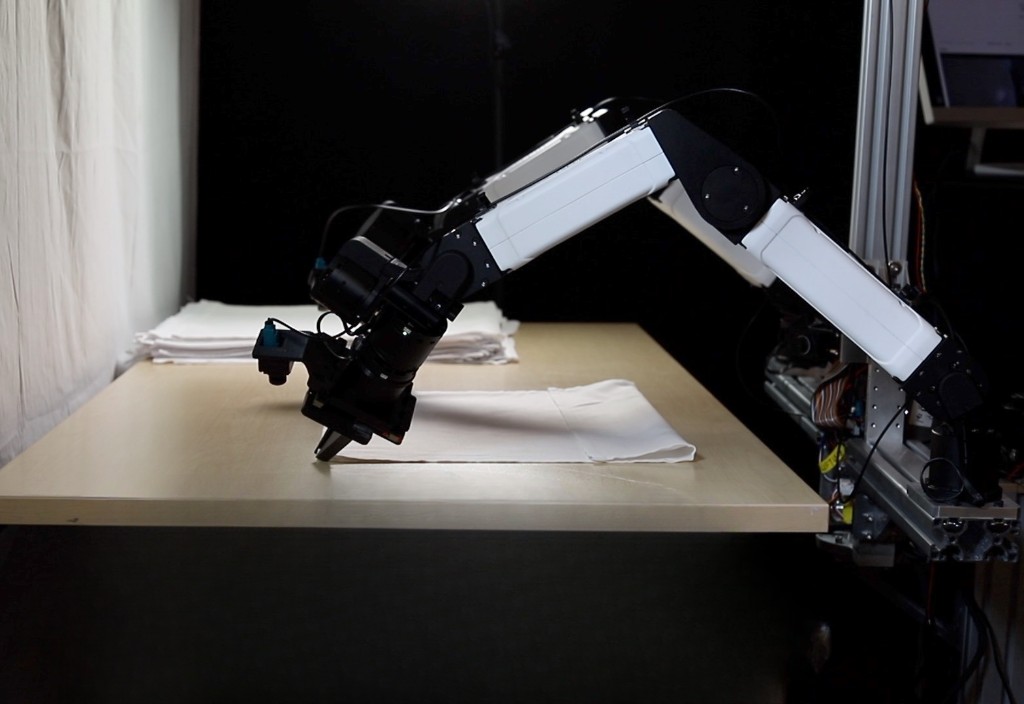
Three figures: a 99.4% success rate folding restaurant napkins, per Latent Space's summary of the talk; a 24-hour run that included recovering after the robot pulled over the whole stack; and 6 failures per 1,000 napkins implied by that rate.
| Figure | Value | Note | Claim |
|---|---|---|---|
| Napkin-folding success rate, per talk summary | 99.4% | 12 | |
| Hours in the folding run | 24 hours | 13 | |
| Implied failures | 6 per 1,000 | 11 |
What happened
- According to the summary of Jason Ma's talk, the 24-hour run included the robot recovering after it pulled over the whole stack.
- Dyna-2.1 is a physical robot agent that follows Dyna-2, a world-action model pre-trained on one million hours of human video.
- The episode description says robots can learn new tasks from as little as 45 minutes of demonstrations.
Why it matters
- constraint Without a napkin count or a failure definition, a buyer cannot turn 99.4% into interventions per shift, and six failures per 1,000 is the only conversion the page allows.
- contradiction The page's blurb says Dyna is pushing physical AI beyond impressive demos into production, but the evidence it offers for Dyna-2.1 is a demo and a summary of a talk.
- constraint The result belongs to Dyna's own wheeled semi-humanoid hardware and models, so it does not extend to anyone buying off-the-shelf humanoids.
A success rate is a ratio, and the page reports one side of it. At 99.4% the failure rate is 0.6% [10], or six failed folds in every 1,000 napkins [11]. Latent Space's summary of the talk does not say how many napkins the 24-hour run covered, what counted as a failure, or whether a person ever reset the table.
The one operational detail is the recovery. According to the summary, the run included the robot recovering after it pulled over the whole stack [13]. If that recovery counts inside the 24 hours, the test is harder than a clean repeat loop. The episode's topic list ties agentic harnesses to multi-step, hour-long physical workflows [7]. Which layer produced this particular recovery is open.
The 99.4% figure and the Din Tai Fung deployment sit in different sentences on the page. The figure belongs to a 24-hour run [12]. The restaurant is where Dyna's robots fold thousands of napkins daily [14]. If the same rate held there, every 1,000 napkins would still include about six failures [11].
Latent Space wrote that Dyna-2.1 "has to be seen to be believed" [6]. The evidence on offer is that demo and the account of co-founder and Chief Scientist Jason Ma [8].
Ma frames the real challenge in robotics as reliable, long-horizon autonomy, per the page's summary of his AIE talk [3]. A 24-hour run on one task is a test of that. It cannot be read as a measure across tasks, and one company's own figure from one task can only speak for Dyna-2.1. In our view the Din Tai Fung deployment is the better test, because it accumulates failures over weeks instead of hours.
Dyna names its own open problems on the same page: dexterous hands still overheat, and missing sensory data remain major bottlenecks [5].
What to watch
- A failure definition and napkin count for the 24-hour run, from Dyna or from the AIE talk recording.
- A production figure from Din Tai Fung, such as human interventions per shift, measured over weeks.
- Whether Dyna reports a comparable success rate on a task other than napkin folding.
Clarity's read
What the record supports and how the coverage leans. The claims behind it follow.
Reality
- Evidence30
- Adoption35
- Hype gap+30
- Incentives70
- Confidence45
Claim ledger
Ranked by verification strength, evidence, and original report placement.
- [1]
Dyna-2 is a world-action model pre-trained on one million hours of human video.
- [2]
Dyna followed Dyna-2 with a physical robot agent, Dyna-2.1.
- [3]
In his AIE talk, Jason Ma said the real challenge for robotics in the real world is reliable, long-horizon autonomy, according to the page's summary.
- [4]
Dyna builds its own hardware instead of relying on off-the-shelf humanoids, and chose wheeled semi-humanoids over traditional bipedal robots.
- [5]
Dexterous hands and missing sensory data remain major bottlenecks, and dexterous robot hands still overheat.
- [6]
Latent Space wrote that Dyna-2.1 'has to be seen to be believed'.
- [7]
The episode's topic list covers agentic harnesses and robots executing multi-step, hour-long physical workflows.
- [8]
Jason Ma is co-founder and Chief Scientist of Dyna Robotics.
- [9]
The page's blurb says Dyna Robotics is 'pushing physical AI beyond impressive demos and into real-world production'.
- [10]
A 99.4% success rate implies a 0.6% failure rate.
- [11]
A 0.6% failure rate is six failures per 1,000 napkins.
- [12]
Dyna got its models to a 99.4% success rate folding restaurant napkins for 24 hours straight.
- [13]
The 24-hour napkin-folding run included recovering after the robot pulled over the whole stack.
- [14]
Dyna's robots fold thousands of napkins daily at Din Tai Fung.
- [15]
Jason Ma explains in the episode how robots can learn new tasks from as little as 45 minutes of demonstrations.
Sources
1 independent publisher whose own reporting we read for this story.
- latent.spaceDyna-2: General Purpose Physical Agents with Hour-Long Autonomy — Jason Ma, Dyna Robotics
1 article · October 13, 2026
Topics and entities
Follow any of these and your For You feed starts watching them — no settings page required.
Entities
- Latent SpaceFollow
- Jason MaFollow
- Dyna RoboticsFollow
- Dyna-2Follow