Science1 publisherNot yet confirmed elsewhere2 min readPublished
SpaceX cargo resupply mission carries test of building artificial retinas in orbit
NASA and SpaceX are targeting no earlier than Oct. 13 to fly more than 6,300 pounds of cargo to the space station on a Dragon capsule. On board are experiments testing whether microgravity builds better artificial retinas and heart tissue models.
The Scientist · Science desk
What happened
- After a Falcon 9 launch from Cape Canaveral, Dragon will dock autonomously to the space-facing port of the station's Harmony module.
- The cargo includes the final pair of roll-out solar arrays, completing a power upgrade NASA says supports the station's safe and controlled deorbit.
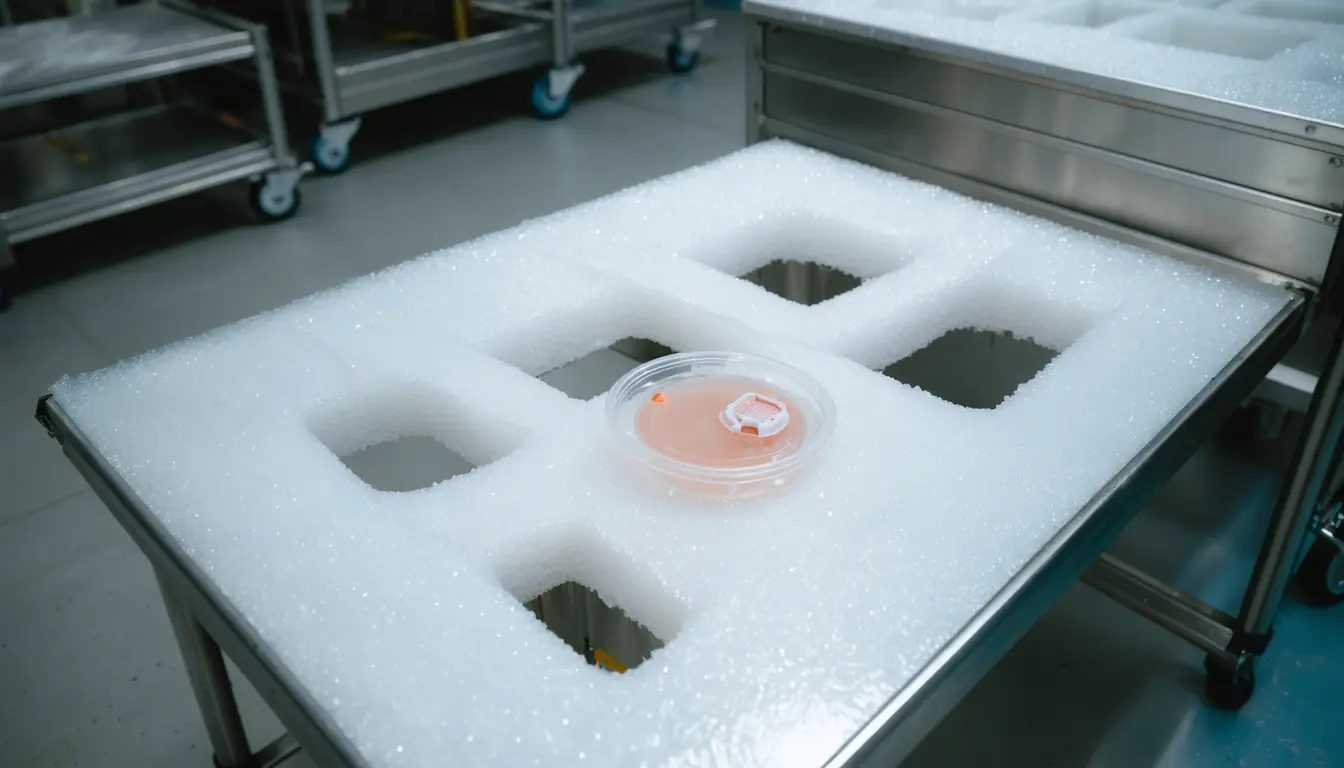
- A large foam clamshell flies up empty to bring home the Canadarm2 joint that failed and was replaced during a June 30 spacewalk.
- Dragon will stay docked about a month, then splash down in the Pacific in mid-November with science and hardware for teams on Earth.
Compiled by The ScientistSomething wrong?How this is made
Why it matters
- constraint Teams whose results depend on ground analysis, such as the glass group with its solid samples, cannot start that work until Dragon splashes down.
- constraint A strong LambdaVision-1 result would be evidence about layer quality; it would still have to be shown that better layers restore more vision in patients.
- capability Because each MINDS organoid pools cells from several donors, a microgravity effect seen there is less likely to reflect one person's cells alone.
Settling is the variable LambdaVision-1 is built around. NASA is testing how to manufacture artificial retinas in microgravity, building them one thin layer at a time [4]. Its premise is that reduced settling in microgravity may produce more uniform, stable layers, potentially improving the implants' performance [18]. That is a physical claim, and measuring the layers can test it. NASA says the retinas could help restore vision for patients with currently incurable retinal diseases [19].
The thing the overview doesn't tell you is what the orbital layers will be compared against. It does not describe ground controls or sample numbers for any of the experiments it highlights. Before crediting microgravity with any gain in uniformity, I'd want to see the same layer stack built on Earth and measured the same way.
Stellar Spheroids asks a parallel question of living tissue. Researchers will assess whether microgravity improves the formation of advanced vascular networks in 3D human heart tissue models [5]. NASA says a positive answer could lead to more realistic heart models for disease research and support larger-scale drug testing on future missions [6].
MINDS has the design I like best. It grows brain organoids to study inflammation linked to neurodegenerative disease [7], and it grows them as "organoid villages" that combine cells from multiple people [16]. NASA says the point of pooling the cells is to better represent patient diversity [16]. The diseases it names as places to look for new treatment targets are Alzheimer's, Parkinson's and multiple sclerosis [8].
ELF-Unconventional Glass 2 does half its work in orbit and half in the lab. Researchers will watch molten glass made from non-traditional elements behave in space, then return the solid samples to Earth for detailed analysis [9]. The gains NASA hopes for are higher strength, better optical properties and more durability for spacecraft and habitats [10].
Most of the rest of the manifest is maintenance. NASA astronauts Anil Menon and Jessica Watkins will monitor Dragon's arrival [15]. A collapsible urinal flies as a demonstration and test unit for NASA's Artemis III mission [17]. Also coming home are a spacesuit due to be refurbished on the ground, the urine processor's pump assembly for controlling fluid and pressure, and a filtration unit that serves the water processor assembly [13].
What to watch
- Whether the no-earlier-than Oct. 13 launch date holds, since Dragon's return and the start of each team's sample analysis depend on it.
- Published comparisons of LambdaVision-1's orbit-built layers against retinas built on the ground.
- Findings from the ground analysis of the failed Canadarm2 joint.