Science1 publisherNot yet confirmed elsewhere3 min readPublished
Teeth from Cretaceous shorelines hold a carbon signal pointing to food from the sea
Clayton Forster's University of Arkansas team found higher carbon-13 ratios in coastal than inland Cretaceous teeth up to 113 million years old. If the team's seaweed explanation holds, storm-fed coastal food webs already existed in the greenhouse Cretaceous.
The Scientist · Science desk
Drafted by a language model from the sources cited here and checked against its claim ledger before publication. How we use AISend a correction
What happened
- The coastal fossils came from former shores of the Western Interior Seaway, which split North America around 100 million years ago, and the ancient Gulf of Mexico, with landlocked sites as the comparison.
- The samples date to two windows: the early Albian, about 113 to 107 million years ago, and the early Cenomanian, about 100 to 96 million years ago.
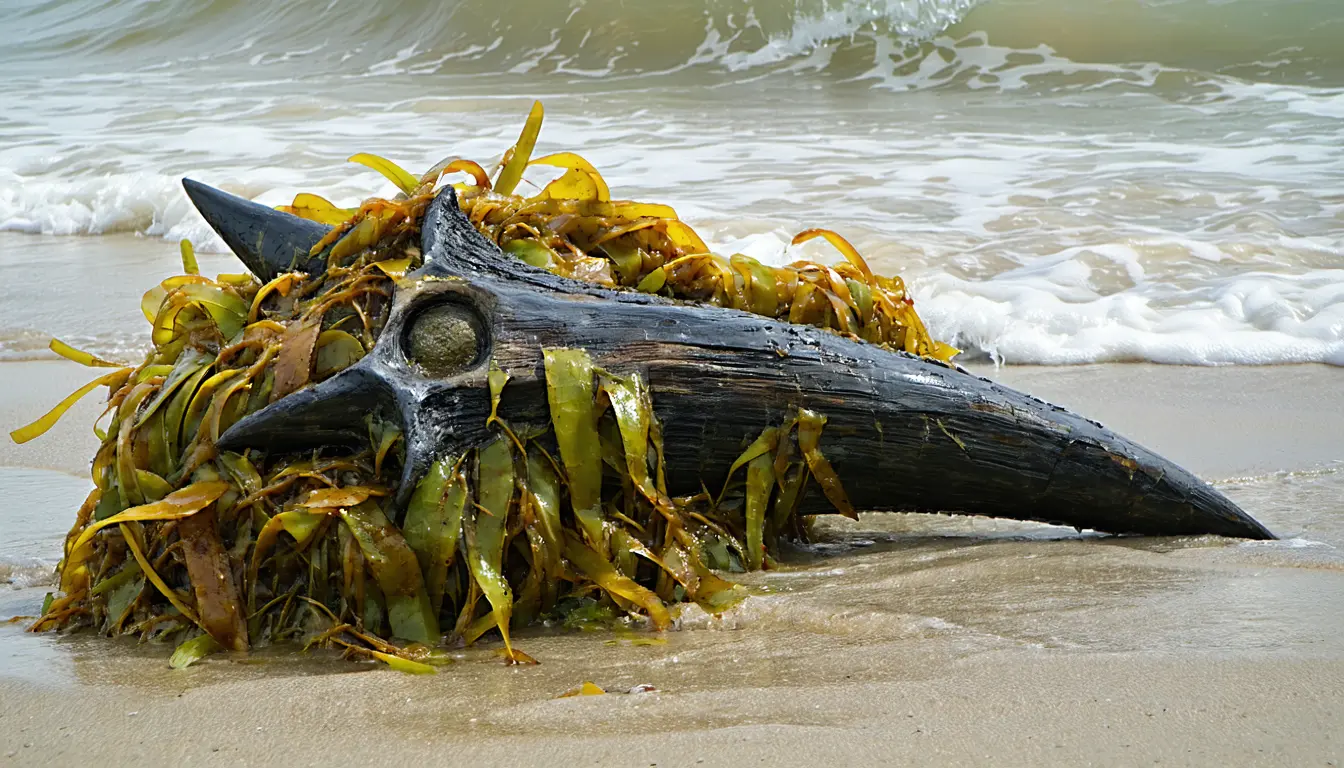
- Forster names marine macroalgae or macrophytes, meaning seaweeds, as the only likely candidates for the extra carbon source.
Compiled by The ScientistSomething wrong?How this is made
Why it matters
- decision Researchers who use dinosaur enamel carbon to reconstruct diet now have to check how close an animal lived to the sea before reading its values as a pure land-plant signal.
- constraint Until polar and equatorial Cretaceous coasts are sampled, the result cannot say whether marine subsidy was a global pattern or a feature of these North American shores.
- precedent Other paleoecologists can reuse the design, coastal and inland beds plus a control species, to look for marine subsidy in Jurassic and early Cenozoic rocks.
The puzzle starts in the enamel. When an animal eats, the carbon-13 ratio of its food, written delta-13C, passes into its tooth enamel at a higher value [4]. In living animals the step is 11 to 13 parts per thousand [4]. Dinosaur teeth have consistently shown a larger step, with values above what a diet of land plants alone should give [5]. Land plants run lower in delta-13C than most marine plants, so marine matter somewhere in the diet could explain the excess [5].
The study's control is geography. Clayton Forster, a University of Arkansas geologist, and colleagues measured enamel from coastal and inland sites and reported the results in Frontiers in Ecology and Evolution [1][6]. Coastal fossils ran higher than those from the landlocked formation, and the coastal values agreed with one another regardless of latitude or age [8]. The two sampling windows sit about 12 million years apart at their midpoints [15].
Agreement across latitudes and across that span makes one unusual site an unlikely cause. It does not rule out changes to the enamel after the animals died. For that, the authors point to Tenontosaurus tilletti, a large plant-eater known from many Cretaceous localities, whose values looked like those of living land-plant eaters [13]. If burial chemistry had raised every tooth, it should have raised that one too. The check holds only if those teeth came from the same coastal beds as the high readings. The published account does not say where they were collected, how many teeth were sampled per species, or how large the coastal offset was.
Forster reads the spread of the signal as a clue to its source. "This pattern is shared from fish to megaherbivores and indicates that the extra carbon source must have been low in the food chain to affect both aquatic and terrestrial animals," he said [9]. That source also had to live on coasts but not inland, and stay available for millions of years [10]. Seaweed fits [11]. The identification is by elimination, since enamel records a carbon ratio and not the organism that supplied it. Forster adds an analogy to modern shores: "Given the almost ubiquitous behavior of large coastal herbivores today to supplement their diet with seaweeds, it's likely that most of the sampled herbivorous dinosaurs were no different," he said [12].
In my view the coastal-inland contrast is the firm result, and seaweed is a reasonable leading explanation for it. "We show that coastal terrestrial organisms in the greenhouse climates of the Cretaceous relied on marine resources to supplement their diets in a similar way that modern organisms do," Forster said [3]. On today's coasts, storms wash marine material ashore that feeds land animals, and the supply matters most when land food runs short, as in droughts [2]. According to phys.org, the study is the first to identify that kind of marine subsidy in a prehistoric ecosystem [16]. The authors note that their samples exclude polar and equatorial latitudes for both windows, and they name the Jurassic and the early Cenozoic as periods still to test [14].
What to watch
- Isotope data from polar or equatorial Cretaceous coasts, which would show whether the coastal carbon excess holds outside these North American sites.
- Coastal-versus-inland comparisons from the Jurassic or early Cenozoic, the periods the authors name as the next tests.
- Published offset sizes and per-species sample counts, which would indicate how large a share of the diet the marine carbon could represent.