Product2 publishersIndependently confirmed3 min readPublished
Cisco builds Webex agents that keep working after the customer hangs up
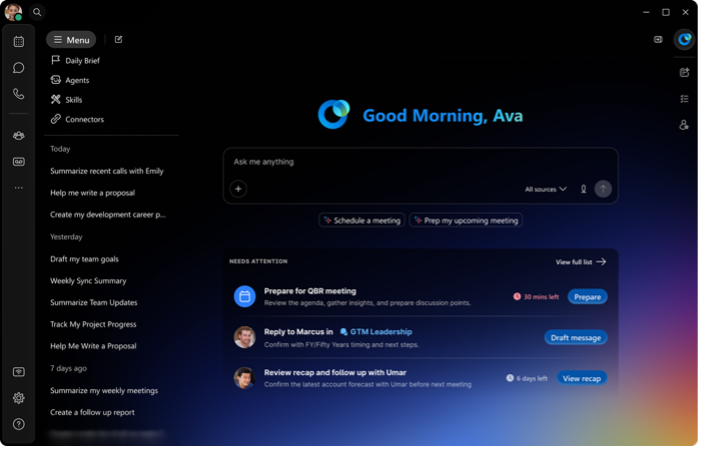
Cisco is putting AI agents into Webex, including a Dialog layer that keeps customer-service agents working on a request after the conversation ends. Most of it arrives in early 2027, SiliconANGLE reported, so buyers signing next year will be judging features with no track record.
The Product Desk
What happened
- Cisco expects Dialog, its harness for customer-service agents, to reach beta in the first quarter of 2027.
- Cisco plans to bring Anthropic's Claude into Webex through Claude Managed Agents and to connect OpenAI's Dots agents to Webex data over Model Context Protocol.
- New personal agents can answer when a user is busy, judge the caller's request and urgency, then schedule a follow-up or send a message.
- Cisco's AI Agent 360 control plane is adding Splunk-based observability, with general availability planned for December.
- Engadget cited Carnegie Mellon research finding the best-performing agent, then Gemini 2.5 Pro, failed real-world office tasks 70 percent of the time.
Compiled by The Product DeskSomething wrong?How this is made
Why it matters
- decision Buyers renewing collaboration contracts in 2027 will be choosing before the agent features have run in production, so the agent layer belongs in a priced pilot with an exit, kept apart from the meeting and calling commitment.
- exposure An agent that keeps working after the customer hangs up changes backend records with no person on the line, and the contact-center owner answers for those changes.
- precedent With Claude and Dots planned inside Webex and Dialog built to run third-party agents, buyers can expect to pick an agent vendor and a meeting platform as two separate decisions.
Engadget's picture of the new Webex is a presenter in the middle of a pitch who asks an agent to pull up statistics and update the PowerPoint on the fly [3]. Engadget wrote that this "could be extremely useful, assuming it works" [3].
Cisco's larger claim is about the work that happens after the customer hangs up. Dialog is a layer beneath the Webex AI Agent platform that ties a customer's history to enterprise systems, knowledge and policies, SiliconANGLE reported [4]. An agent running on it coordinates with employees, other agents and backend systems until the request is resolved, and it keeps its context across channels [4]. "We are moving away from a world where we build agents to where we train and onboard agents like digital co-workers," said Vinod Muthukrishnan, who leads Webex customer experience operations [11]. Cisco says teams will not have to build individual conversation flows, and that Dialog will run third-party agents alongside Cisco's own [5].
Cisco's executives talk about the agents in the present tense. "Agents are entering the workforce at an unprecedented pace, both to help you and operating by themselves," said Snorre Kjesbu, Cisco's senior vice president and general manager of collaboration [15]. Most of the new features and products are planned for early 2027 [9]. What a contact center can run now is narrower. Webex AI Agent is generally available for Unified Contact Center Enterprise, with voice support for Contact Center Express planned this month [14]. Neither report includes pricing.
The only measured performance in either source comes from outside Cisco. Engadget, citing multiple studies, put agent failure rates on multi-step tasks at 60 to 70 percent [18]. It also noted that an agent with 95 percent reliability per step completes a 20-step workflow about 36 percent of the time [17]. That is 0.95 multiplied by itself 20 times, or 0.358 [20]. At 99 percent per step, the same 20-step job still fails about 18 percent of the time [21]. Cisco says Dialog "continuously refines agent performance with every interaction" [8]. Engadget answered that "that's kind of the promise with all AI agents" [19].
Cisco's executives say the oversight job grows with the scope. "We are talking about securing, observing and governing an entire execution chain that starts with the conversation and goes well into the enterprise," Muthukrishnan said [12]. The AI Agent 360 control plane is meant to connect agent behavior to escalation patterns and business impact [6]. A count of agent sessions would only measure activity. For a pilot, I'd ask for two figures: the share of post-call runs that closed with no human involved, and how long escalated customers waited.
For a 2027 platform decision, I'd sort each candidate task by two things: how many steps it takes, and whether a person can cheaply undo a wrong one. Rebooking a callback is short and easy to reverse, so it can run after the call with sampled review. A long but reversible task belongs in the Dialog beta, with every escalation logged. Refunds and account changes are short and hard to undo; the agent drafts and a human approves. Anything long and hard to undo stays with a person through 2027. I'd sign the meeting and calling platform on what is generally available today and buy the agent layer as a separate pilot. The cost of that caution is a mid-contract renegotiation if Dialog leaves beta and its resolution rates hold up.
What to watch
- Whether Dialog reaches beta on its first-quarter 2027 schedule, and what Cisco charges for it once it does.
- Resolution and escalation figures from early AI Agent 360 deployments after its planned December release.
- Whether the Claude Managed Agents and Dots integrations ship with the early-2027 wave or slip later.