Product1 publisher3 min readPublished
China's EV price war has left home: one car exported for every two sold domestically
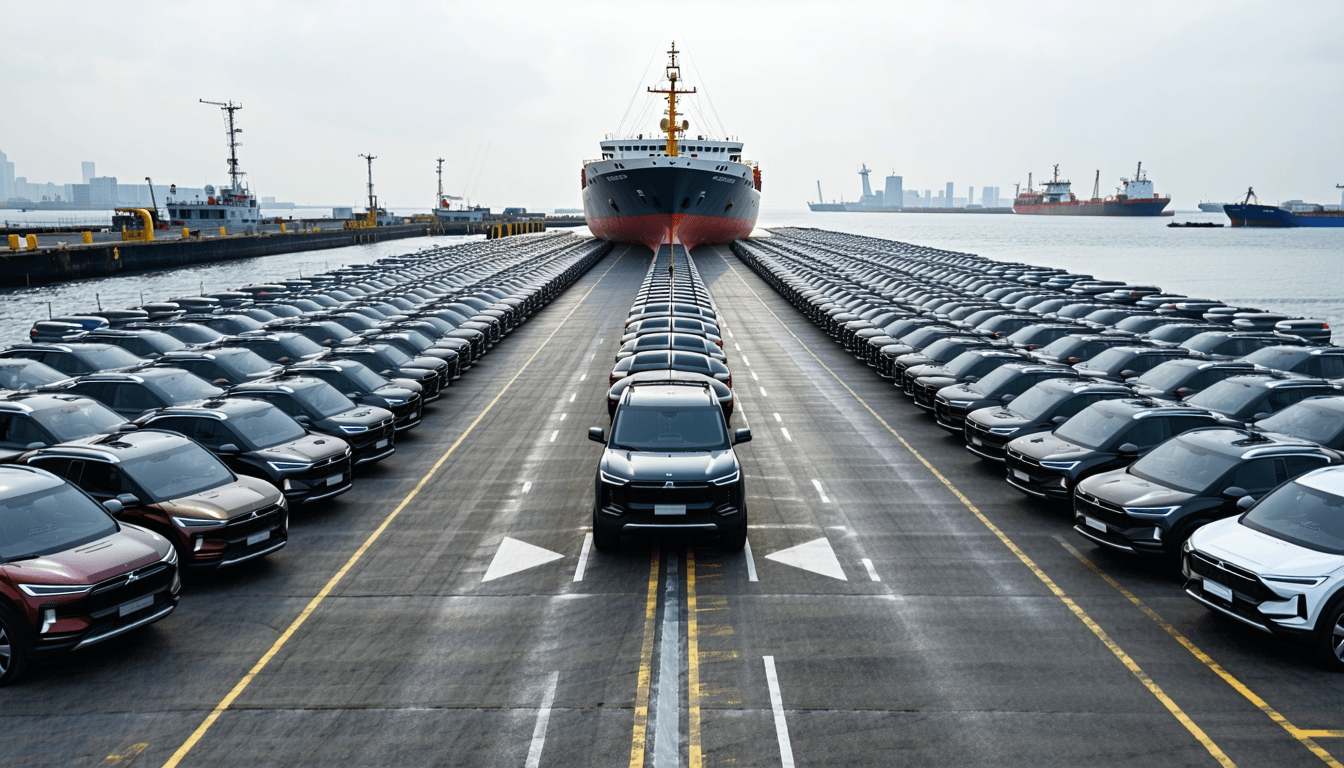
Exports hit a record 540,000 EVs in July against 980,000 domestic sales, up from a one-in-five ratio a year ago. Over a million shipped cars are still sitting unsold.
The Product Desk · Product desk
Drafted by a language model from the sources cited here and checked against its claim ledger before publication. How we use AISend a correction
What happened
- Some 540,000 EVs left China in July, a monthly record, while about 980,000 were sold at home, according to a report from Benchmark Mineral Intelligence, a London-based research firm.
- That worked out to one EV exported for every two sold domestically, compared with one for every five last July.
- The price war that has played out inside China for two years is following the cars overseas, and Chinese EV makers have found buyers in Brazil, Thailand and the Gulf.
- Sales inside China fell 12% in the first seven months of 2026, and the International Energy Agency expects the market to end flat this year for the first time this decade.
- Tesla's Shanghai plant sold 238,955 cars inside China in the first half of this year and shipped out 228,994, according to China Passenger Car Association figures published on August 4.
Compiled by The Product DeskSomething wrong?How this is made
Why it matters
Chinese carmakers shipped about 540,000 EVs out of the country in July, a monthly record, while selling roughly 980,000 at home, according to a report from the London-based research firm Benchmark Mineral Intelligence [1]. That is one car exported for every two sold domestically, against one in five last July [2], and it converts a two-year domestic discounting war into a pricing problem for dealers in Brazil, Thailand and the Gulf [15].
The domestic arithmetic explains the urgency. Sales inside China fell 12% over the first seven months of 2026, and the International Energy Agency expects the market to finish the year flat for the first time this decade [7]. Even Tesla is using its Shanghai plant as an export base: it sold 238,955 cars in China in the first half and shipped out 228,994, per China Passenger Car Association figures published on August 4 [3], meaning outbound volume ran at about 96% of its domestic sales [9].
The totals are large. China's customs administration recorded 2.4 million pure-battery and plug-in hybrid exports in the first half of 2026, more than double a year earlier [8]. EV sales outside China, Europe and North America nearly doubled to 1.7 million units in the first seven months, with Chinese brands supplying half, up from a quarter in 2023 [4] - roughly 850,000 vehicles [10]. George Whitcombe, senior EV analyst at Benchmark, told Rest of World he expects significantly more EVs to be sold in that rest-of-world region this year than in North America [16].
Because the cars are too cheap to exclude outright, importing governments are writing terms instead [5]. In Thailand, where the top five brands are all Chinese, carmakers that took government subsidies must build two cars locally for every one they import, rising to three next year [11]. Brazil, in a region where Chinese brands account for almost 90% of EV sales, has raised its EV import tax to the level gasoline cars pay, according to Whitcombe [12]. Canada moved the other way in March, cutting a 100% tax to 6.1% and admitting 49,000 cars a year [13]. Gulf states have attached no conditions, with low barriers and growing appetite for Chinese technology, according to Bill Russo of the Shanghai advisory firm Automobility [17].
The inventory picture is the part operators should read closely. More than a million EVs shipped from China in the past 18 months have not been sold, and only about two-thirds of this year's exports have reached a buyer, according to the IEA [6] - implying roughly 800,000 unsold units from the first half alone [14]. "Excess inventory means discounting, incentives, and pressure on residual values as distributors clear stock," Russo said, adding that China can export vehicles faster than overseas retail networks can absorb them [18]. Lei Xing, founder of the consultancy AutoXing, told Rest of World the move abroad is permanent rather than a reaction to one bad year, and that the internal price war is following the cars overseas [19]. Overcapacity is part of the surge but not all of it, he said [20].
Watch three things. Whether Thailand's local-build ratio at three-to-one next year holds, or gets waived under pressure [11]. Whether Canada's 49,000-unit allowance is filled early, which would show how quickly a low-tariff opening absorbs stock [13]. And whether the next phase is what Russo describes as localizing manufacturing, supply chains and technology overseas [21], because that is what would make the residual-value damage a local problem rather than a shipping one.