Product2 publishers3 min readPublished
Type One Energy says $200M gets it halfway to paying for a 400 MW fusion plant at TVA's Bull Run
Type One Energy's CEO says its new $200 million Series B gets the company halfway to paying for a 400 MW fusion plant at TVA's Bull Run. Grid planners and large power buyers now have a named utility site and a 2034 target to track.
The Product Desk · Product desk
Drafted by a language model from the sources cited here and checked against its claim ledger before publication. How we use AISend a correction
What happened
- Type One plans to design the plant and many of its parts itself, then hire a bespoke network of suppliers chosen for the project to build them.
- Infrastructure consultant AECOM is doing the engineering for Infinity Two, the commercial plant in Type One's Project Infinity.
- Competitor Commonwealth Fusion Systems has licensed its high-temperature superconducting magnet technology to Type One for its reactor design.
- Breakthrough Energy Ventures and Clutterbuck Capital led the round, with Lowercarbon Capital, Siemens Energy Ventures and SiteGround Capital also investing.
Compiled by The Product DeskSomething wrong?How this is made
Why it matters
- cost By Mowry's own forecast the plant needs one or more further rounds, so later investors will be asked to fund the rest of Infinity Two while it is still a design-stage project.
- exposure Because a competitor's licensed magnets form part of the reactor's backbone, Infinity Two's schedule depends in part on Type One's relationship with Commonwealth Fusion Systems.
- precedent If the supplier model holds at Bull Run, Type One says it can design several plants at once, and its UK consortium with Tokamak Energy, AECOM, Sheffield Forgemasters and Barclays would be the first repeat.
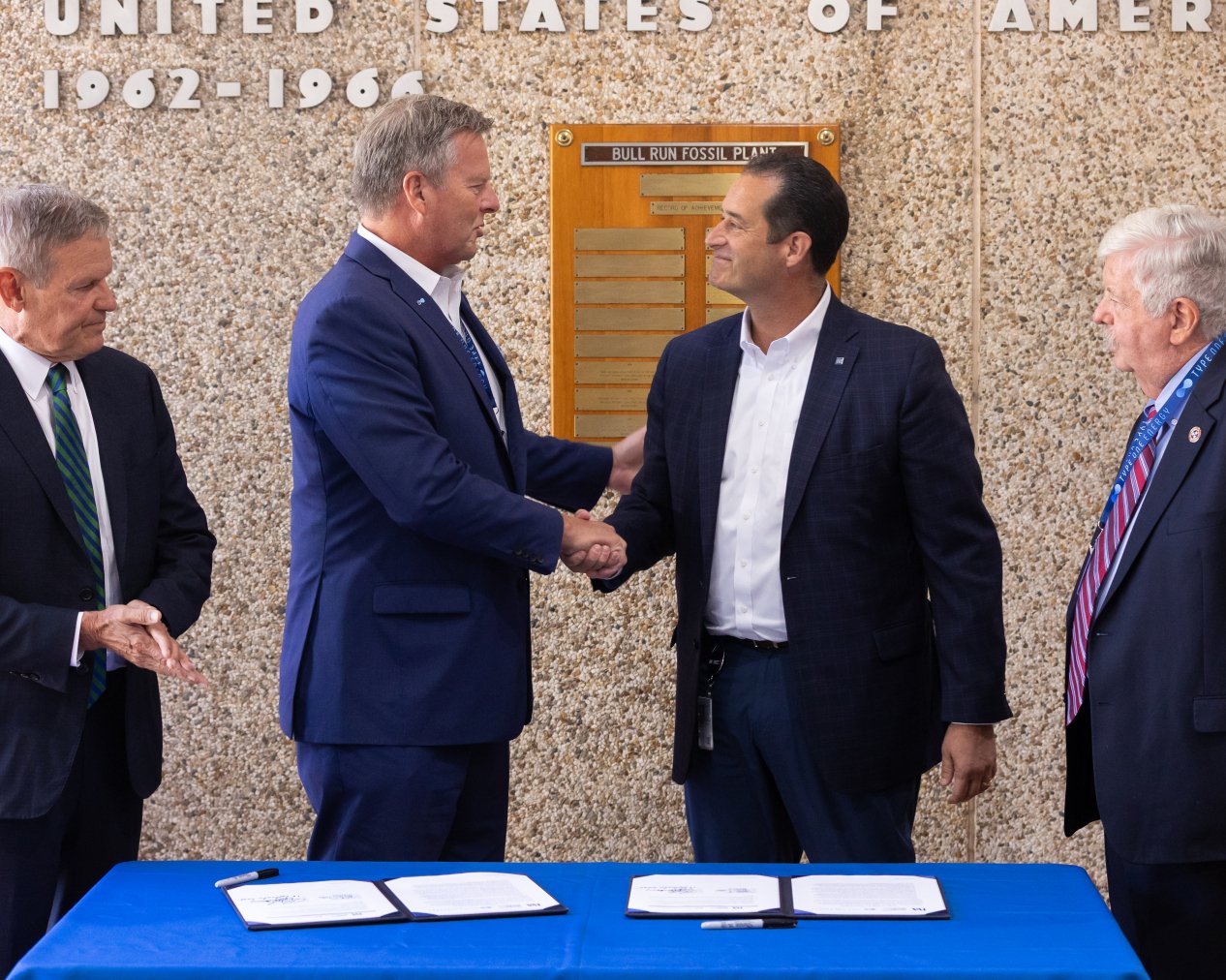
Picture the analyst at a utility, or at a company buying firm power for its data centers, who keeps a spreadsheet of plants that might exist in the 2030s. Each row has to be defended to a manager. For Type One Energy's row, the easiest part to defend is the site. The Knoxville company, founded in 2019, plans to build both of its first two fusion devices on the Tennessee Valley Authority's Bull Run land [1][2].
The pitch is the big number. By TVA's benchmark, 400 MW would power roughly 226,000 US homes, according to Interesting Engineering [6]. The work the money pays for comes earlier. Infinity One is an engineering prototype, meant to design and test the systems a commercial plant needs, and Infinity Two is the plant itself [3]. Chief executive Christofer Mowry described the round in those terms. "The Series B financing enables us to remain focused on advancing our stellarator technology and Project Infinity design activities, while working with experienced industrial partners to deliver the first commercial fusion power plant at TVA's Bull Run site," he said [7].
Type One says the hardest problems for stellarators are now engineering and large-scale deployment, not plasma physics [8]. Carmichael Roberts of Breakthrough Energy Ventures said fusion's main challenge is deploying the technology instead of making new scientific discoveries [9]. The design's record is short. Stellarators have been studied for decades and have yet to generate electricity on a commercial scale [10].
The supplier plan is how Mowry intends to make the money stretch. "The amount of capital that we need to raise to commercialize fusion at Type One is just a different order of magnitude than if you were going to be vertically integrated," he told TechCrunch [12]. "Why would I want to spend on bricks and mortar?" he said. "I used to run a big nuclear manufacturing company. That's expensive." [20] Of AECOM, he said: "They have 10,000 people, most of them are engineers of one kind. We're never going to have 10,000 people." [15]
TechCrunch spelled out the cost of that choice. An integrator has less control over suppliers than an in-house team, and Boeing ended up buying fuselage supplier Spirit AeroSystems after quality failures that included a door plug blowing out on an Alaska Airlines flight in 2024 [16]. Type One is betting the integration risk is lower than the risk of doing everything in-house [21]. "These business models are successful because they let companies focus on managing risk and developing a high level of competency in their slice of the value chain," Mowry said [17].
The "halfway" figure is hard to check. Mowry also told TechCrunch that if the plant comes online on schedule, Type One could finish it on less capital than many competitors, even with one or more further rounds [23]. With at least $82.5 million raised before this round, the company has now taken in at least $282.5 million [18][22]. Neither report includes a total cost for Infinity Two or a buyer for its power.
For the analyst with the spreadsheet, two tests sort a fusion row. The first is whether a named site has outside engineers working on it. The second is whether anyone has signed for the output, through an offtake contract or a grid connection request. A row that fails both is a watch item without a date. Passing the first test alone puts it in a scenario case with a target year. A buyer with no site is a hedge on the buyer's part. Both together earn a line in the capacity plan. On these two reports, Type One passes the first test only.
What to watch
- Any signed agreement for TVA or another buyer to take Infinity Two's power, the step that would move the project into a utility capacity plan.
- The further funding round or rounds Mowry expects, and whether a total budget for Infinity Two is disclosed alongside them.
- The Infinity One build at Bull Run, the first test of whether outside suppliers can deliver hardware to Type One's designs.