ScienceNot yet confirmed elsewhere1 publisher3 min readPublished
California regulators weigh a ban on engineered stone after 662 worker silicosis cases
California's workplace safety board is reviewing a ban on engineered stone, the countertop material tied to 662 confirmed silicosis cases among workers. If the board approves it in a decision expected in October, California would become the first US state to follow Australia's 2024 national ban.
The Scientist · Science desk
What happened
- The petition the California Occupational Safety and Health Standards Board advanced in May 2026 would bar fabricating or installing engineered stone above 1 percent crystalline silica.
- The state's surveillance dashboard counts 35 deaths among the confirmed cases, and 75 of the workers have had lung transplants.
- Workers are being diagnosed relatively young, with a median age at diagnosis of 46 among California cases.
Compiled by The ScientistSomething wrong?How this is made
Why it matters
- constraint Because the limit attaches to the material's silica content, a California shop could not keep cutting standard engineered stone by improving ventilation or wet cutting; it would have to stop handling the product.
- exposure If Michaels's estimate of thousands of cases nationwide holds, the undiagnosed disease sits in fabrication shops in other states, where clinicians and health departments are now being asked to look for it.
- contradiction Discover's Victoria figures disagree with themselves, 21.5 percent by the stated counts against 28.2 percent quoted, so the best prevalence figure in the account depends on which group was actually counted.
California began tracking engineered-stone silicosis in 2019. According to the CDC, the first count was six workers: two who had died and four others [5][15]. The state's dashboard now lists 662 [1], roughly 110 times that first tally [15], and the reported number has risen every year [14]. A surveillance count measures what gets found. Part of that climb is disease and part is a health department learning where to look, and these figures cannot separate the two. The authors of an August 2026 report in NEJM Evidence think the count is too low, since many workers go undiagnosed or are diagnosed late [9].
The 35 deaths and 75 transplants come to 5.3 and 11.3 percent of confirmed cases [16][17]. Both are shares of diagnosed workers. They measure how severe the disease is once it is found, and they are not a rate of disease among everyone who cuts the stone. The lung damage cannot be reversed, and silicosis raises the risk of tuberculosis [13].
Victoria's screening study is the closest thing to a rate in the record. Screening examines everyone in a workforce, including people who never sought care, so its denominator is the exposed group itself. Its numbers, as Discover reports them, do not agree. 117 of 544 is 21.5 percent [18], while the article gives 28.2 percent [21]. If 117 is 28.2 percent, the group was about 415 workers [19], so the count and the percentage were probably computed on different groups. On either reading, at least one screened worker in five had silicosis [18].
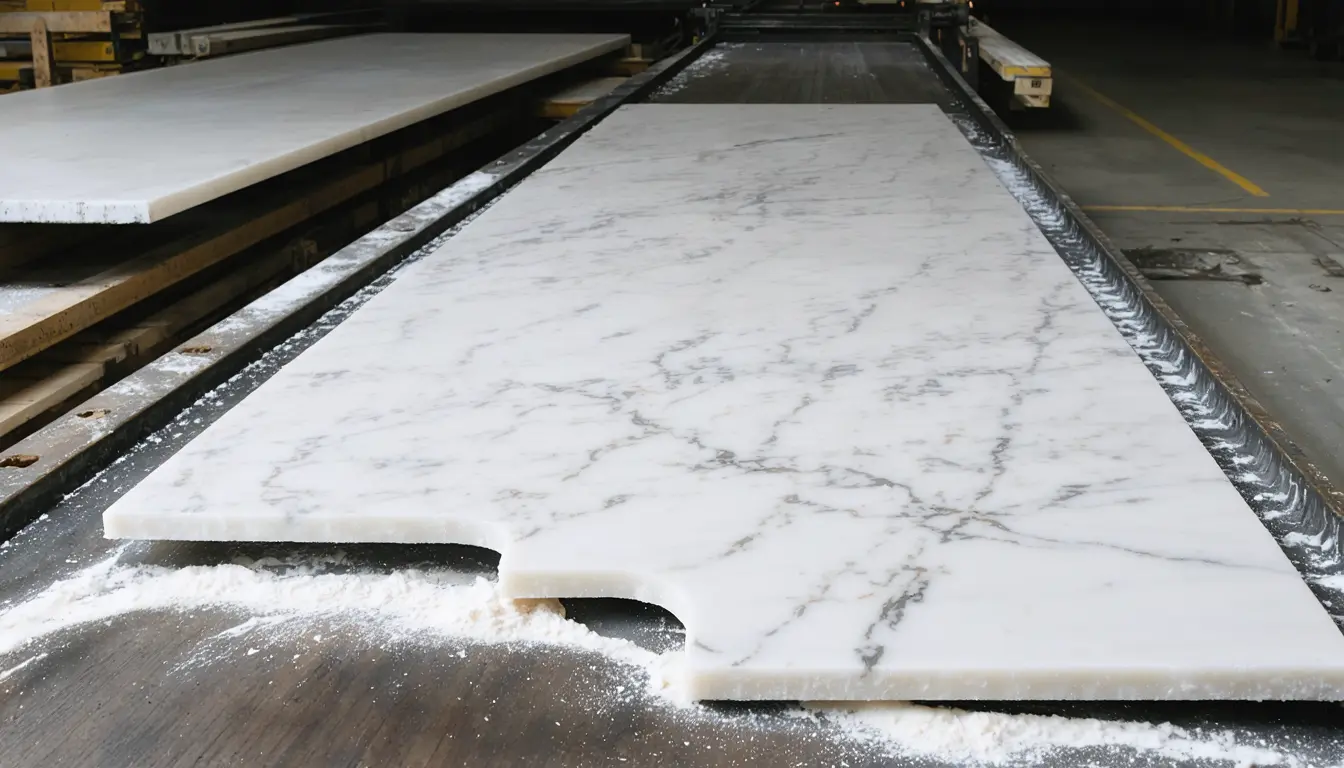
California's proposal puts its limit on the slab. It covers engineered stone with more than 1 percent crystalline silica [2], and the product is made from 95 percent finely ground quartz bound with polyester resins and pigments [4]. Under a rule written this way, a shop cannot qualify by cutting wet or ventilating better, because the prohibition attaches to the material. I think the design means the petition's backers are not counting on workplace controls to protect fabricators. The Discover account does not report whether the California shops behind these cases used wet cutting, exhaust ventilation or respirators, so the record does not show controls being tried and failing.
Silicosis had been falling nationally. The CDC's Morbidity and Mortality Weekly Report counted 185 US deaths in 1999 and 111 in 2013, a 40 percent drop [12]. That series ends six years before California started counting engineered-stone cases [20]. It cannot show whether the new cases have reversed the decline. David Michaels, an epidemiologist at George Washington University and a co-author of the NEJM Evidence report, said in a statement: "Given the hundreds of diagnosed cases of silicosis in California, there are likely thousands of more cases across the country. Health care practitioners and public health departments should be on the lookout for cases and join the effort to stop this epidemic and save workers lives." [10]
What to watch
- Whether the Standards Board adopts the 1 percent crystalline silica threshold as petitioned or narrows its scope when it rules.
- Engineered-stone silicosis counts from health departments outside California, which would test Michaels's estimate of thousands of cases nationwide.
- Published detail on dust controls in the California shops where cases arose, which would show whether wet cutting, ventilation or respirators were used and failed.
Clarity's read
What the record supports and how the coverage leans. The claims behind it follow.
Reality
- Evidence55
- Adoption20
- Hype gap+15
- Incentives
- Insufficient
- Confidence50
Claim ledger
Ranked by verification strength, evidence, and original report placement.
- [1]
The California Department of Public Health reports 662 confirmed cases of engineered-stone silicosis in the state.
- [2]
In May 2026, the California Occupational Safety and Health Standards Board moved forward with a petition to prohibit all fabrication and installation of engineered stone containing more than 1 percent crystalline silica.
- [3]
The ban is currently under review, with news expected later in October 2026.
- [4]
Engineered stone is a synthetic product that contains 95 percent finely ground quartz mixed with polyester resins and pigments.
- [5]
The California Department of Public Health began tracking engineered-stone silicosis cases in 2019, initially identifying two fatalities caused by the disease along with four other cases among California workers.
- [6]
The state's surveillance dashboard lists 662 cases and 35 deaths from engineered-stone silicosis; 75 of the workers with silicosis have undergone lung transplants.
- [7]
The median age of diagnosis among California engineered-stone silicosis cases is 46, according to the surveillance dashboard; workers are being diagnosed at a relatively young age.
ReportedSupportedSource: California Department of Public Health dashboard and NEJM Evidence report, via DiscoverView cited source - [8]
An August 2026 report in NEJM Evidence states that many workers are being diagnosed with silicosis at a relatively young age after comparatively short periods of silica dust exposure.
- [9]
The NEJM Evidence report's authors warn that the burden of the disease is likely much higher because many workers remain undiagnosed or are diagnosed late.
- [10]
"Given the hundreds of diagnosed cases of silicosis in California, there are likely thousands of more cases across the country. Health care practitioners and public health departments should be on the lookout for cases and join the effort to stop this epidemic and save workers lives."
ReportedSupportedSource: David Michaels, epidemiologist and professor at George Washington University, report co-author, in a statementView cited source - [11]
Australia banned the use, supply and manufacture of engineered stone in July 2024, becoming the first country to do so.
- [12]
Silicosis cases have gone down in the US; annual silicosis deaths declined 40 percent, from 185 in 1999 to 111 in 2013, according to a 2015 CDC Morbidity and Mortality Weekly Report.
- [13]
Silicosis cannot be cured; once lung damage is done it cannot be reversed, and the disease raises the risk of tuberculosis.
- [14]
Reported engineered-stone silicosis cases in California have risen year after year.
- [15]
California's initial count was six cases, and the current 662 is about 110 times that.
- [16]
Deaths are about 5.3 percent of confirmed California cases.
- [17]
Lung transplants are about 11.3 percent of confirmed California cases.
- [18]
117 of 544 screened Victorian workers is 21.5 percent, below the 28.2 percent reported; either figure means at least one screened worker in five had silicosis.
- [19]
If 117 cases were 28.2 percent of the group, the group was about 415 workers.
- [20]
The CDC national death series ends six years before California began tracking engineered-stone cases.
- [21]
A 2023 Occupational and Environmental Medicine study from Victoria, Australia, screened 544 workers in the stone countertop industry and found that 117 of them (reported as 28.2 percent) were diagnosed with silicosis.
ReportedContestedSource: Discover, citing the 2023 OEM study2 sources— create a free account to open themView cited source - [22]
California is considering a proposed ban on quartz (engineered stone) countertops and is expected to be the first US state to enact such a ban.
Sources
1 independent publisher whose own reporting we read for this story.
- discovermagazine.comCalifornia May Ban Quartz Countertops Over Risk of Incurable Lung Disease in Workers
1 article · October 8, 2026
Topics and entities
Follow any of these and your For You feed starts watching them — no settings page required.