InvestIndependently confirmed2 publishers2 min readPublished
Brookfield's $100 billion AI program covers 1.4% of the $7 trillion buildout it estimates
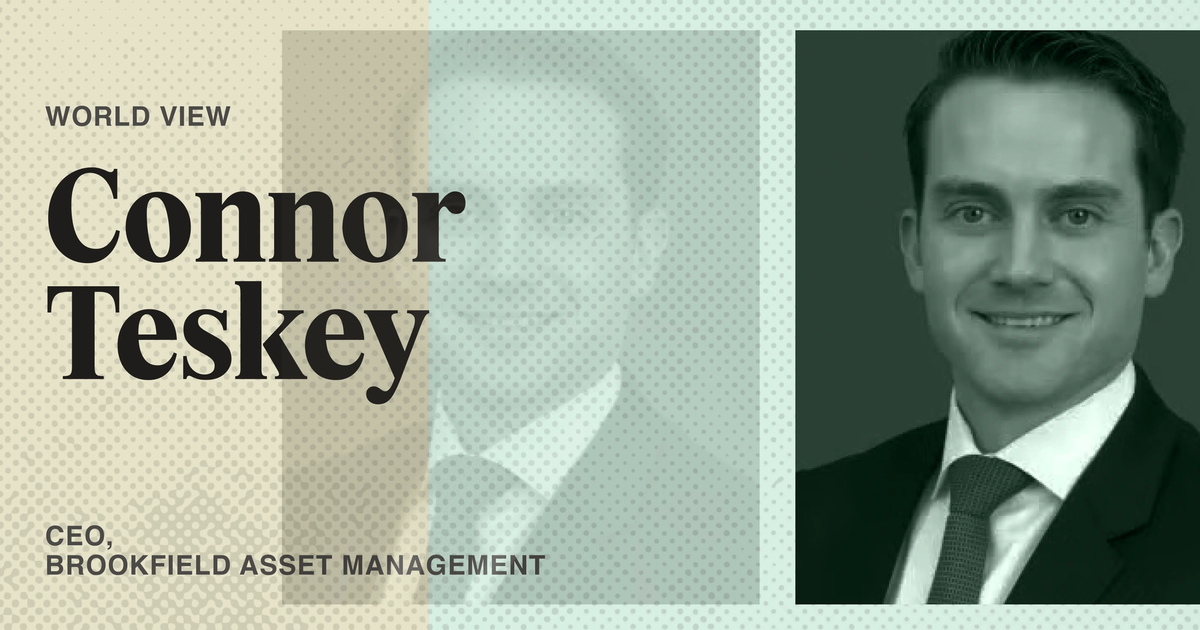
Brookfield CEO Connor Teskey says AI compute and power demand will exceed supply through the decade, with the US needing about 100 GW of extra power. Brookfield is also the one raising a flagship fund to meet it.
The Investor · Invest desk
Two bars in gigawatts. Per Crypto Briefing, the US needs approximately 100 GW of additional power to support AI over the next decade, and the current US grid can supply about 30 GW. Both figures are contested and unattributed in the article.
US power for AI, in gigawatts, both figures per Crypto Briefing
| Item | Value | Claim |
|---|---|---|
| Need, approx., per Crypto Briefing | 100 GW | 19 |
| Grid, about, per Crypto Briefing | 30 GW | 20 |
What happened
- In November 2025 Brookfield launched a $100 billion global AI infrastructure program spanning data centers, power generation and compute.
- The flagship AI infrastructure fund targets $10 billion in equity, and Nvidia and the Kuwait Investment Authority are among its backers.
- Brookfield scaled up its Bloom Energy partnership, with a revised target of $25 billion for quick-deploy power solutions.
Why it matters
- exposure AI and digital infrastructure are 25% to 40% of Brookfield's activities. A weak contract market would reach a large part of the firm, though 60% to 75% of its activities sit elsewhere.
- constraint Permitting rules, grid interconnection policy and nuclear licensing set how fast new capacity comes online. That leaves part of the timing of returns with regulators, whatever the contract book looks like.
- precedent Teskey says no single firm can fund $7 trillion, and Apollo, Blackstone and KKR are already named collaborators. Expect rival managers to co-invest on deals this size.
Brookfield's program is a small slice of Brookfield's own forecast. The program is $100 billion [5] and the buildout the firm estimates is $7 trillion over ten years [4]. The program covers about 1.4% of the forecast [14]; the other 98.6% [18] sits outside it. Spread evenly, $7 trillion is $700 billion a year [15]; the whole program would be about 14% of one such year [16]. The two figures measure different things: a global ten-year buildout and one firm's launch program.
Teskey sized the shortfall in multiples. He said: "Not by percentages, but by three, four, five, six, eight, 10 times." [2] The top of that range is 3.3 times the bottom [13]. He also called the problem structural and said small efficiency gains or supply chain tweaks will not fix it [3].
The 70 GW difference between the US power need and what the current grid can supply [23] is what Crypto Briefing's report calls the clearest stress point [21]. The report attributes the $7 trillion to Brookfield; the 100 GW and 30 GW figures appear without a named source.
We think the power half of the argument is the sturdier one. Grid connection waits can stretch for years, and Bloom's on-site fuel cells let a data center sidestep some of that wait [8]. That queue exists whatever Brookfield says about it. The financing half is where we would want more than the CEO's word. Teskey runs a firm raising a flagship fund [6], and the multiples he cites help make the case for it.
The counter-case is his own. He does not fear immediate overbuilding, and the report says that confidence rests on hyperscaler and sovereign backing, much of it locked in through long-term contracts [9]. If those contracts stop being signed, a 3x or 10x shortage is unmet demand with nothing contracted behind it. The report says the thesis depends heavily on hyperscalers and sovereigns continuing to sign long contracts [10].
What to watch
- Fundraising progress on the flagship fund against its $10 billion equity target.
- Whether hyperscaler capital spending keeps pace with Teskey's forecast, and how long the contracts it produces run.
- New power partnerships beyond Bloom Energy, and any change in permitting or interconnection rules.
Clarity's read
What the record supports and how the coverage leans. The claims behind it follow.
Reality
- Evidence38
- Adoption40
- Hype gap+30
- Incentives80
- Confidence58
Claim ledger
Ranked by verification strength, evidence, and original report placement.
- [1]
Brookfield Asset Management CEO Connor Teskey expects demand for compute and energy infrastructure to exceed supply through the end of the decade and beyond.
ReportedSupportedSource: Crypto Briefing report on Teskey's remarks2 sources— create a free account to open themView cited source - [2]
Teskey said demand would outstrip supply: "Not by percentages, but by three, four, five, six, eight, 10 times."
ReportedSupportedSource: Connor Teskey, Brookfield Asset Management CEO, as quoted by Crypto Briefing2 sources— create a free account to open themView cited source - [3]
Teskey argued the problem is structural rather than temporary, and that small efficiency gains or supply chain tweaks will not solve it.
ReportedSupportedSource: Crypto Briefing report on Teskey's remarks2 sources— create a free account to open themView cited source - [4]
Brookfield estimates the global AI buildout could reach $7 trillion over the next ten years.
ReportedSupportedSource: Brookfield estimate, per Crypto Briefing2 sources— create a free account to open themView cited source - [5]
In November 2025 Brookfield launched a $100 billion global AI infrastructure program spanning data centers, power generation and the wider compute landscape.
ReportedSupportedSource: Crypto Briefing2 sources— create a free account to open themView cited source - [6]
The flagship Brookfield Artificial Intelligence Infrastructure Fund targets $10 billion in equity and counts Nvidia and the Kuwait Investment Authority among its backers.
ReportedSupportedSource: Crypto Briefing2 sources— create a free account to open themView cited source - [7]
Brookfield's partnership with Bloom Energy has been scaled up, with a revised target of $25 billion for quick-deploy power solutions.
ReportedSupportedSource: Crypto Briefing2 sources— create a free account to open themView cited source - [8]
Bloom makes fuel cells that generate electricity on site, letting a data center sidestep some of the wait for grid connections, which can stretch for years.
ReportedSupportedSource: Crypto Briefing2 sources— create a free account to open themView cited source - [9]
Teskey has said he does not fear immediate overbuilding in the sector; his confidence rests on strong backing from hyperscalers and sovereign entities, much of it locked in through long-term contracts.
ReportedSupportedSource: Crypto Briefing report on Teskey's remarks2 sources— create a free account to open themView cited source - [10]
Teskey's thesis depends heavily on hyperscalers and sovereigns continuing to sign long contracts.
ReportedSupportedSource: Crypto Briefing2 sources— create a free account to open themView cited source - [11]
AI and digital infrastructure now make up 25-40% of Brookfield's activities.
- [12]
Teskey says the scale of the buildout will push competitors into cooperation because no single firm can fund $7 trillion; Brookfield's AI infrastructure collaborations include Apollo, Blackstone and KKR.
- [13]
The top of Teskey's range (10 times) is about 3.3 times the bottom (3 times).
- [14]
The $100 billion program is about 1.4% of the $7 trillion buildout estimate.
- [15]
$7 trillion spread evenly over ten years is $700 billion a year.
- [16]
The $100 billion program is about 14% of one average year of the $7 trillion buildout.
- [17]
If AI and digital infrastructure are 25-40% of Brookfield's activities, 60-75% sit elsewhere.
- [18]
About 98.6% of the $7 trillion estimate sits outside the $100 billion program.
- [19]
The US needs approximately 100 GW of additional power to support AI over the next decade; the article gives no named source for the figure.
ReportedInsufficientSource: Crypto Briefing, unattributed in the article2 sources— create a free account to open themView cited source - [20]
The current US grid can supply only about 30 GW.
ReportedInsufficientSource: Crypto Briefing, unattributed in the article2 sources— create a free account to open themView cited source - [21]
The article calls the roughly 70 GW gap between the approximately 100 GW of new US power needed and the about 30 GW the grid can supply the clearest stress point.
ReportedInsufficientSource: Crypto Briefing2 sources— create a free account to open themView cited source - [22]
Permitting rules, grid interconnection policy and nuclear licensing will shape how quickly new capacity can come online.
- [23]
The difference between the 100 GW US power need and the 30 GW current grid supply is 70 GW.
Sources
2 independent publishers whose own reporting we read for this story.
- cryptobriefing.comBrookfield CEO Connor Teskey sees AI infrastructure demand outrunning supply for years
1 article · October 13, 2026
- qz.comBrookfield CEO says AI infrastructure demand will far outstrip supply through the decade
1 article · October 13, 2026
Topics and entities
Follow any of these and your For You feed starts watching them — no settings page required.
Topics
- AI InfrastructureFollow
- Data centre power supplyFollow
- Private capital in infrastructureFollow
Entities
- OpenAIFollow
- NvidiaFollow
- Bloom EnergyFollow
- Connor TeskeyFollow
- Brookfield Asset ManagementFollow
- Kuwait Investment AuthorityFollow
- NextEra EnergyFollow