ScienceNot yet confirmed elsewhere1 publisher2 min readPublished
Brazzein ice cream roughly halved glucose spikes in 101 adults with fatty liver disease
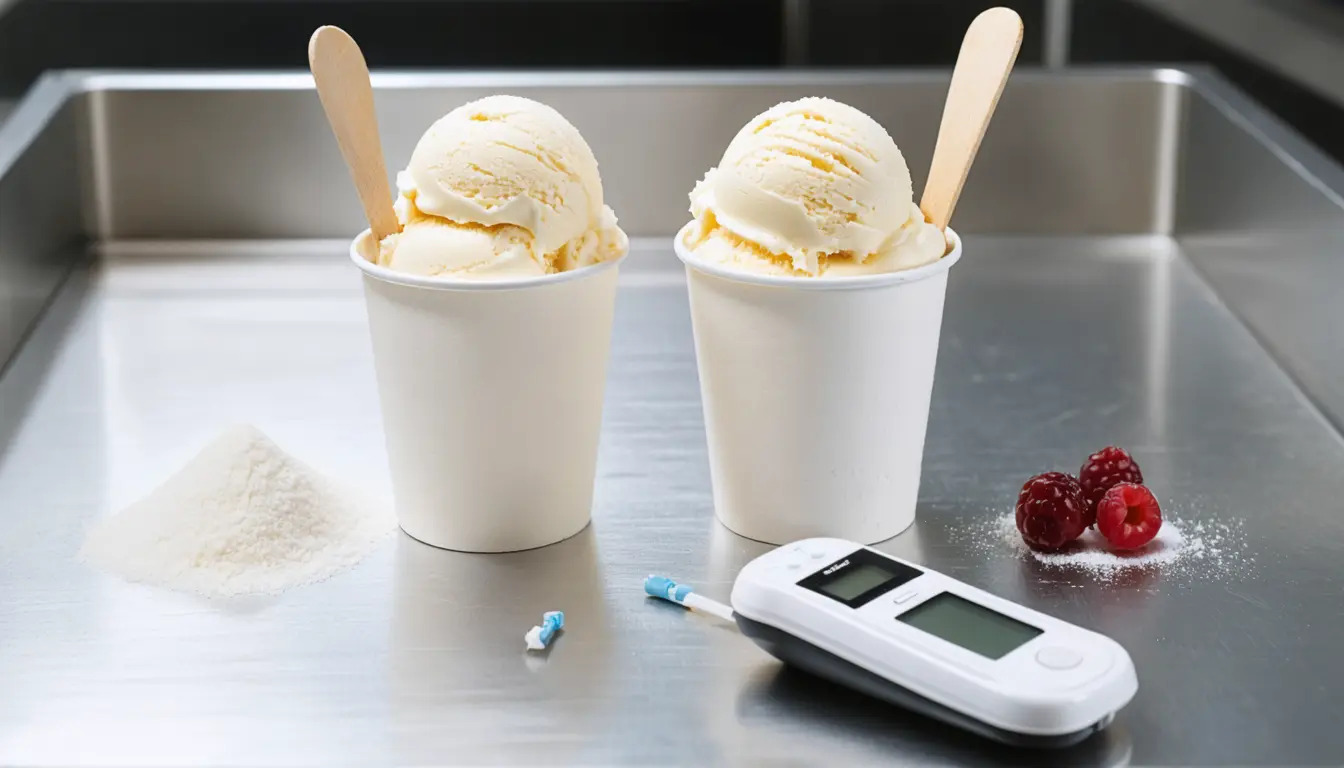
Researchers in Russia found that brazzein-sweetened vanilla ice cream raised blood sugar about half as much as a sugar version in 101 adults with MASLD. The test covered a single serving, so its value for reformulated foods depends on longer trials that have not yet been run.
The Scientist · Science desk
What happened
- Each participant ate a 100-gram serving of vanilla ice cream on three separate days: one sweetened with sugar, one with brazzein, and one with brazzein plus the fibre inulin.
- The reductions were larger in participants with type 2 diabetes and still substantial in those without, and no serious side effects were reported.
- Brazzein was first found in a West African fruit, is now mostly made by engineered fungi, and is up to 2,000 times sweeter than sugar by weight.
Why it matters
- decision Food makers weighing brazzein against sweeteners already on the market get no head-to-head data from this trial, because every brazzein recipe was compared only with sugar.
- constraint The result covers one serving in adults with MASLD, many of them obese, so it cannot yet support claims about liver fat, diabetes control or blood pressure over months.
- capability Brazzein tolerates heat up to 80 C and a wide range of acidity, so it could go into foods well beyond frozen desserts, though ice cream is the only food this trial tested.
We would expect any recipe without sucrose to lower the glucose rise after a 100-gram dessert [5]. A spike about half the size of the sugar version's [6] is the expected direction. What the trial has to show is how much of that drop comes from brazzein.
The researchers point out that sugar also gives ice cream its bulk and viscosity [12]. A sugar-free recipe has to make that up with other ingredients, and ScienceAlert reports that filler ingredients used with brazzein produced something very similar to the real thing [17]. Those other ingredients were in every brazzein serving the participants ate [7]. In their conclusion the team gives the credit to the whole recipe, not to the protein alone: "From a clinical nutrition perspective, the present findings indicate that the tested sucrose-free brazzein-containing formulations may warrant further investigation as potential sugar-substitution options for patients with MASLD, including those with type 2 diabetes," the researchers wrote [9].
The nearest the trial gets to testing a single ingredient is its third arm, which added the fibre inulin to brazzein [5]. That version also produced a spike about half the size of the sugar one's, much the same as brazzein without inulin [6]. ScienceAlert's account does not give the glucose values or the time window in which they were measured.
For a question about one serving, the design is a good one. The team, from Russia's Federal Research Center of Nutrition, Biotechnology and Food Safety, enrolled 101 adults with MASLD [3]. They ran a randomized, double-blind crossover [4], published in Clinical Nutrition ESPEN [1]. Each participant ate all three ice creams on separate days [5]. ScienceAlert notes that blood sugar responds to things as ordinary as who you eat with and how you eat [16]. In a crossover each person is compared with themselves [4]. That removes the differences between people, though not the differences between one day and the next.
Earlier work in mice suggested brazzein could replace sugar while keeping the sweetness [19]. This trial takes that idea into people, for one serving. In our view it is good evidence that a sugar-free brazzein ice cream lowers the immediate glucose rise in adults with MASLD. As evidence about brazzein itself, it is still thin. The authors' case for substitution rests on adherence, and we think that case holds for any sugar-free dessert people will keep eating, whatever sweetener is in it. "Extensive restriction of these products in the diet is often unrealistic and may lead to poor adherence to dietary recommendations," they wrote [13].
What to watch
- Longer trials of repeated substitution that track metabolic, liver, microbiome and behavioural outcomes, which the authors say are needed.
- Studies that swap brazzein for sugar across a range of commonly eaten foods, as the researchers propose.
Clarity's read
What the record supports and how the coverage leans. The claims behind it follow.
Reality
- Evidence45
- Adoption
- Insufficient
- Hype gap+30
- Incentives
- Insufficient
- Confidence55
Claim ledger
Ranked by verification strength, evidence, and original report placement.
- [2]
Brazzein was originally found in a West African fruit, is now mostly made by engineered fungi, and is up to 2,000 times sweeter than sugar, weight for weight.
- [3]
Researchers from the Federal Research Center of Nutrition, Biotechnology and Food Safety in Russia ran tests with 101 adults diagnosed with metabolic dysfunction-associated steatotic liver disease (MASLD), a condition where fat builds up in the liver, often accompanied by obesity and diabetes.
- [4]
The study was a randomized controlled double-blind crossover trial.
- [5]
Each participant consumed a standard 100-gram serving of vanilla ice cream on three separate days: one using sugar, one sweetened with brazzein, and one with brazzein and the dietary fiber inulin.
- [6]
Post-meal rises in blood sugar were significantly cut by both brazzein and brazzein with inulin; the spikes were about half as large as with sugar-sweetened ice cream in both cases.
- [7]
The sugar-free recipes also differed in other ingredients, so the researchers caution that they cannot attribute the effect to brazzein alone.
- [8]
The reductions in blood sugar spikes were more noticeable in participants with type 2 diabetes, though still substantial in those without, and no serious side effects were reported.
- [9]
"From a clinical nutrition perspective, the present findings indicate that the tested sucrose-free brazzein-containing formulations may warrant further investigation as potential sugar-substitution options for patients with MASLD, including those with type 2 diabetes,"
- [10]
Participants were a narrow slice of the population, all with MASLD and many diagnosed as obese, and the study gives no indication of how brazzein-sweetened foods might affect liver fat, diabetes, blood pressure or related conditions over months or years.
- [11]
Brazzein withstands temperatures up to 80 C and a wide range of acidity levels, so it could potentially be added to multiple foods, including frozen desserts.
- [12]
The researchers point out that sugar does not just add sweetness; in ice cream it provides bulk and viscosity.
- [13]
"Extensive restriction of these products in the diet is often unrealistic and may lead to poor adherence to dietary recommendations."
- [14]
"Longer-term studies are needed to determine whether repeated substitution of sucrose-containing desserts with brazzein-sweetened alternatives translates into sustained metabolic, hepatic, microbiome, or behavioral benefits,"
- [15]
The researchers wrote that "the magnitude and timing of the observed effects support future studies of brazzein-sweetened foods," calling for longer studies that swap sugar for brazzein across a range of commonly eaten foods.
- [16]
Multiple factors can affect blood sugar, from who you're eating with to how you're eating.
- [17]
The study shows that other filler ingredients alongside brazzein can work to make something very similar to the real thing.
- [18]
None of the three trial arms used a non-sugar sweetener other than brazzein, so the trial contains no head-to-head comparison with existing sugar substitutes.
- [19]
Previous research in mice suggested brazzein could work as a sugar substitute that keeps the sweetness without the downsides.
Sources
1 independent publisher whose own reporting we read for this story.
- sciencealert.comA Protein 2,000 Times Sweeter Than Sugar Halved Ice Cream's Blood Sugar Response
1 article · October 10, 2026
Topics and entities
Follow any of these and your For You feed starts watching them — no settings page required.