Industrial Next says its AI robot stations retool lines in minutes, and announces BMW Group Technology Office partnership to evaluate its dexterous manipulation
Industrial Next says its robot stations can retool a factory line in minutes, and BMW's technology office will evaluate its dexterous manipulation. TechCrunch attributes the minutes figure to the company; BMW's announced role is to evaluate.
The Product Desk
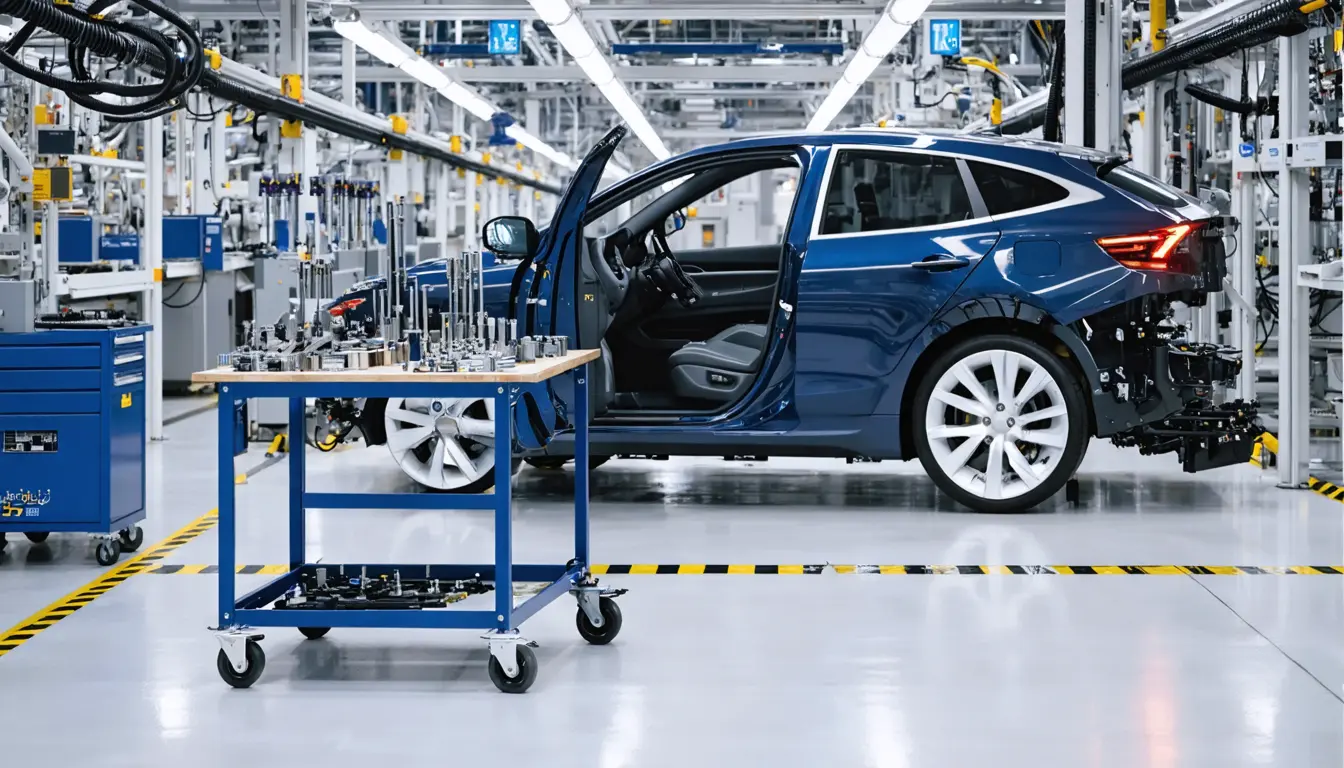
Contested: Industrial Next says a line can be retooled in minutes rather than weeks. Supported: factory line changes can take weeks or months; BMW Group Technology Office will evaluate its dexterous manipulation; Pankau describes a high-fidelity simulation engine.
- Contested The company says its approach lets a production line be retooled in minutes rather than weeks without traditional programming., claim 11
- Supported In most factories automation is fixed: robots and machines are programmed for one specific task and product, and changing a line means reprogramming and physical retooling, or swapping out equipment, which can take weeks or months., claim 2
- Supported The company announced on stage that it is partnering with BMW Group Technology Office to evaluate Industrial Next's AI-powered dexterous manipulation for manufacturing., claim 1
- Supported Pankau said: "we build that understanding using an extremely high-fidelity simulation engine that is close to the real dynamics to where we can let the robot do these kinds of high precision tasks almost without seeing the parts at all.", claim 9
| Claim | State | Claim number |
|---|---|---|
| The company says its approach lets a production line be retooled in minutes rather than weeks without traditional programming. | Contested | 11 |
| In most factories automation is fixed: robots and machines are programmed for one specific task and product, and changing a line means reprogramming and physical retooling, or swapping out equipment, which can take weeks or months. | Supported | 2 |
| The company announced on stage that it is partnering with BMW Group Technology Office to evaluate Industrial Next's AI-powered dexterous manipulation for manufacturing. | Supported | 1 |
| Pankau said: "we build that understanding using an extremely high-fidelity simulation engine that is close to the real dynamics to where we can let the robot do these kinds of high precision tasks almost without seeing the parts at all." | Supported | 9 |
What happened
- Industrial Next, based in San Francisco, presented on the Startup Battlefield stage at TechCrunch Disrupt 2026.
- Its stations are self-contained and run on proprietary foundation models that connect vision, task context and motion.
- TechCrunch describes most factory automation as fixed, with a line change needing reprogramming and physical retooling that can take weeks or months.
- Lukas Pankau and Allen Pan founded the company in 2021, and both had previously worked at Tesla.
- The stated goal is to let manufacturers automate complex and delicate tasks that traditionally require human labor.
Why it matters
- What doesn't add up contradiction The headline claim covers whole-line retooling, but the scope BMW's technology office agreed to is dexterous manipulation. A buyer who reads the partnership as backing for the minutes figure is reading more than was announced.
- Who's exposed exposure The robots learn largely in simulation, so any gap between the simulator and a real part shows up on the buyer's line as a failed task, after the vendor's demo has ended.
- What it costs cost A pilot spends the buyer's line time and engineer hours testing a changeover figure that so far comes only from the vendor.
Lukas Pankau, Industrial Next's co-founder, put the problem in one sentence. "But I couldn't figure out how to program a robot, and this was pretty common for engineers at Tesla," Pankau said [6].
Here's what plants actually do, by Pankau's account. Traditional industrial robots are programmed for highly specific, repeatable tasks, so a small change in the process or product can make them fail or trigger costly downtime [7]. Manufacturers respond by simplifying their products for repeatability [7]. The pitch for a flexible robot is that designers can stop doing that, and a pilot is the only place that gets tested.
The obstacle is data. AI models can be trained on the internet, but robotics has no comparably large body of data for teaching machines complex physical tasks [8]. Industrial Next's answer is simulation. Pankau said the company builds the robots' understanding of a process "using an extremely high-fidelity simulation engine that is close to the real dynamics to where we can let the robot do these kinds of high precision tasks almost without seeing the parts at all." [9] The minutes figure rests on that fidelity, and the company is its only source in the report [11].
TechCrunch's report does not give a timeline or a result for the BMW evaluation [1]. Industrial Next was founded in 2021, so the announcement comes about five years in [10].
For a plant weighing a call from the vendor, we'd sort lines on two axes: how often the product mix changes, and what a changeover costs in downtime today. Lines that change often and lose a lot of time per change are where a minutes-long retool would pay, and those are the only lines worth a pilot. Lines that rarely change have little to gain, and so do lines whose changeovers are already cheap.
For the first group, the forcing function is a timed changeover on a part the vendor has not seen, run on the buyer's floor and compared with the changeover time the plant records today. The tradeoff is that this puts the vendor on the hardest case first and may end the pilot early. We think an early end costs less than finding out after installation.
What to watch
- A BMW or other customer report of a timed changeover on a production line, with the part and the clock stated.
- A timeline or result for the BMW Group Technology Office evaluation of dexterous manipulation.
- Whether Industrial Next publishes how its simulation-trained stations perform on parts they have never handled physically.
Clarity's read
What the record supports and how the coverage leans. The claims behind it follow.
Reality
- Evidence25
- Adoption15
- Hype gap+35
- Incentives70
- Confidence60
Claim ledger
Ranked by verification strength, evidence, and original report placement.
- [1]
The company announced on stage that it is partnering with BMW Group Technology Office to evaluate Industrial Next's AI-powered dexterous manipulation for manufacturing.
- [2]
In most factories automation is fixed: robots and machines are programmed for one specific task and product, and changing a line means reprogramming and physical retooling, or swapping out equipment, which can take weeks or months.
- [3]
San Francisco-based Industrial Next presented on the Startup Battlefield stage at TechCrunch Disrupt 2026.
- [4]
Industrial Next builds AI-driven, self-contained robotic stations powered by proprietary foundation models that connect vision, task context and motion.
- [5]
Industrial Next was founded in 2021 by Lukas Pankau and Allen Pan, both of whom previously worked at Tesla.
- [6]
"But I couldn't figure out how to program a robot, and this was pretty common for engineers at Tesla," Pankau said.
- [7]
Pankau notes that traditional industrial robots are typically programmed for highly specific, repeatable tasks, so even a small change in the process or product can cause the robot to fail or trigger costly downtime, which forces manufacturers to simplify their products for repeatability.
- [8]
Making robots truly flexible needs enormous amounts of training data, and unlike AI models trained on the internet, robotics lacks the vast datasets needed to teach machines complex physical tasks.
- [9]
Pankau said: "we build that understanding using an extremely high-fidelity simulation engine that is close to the real dynamics to where we can let the robot do these kinds of high precision tasks almost without seeing the parts at all."
- [10]
Industrial Next was founded about five years before its 2026 Disrupt presentation.
- [11]
The company says its approach lets a production line be retooled in minutes rather than weeks without traditional programming.
- [12]
The goal is to let manufacturers automate complex and delicate tasks that traditionally require human labor.
Get this ledger inside ChatGPT. Ask about any of our stories and the answer brings its figure, each claim’s verdict and the sources. Free, no account.
Sources
1 independent publisher whose own reporting we read for this story.
- runtimewire.comIndustrial Next partners with BMW to test AI-powered factory robots
1 article · October 13, 2026
- techcrunch.comIndustrial Next wants factory robots to switch tasks in minutes, not weeks
1 article · October 13, 2026
Topics and entities
Follow any of these and your For You feed starts watching them — no settings page required.
Topics
- Startup launchesFollow
- Physical AIFollow
- Industrial RoboticsFollow