Science1 publisher2 min readPublished
Researchers open a 6-million-cell map of prefrontal gene activity from nearly 1,500 brains
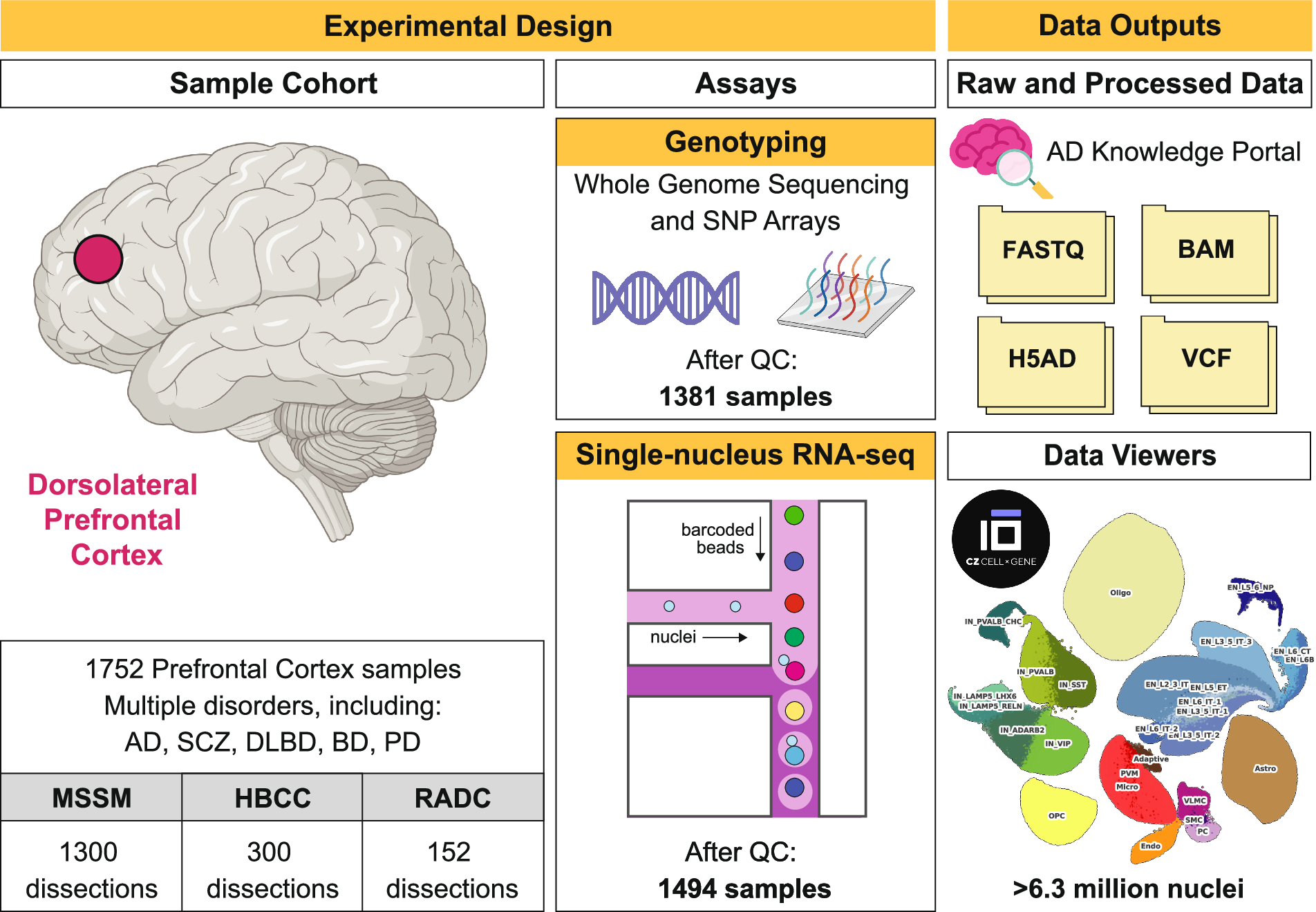
Researchers measured gene activity in over 6 million prefrontal cortex cells from nearly 1,500 donors and published it openly in eight studies. Each sample is a postmortem snapshot, so the map can link cell changes to a disease without showing which came first.
The Scientist · Science desk
What happened
- Postmortem prefrontal cortex tissue came from almost 1,500 donors aged from infancy to 108, some healthy and some with Alzheimer's, Parkinson's, schizophrenia or bipolar disorder.
- Single-cell RNA sequencing recorded which genes were active in more than 6 million individual brain cells.
- The results appeared as eight studies published at the same time, three of them in Nature.
- All the data, along with instructions for analysing it, have been made publicly available.
- Immune cells in Alzheimer's and Parkinson's tissue shared several changes in gene activity, even though the two diseases present with different symptoms.
Compiled by The ScientistSomething wrong?How this is made
Why it matters
- capability Dementia and Parkinson's labs can compare their own samples with a public healthy-aging baseline without first assembling a donor cohort of this size.
- decision A disease team weighing the map as its reference has to find out first how many donors carry its diagnosis, since the 1,500 figure pools healthy and diseased brains.
- constraint The immune changes shared by Alzheimer's and Parkinson's cannot yet justify one treatment aimed at both diseases. That would need evidence that the changes come before the damage.
More than 6 million cells [6] across close to 1,500 donors [1] works out to a little over 4,000 cells per brain on average [1]. That figure averages over every cell type and every diagnosis. Discover's account of the work does not say how many donors had Alzheimer's or Parkinson's, or how many immune cells went into the comparison between the two diseases [5][10].
The design does include a real control. Clinically healthy donors from infancy to age 108, drawn from a range of ancestral backgrounds, sit beside the diseased ones [5]. The team first charted normal aging in the dorsolateral prefrontal cortex, then compared disease samples against that baseline [9]. Normal aging came out in three stages: heavy remodeling in youth, stability through midlife and a second remodeling after 65 [7]. Across those stages, cell types differed in immune activity, stress responses and the internal biological clock [8].
Each donor gives one sample, taken after death [5]. So the three stages come from lining up people who died at different ages. That shows how the cortex differs between people of different ages. It cannot follow one person's cortex into its second remodeling.
The same limit applies to disease. Single-cell RNA sequencing records which genes were active in a cell at the moment it was sampled [6]. The immune changes that Alzheimer's and Parkinson's share [10] therefore describe tissue at the end of illness. The pathways tying Alzheimer's to the behavioral symptoms common in patients [11] are associations of the same kind, found in the same end-stage tissue.
The map covers one region. According to Discover, it is the largest gene-activity map to date for the prefrontal cortex [1], a region whose dysfunction is linked to several types of dementia, Parkinson's disease and bipolar disorder [2]. The researchers hope to extend it to other brain regions [12]. Their stated long-term aim is treatment matched to a patient's genetic makeup [13].
I think the open release of data and analysis instructions [4] will outlast any single finding in the eight papers [3]. A public lifespan baseline is useful to a dementia or Parkinson's group even if some first-round results fail to replicate. How useful it is will depend on how many donors carry each diagnosis.
What to watch
- The methods sections of the three Nature papers, for the number of donors with each diagnosis and the immune-cell counts behind the Alzheimer's-Parkinson's comparison.
- An independent cohort, analysed with the public data and instructions, that reproduces or fails to reproduce the shared immune changes.
- The researchers' planned extension to other brain regions, which would test whether the three-stage aging pattern holds outside the prefrontal cortex.