Invest1 publisherNot yet confirmed elsewhere2 min readPublished
Beijing fielded 2,000 humanoids the same month Washington banned importing them
The World Humanoid Robot Games reads as a volume-manufacture demonstration. The FCC import ban and Unitree's Pentagon listing leave Western buyers cut off from the supplier doing the demonstrating.
The Investor · Invest desk
What happened
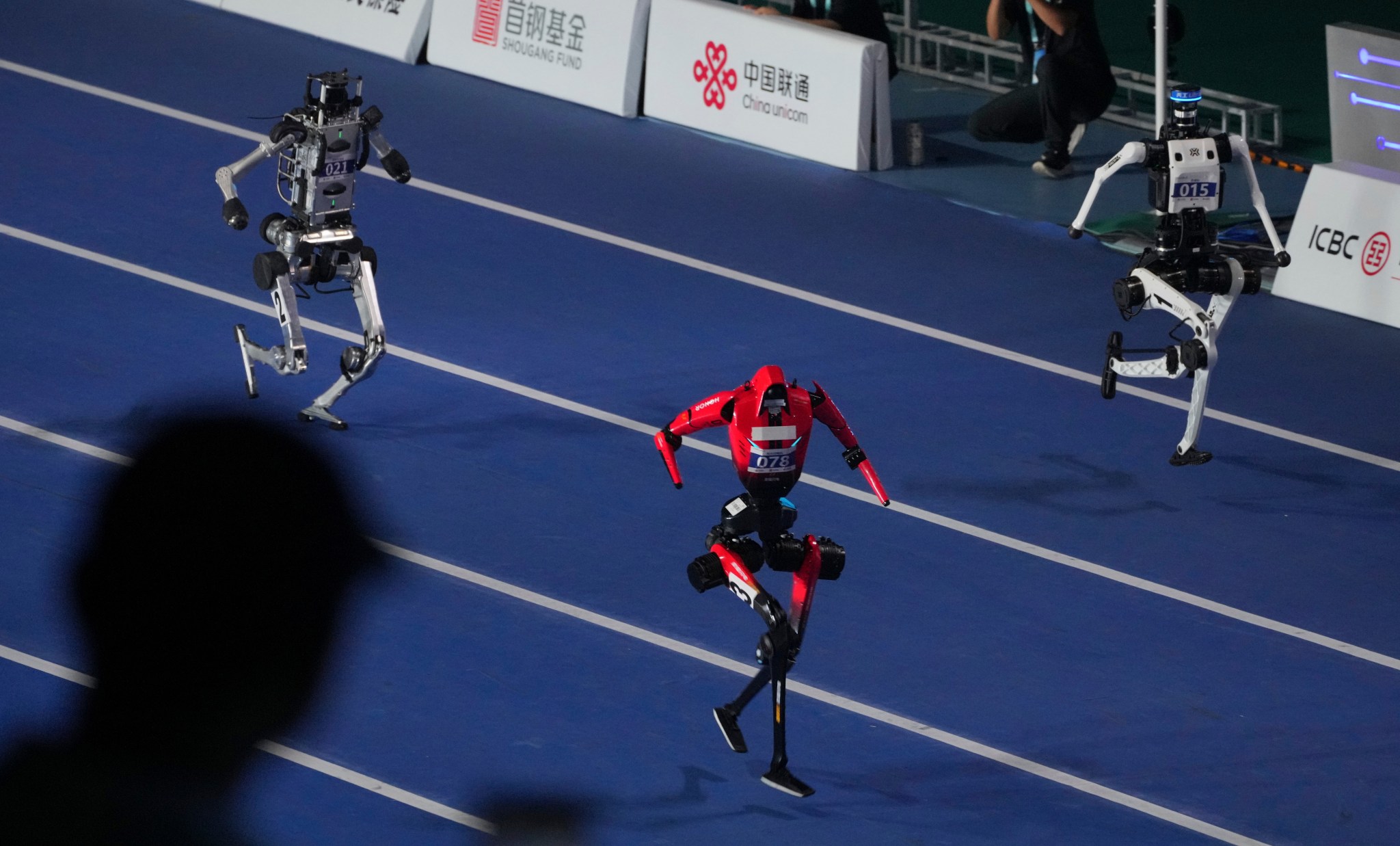
- More than 2,000 humanoid robots competed at the second World Humanoid Robot Games in Beijing, according to the organizer.
- An X-Humanoid machine ran 100 metres in 9.39 seconds, inside Usain Bolt's 9.58-second human record from 2009.
- The Pentagon listed Unitree among firms it says have Chinese military ties, an accusation Beijing rejects.
Compiled by The InvestorSomething wrong?How this is made
Why it matters
- capability Staging and servicing a four-figure fleet for five continuous days is evidence of repeatable build and field support, which is a different asset from a single impressive prototype.
- constraint Western buyers who want humanoids at Chinese volumes and prices now have to obtain them without the country that makes most of them.
- decision Integrators with Unitree hardware or Unitree-derived subsystems in a roadmap have to decide whether to re-source now or wait to see how far the listing reaches.
- contradiction The expert view that these units are still demo-grade weakens the sports headline but leaves the manufacturing read intact, since demos at this count still require an assembly line.
Two thousand-plus humanoids on one site for five days [1] is a bill-of-materials problem before it is a sports result. Every unit needs actuators, battery packs, spare limbs, and a technician who can swap a hip joint between heats, across 51 events and more than 1,000 individual competitions [2]. The venue was the National Speed Skating Oval built for the 2022 Winter Olympics, and the same week Beijing ran the 2026 World Robot Conference, where companies showed around 3,000 products [3]. Read as procurement rather than spectacle, that says the assembly and field-service layers exist at fleet scale.
The record lines reward a second look. Honor's trial run of 100 metres in 9.32 seconds came with a claimed peak speed of 14.5 metres per second [12]. The average pace implied by that time is about 10.7 m/s, which puts the peak roughly 35 percent above it [8]. That is a burst number, not a sustained one, and it tells you the machine is tuned for a short straight line. The standing high jump moved from 0.95 metres at last year's edition to 2.88 metres [11], about a threefold gain in twelve months [9]. Gains of that shape come from actuator power density and control software, and both are manufactured inputs.
The buyer-side arithmetic is what makes this a sourcing story. China makes the majority of the world's humanoid robots [13]. Last month the FCC banned imports of new foreign-made humanoid robots, citing national security in a move aimed at China [4]. The Pentagon added Unitree, one of the leading Chinese makers, to its list of firms it deems tied to the Chinese military, and Beijing has pushed back on the accusations [5]. The highest-volume source of the hardware and the legal route to buying it have been pulled apart from each other, in the same season.
The honest caveat comes from the source too: experts say these machines are still mostly demonstration, performance and research units, and real-world mass deployment remains some way off [6]. That undercuts the athletics framing and strengthens the industrial one. What was on display in the oval is the capacity to build, ship and support many near-identical units. A Western integrator watching it gets no benefit from that capacity without an import path. Sixteen countries entered, among them Germany, Japan and the United States [7], which marks where the interest sits rather than where the production does.
What to watch
- Whether the FCC defines humanoid robot narrowly enough that Chinese actuators, joint modules and subsystems keep flowing in even as finished units do not.
- Whether any non-Chinese entrant from the 16 participating countries can show fleet volumes anywhere near four figures.
- Whether the Unitree listing extends to distributors and research customers, which would reach Western labs already holding units.
Clarity's read
What the record supports and how the coverage leans. The claims behind it follow.
Reality
- Evidence32
- Adoption24
- Hype gap+46
- Incentives74
- Confidence41
Claim ledger
Ranked by verification strength, evidence, and original report placement.
- [1]
More than 2,000 humanoid robots participated in the World Humanoid Robot Games in Beijing, according to the organizer.
- [2]
The five-day games, in their second year, comprised 51 events and more than 1,000 competitions, including running, table tennis and soccer.
- [3]
The games took place in the National Speed Skating Oval built for the 2022 Winter Olympics and opened the same week Beijing held the 2026 World Robot Conference, where companies showcased around 3,000 products including humanoid robots.
- [4]
Last month the U.S. Federal Communications Commission announced a ban on imports of new foreign-made humanoid robots, citing national security reasons in a move that targeted China.
- [5]
The Pentagon recently added Unitree, one of China's leading humanoid robot makers, to its list of companies it deems to have ties with the Chinese military; Beijing has hit back at the accusations.
- [6]
Experts say humanoid robots are still mostly used for demonstrations, performances and research, and that mass real-world deployment will take time.
- [7]
The organizer said 16 countries participated, among them Germany, Japan and the U.S., with events including weightlifting and tug of war.
- [8]
Honor's 9.32-second 100-metre time implies an average speed of about 10.7 metres per second, so the claimed 14.5 m/s peak is roughly 35 percent above the average pace.
- [9]
The standing high jump result improved about threefold in one year, from 0.95 metres to 2.88 metres.
- [10]
A humanoid robot from Beijing-based X-Humanoid ran a 100-metre sprint in 9.39 seconds, beating the human record of 9.58 seconds set by Usain Bolt in 2009.
- [11]
In a standing high jump, an X-Humanoid robot reached 2.88 metres, against a best humanoid result of 0.95 metres at last year's first edition of the games, and above the human record of 2.45 metres set by Javier Sotomayor in 1993.
- [12]
Before the opening, a humanoid robot from Chinese smartphone company Honor completed a 100-metre sprint in 9.32 seconds during a trial, at a peak speed of 14.5 metres per second, the company said.
Sources
1 independent publisher whose own reporting we read for this story.
Topics and entities
Follow any of these and your For You feed starts watching them — no settings page required.
Topics
- Humanoid RoboticsFollow
- Robot Capability BenchmarksFollow
- US-China Tech RestrictionsFollow
- Hardware Supply ChainFollow