A 6bp scare, a one-day fix, and a debt trajectory that outlives both
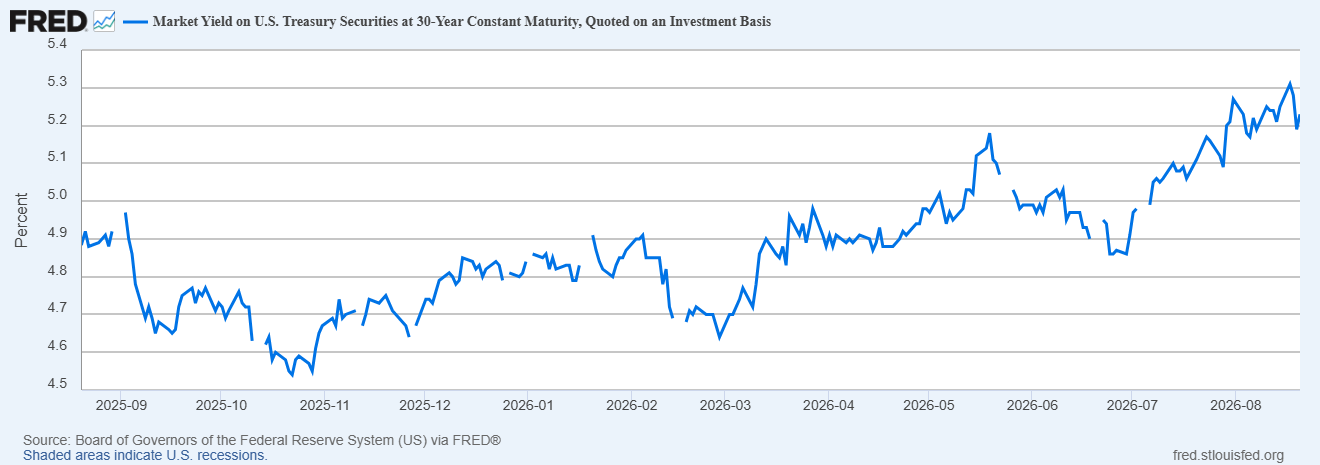
The 30-year gave back more than it moved after Treasury's buyback surprise. The number that belongs in a multi-year plan is the level of long rates, not the daily print.
The Board Room · Leadership desk
What happened
- The 30-year Treasury yield rose 6 basis points, or 0.06 percentage points, and the move was widely read as a warning about demand for US long-dated debt.
- Treasury Secretary Scott Bessent announced a program to buy long-term Treasuries, a surprise increase in buybacks of longer-dated bonds.
- Noahpinion's read is that a true sovereign debt crisis has probably not begun, while borrowing trends still warrant watching.
Why it matters
- constraint Official buying held the long end for one session, which caps how much any borrower should assume policy support will do for the timing of a financing window.
- decision The debt input that survives contact with a multi-year budget is a sustained level of long rates, not a daily print, and that is the number worth arguing about in a planning cycle.
- cost Households absorb this through mortgage rates before the sovereign absorbs it through deficit financing, so consumer-exposed revenue lines feel the move first.
- contradiction Cochrane treats weak long-end demand as the first symptom of retrenchment while Noahpinion calls the same 2026 move too small to read that way, so the evidence chosen decides the conclusion.
The round trip is the useful part of this. Six basis points on the 30-year was enough to produce a policy response [1][5]. The response held the long end for one session [6]. By Thursday the yield had risen more than seven basis points, to as much as 5.27%, which is where it sat just before the Wednesday announcement [7]. The retracement was therefore larger than the move that caused the alarm in the first place [12], and a program built to lift long-bond prices left the long end priced where it found it.
Scale that against the level. A six basis point change on a 5.27% yield is roughly 1.1% of the yield itself [13]. That is the size of the reading that moved the Treasury Secretary, and it is not the size of a reading that should move a five-year cost-of-capital assumption.
The assumption that does need attention is the one nobody prints daily. Except for Japan, most of the global rise in long yields happened in 2021-2023 [8]. In the US, rates fell in 2019, bottomed in the pandemic, rose sustainedly across 2022 and 2023, and have risen only a few tenths of a percentage point since early 2026 [9]. If your hurdle rate was reset after 2023, the repricing being cited this week is already inside it. If it was set on 2020 money, the problem is four years old and has nothing to do with Wednesday.
The two readings in the source are not actually in conflict about mechanism. John Cochrane's early symptom of fiscal trouble is limited demand for long-dated debt, with investors retreating into short maturities [15], and he calls the move to short maturity structures a classic symptom of trouble ahead [16]. Noahpinion accepts that borrowing trends bear watching and that confidence collapses can arrive quickly, while arguing this move is too small to read as the start of one [10][11]. They disagree on whether the threshold was crossed, not on what crossing it looks like. For planning purposes that settles which series to track: the maturity structure of demand, which moves over quarters, rather than the yield print, which moves over hours.
Note also which door the cost comes through. Higher long rates raise mortgage rates before they raise the government's financing bill [4], so the consumer-facing part of a business feels this ahead of the treasury function. And the honest version of the fiscal worry is the slow one: with debt this size, even a small increase in borrowing costs is a headache when it is sustained for years [17]. Level and duration, not the day's move. The one thing this week established firmly is the size of the official bid against the market, measured in sessions.
What to watch
- Whether Treasury extends or enlarges the buyback program, and whether a second attempt holds the long end for more than a single session.
- Whether investor demand keeps drifting toward shorter maturities, the symptom Cochrane names, rather than the daily yield level.
- Whether the few tenths of a percentage point added since early 2026 keeps compounding or stalls at current levels.
Clarity's read
What the record supports and how the coverage leans. The claims behind it follow.
Reality
- Evidence40
- Adoption
- Insufficient
- Hype gap+15
- Incentives60
- Confidence45
Claim ledger
Ranked by verification strength, evidence, and original report placement.
- [1]
The yield on 30-year U.S. Treasury bonds jumped by 6 basis points (0.06%), which worried many investors and commentators.
- [2]
Short-term interest rates are controlled by the central bank, but the Fed does not usually intervene in the market for longer-term bonds, so moves in long rates are read as a market signal.
- [3]
When interest rates go up, bond prices have gone down, meaning fewer people wanted to buy U.S. government bonds.
- [4]
Higher long-term interest rates mean higher mortgage rates, which make American voters mad, and they also make it harder for the U.S. government to finance its deficits.
- [5]
Treasury Secretary Scott Bessent announced that the government was intervening in the bond market with a program to buy long-term U.S. Treasury bonds.
- [6]
The intervention pushed bond prices up and interest rates down for exactly one day, after which the bond markets bounced right back.
- [7]
US Treasuries fell a day after the Trump administration's surprise decision to increase buybacks of longer-dated bonds; the 30-year yield on Thursday rose over seven basis points to as much as 5.27%, where it was just ahead of the Treasury Department's announcement early Wednesday.
- [8]
Except for Japan, most of the rise in long-term yields across countries actually occurred in 2021-2023.
- [9]
U.S. long-term rates fell in 2019 and bottomed out during the pandemic, then rose substantially and sustainedly in 2022 and 2023; the rise since early 2026 has been only a few tenths of a percent.
- [10]
Noahpinion concludes it is probably not yet the beginning of bankruptcy for the U.S. government, while noting that underlying trends of excessive borrowing and poor policy bear watching and that collapses of investor confidence can happen fast once they begin.
- [11]
Noahpinion says it cannot look at the small 2026 rise and see evidence of a bond market collapse, and that this rise in rates should make readers only a tiny bit more worried, if at all.
- [12]
The Thursday rebound of more than seven basis points was larger than the six basis point move that prompted the alarm.
- [13]
Six basis points is about 1.1% of a 5.27% yield level.
- [14]
A rise in long yields could signal expectations of higher inflation, or a loss of confidence in U.S. repayment, in which case investors described as bond vigilantes charge a higher risk premium.
- [15]
John Cochrane argues that unsustainable fiscal policies end when bond investors decide default, expropriation, taxation, capital controls or sharp inflation is coming, stop buying long-term bonds especially, and look to the comfort of short-term bonds, with a global sovereign debt retrenchment showing up first as limited demand for long-term Treasury debt.
- [16]
Cochrane calls moving to short maturity structures a classic symptom of trouble ahead.
- [17]
When carrying as much debt as the U.S. government is, even a small increase in borrowing costs can be a headache if it is sustained over a long period of time.
Get this ledger inside ChatGPT. Ask about any of our stories and the answer brings its figure, each claim’s verdict and the sources. Free, no account.
Sources
1 independent publisher whose own reporting we read for this story.
- noahpinion.blogAre we watching the U.S. go bankrupt?
1 article · August 21, 2026
Topics and entities
Follow any of these and your For You feed starts watching them — no settings page required.