Invest1 publisherNot yet confirmed elsewhere3 min readPublished
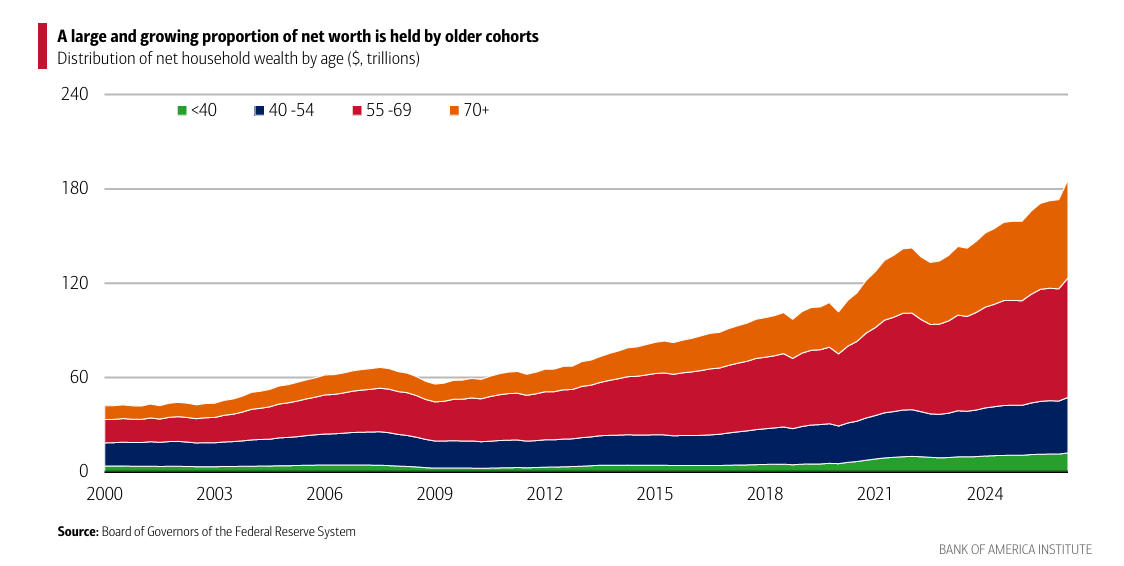
AI-led stock rally lifts Americans 55 and over to $140 trillion, three-quarters of US net worth
Bank of America Institute says Americans 55 and over held about $140 trillion in the second quarter, three-quarters of US net worth. Their spending now depends on a stock rally that a few AI companies drove.
The Investor · Invest desk
What happened
- Senior economist David Michael Tinsley wrote that these households saw "a more than 20% increase in their net worth over the past two years" as equity markets rose.
- Goldman Sachs strategists found technology stocks drove 85% of the S&P 500's return through mid-May this year.
- Baby boomers alone held $97.4 trillion in the second quarter, about 52% of all household net worth, while heading only about 30% of households.
- In stocks and mutual funds, the bottom half of US households held $0.37 trillion in the second quarter against $16.15 trillion for the top 0.1%.
Compiled by The InvestorSomething wrong?How this is made
Why it matters
- exposure Travel and leisure sellers courting the 55-plus customer, credited by the institute with "considerable capacity to spend," are exposed to a few AI stocks through portfolios they do not own.
- constraint A tech drawdown would cut spending power mostly at the top, because the top 0.1% of households hold about 44 times the stocks and funds of the entire bottom half.
- cost Older Americans without assets get nothing from the rally and meet rising costs such as gasoline on Social Security alone; about 14% of recipients over 65 rely on it for over 90% of income.
Worked backwards, the institute's figures put a dollar size on the rally. Net worth that rose by more than a fifth to reach about $140 trillion stood at no more than about $117 trillion two years ago ($140 trillion divided by 1.2), so Americans 55 and over added at least $23 trillion over the period [19]. Fortune ties that gain to AI using index data: more than half of last year's S&P 500 gains came from the Magnificent Seven [1]. "AI-driven return has been the single most important structural driver of equity performance," Capgemini's Luca Russignan told Yahoo Finance in June [3].
The link from older Americans' wealth to a few tech stocks runs through ownership. Baby boomers own 54% of all US stocks [6]. Fortune's account of the report does not say how much of the $140 trillion is held in equities, or how much of the $23 trillion gain came from them [4] [19]. The dependence on a narrow group of companies is therefore inferred from who owns stocks and which stocks rose.
The report's main subject is older consumers [18]. Bank of America calls older households "some of the biggest beneficiaries of recent rises in equities" [10]. In March, Moody's chief economist said people over 50 were doing the "bulk of spending," and summed it up: "They're driving the train" [11]. Ed Yardeni has called the result a "G-shaped economy," a variant of the K-shaped economy that sorts households by age [12].
A sell-off in the AI leaders could reach that spending by more than one route. In the broad case, the whole 55-plus cohort pulls back on travel and leisure as portfolios shrink. A narrower route follows the money to the few who hold it. Boomers' holdings average about $1.4 million for each of roughly 68 million boomers [20]. But the wealthiest 10% of boomer households controlled 71% of the generation's wealth in 2022, and nearly a third of Americans 55 and older had no retirement savings [13]. In earlier research, Bank of America found that the wealth effects of the stock market concentrated among households with higher incomes [17]. Ray Dalio takes the harshest line: he called AI "a bubble that is going to have devastating effects on many people," adding that "most people are not benefiting adequately" [15].
I think the narrower route fits the evidence best. The exposure to a handful of AI stocks is real, and it sits mostly with the top tenth of boomer households, the ones with the most to spend on travel [13] [7]. The case against that view is that most of the $23 trillion came from assets other than stocks [19]. In that case a correction in seven companies would dent the $140 trillion total without much reaching travel budgets.
What to watch
- Federal Reserve distributional data split by asset class: if most of the 55-plus gain came from assets other than stocks, the case that this wealth depends on tech stocks weakens.
- Travel and leisure spending by older households in the first quarter of weak Magnificent Seven returns, the direct test of whether the wealth effect runs in reverse.
- The next quarterly Fed release, which will show whether the 55-plus share of US net worth holds near three-quarters.