An Alaskan ridge above the Tanana River yields three Ice Age occupations spanning 1,100 years
University of Kansas researchers report more than 80,000 specimens from an Alaskan ridge occupied 13,800 to 12,700 years ago. Three dated components allow a comparison across 1,100 years, if finds are reported component by component.
The Scientist · Science desk
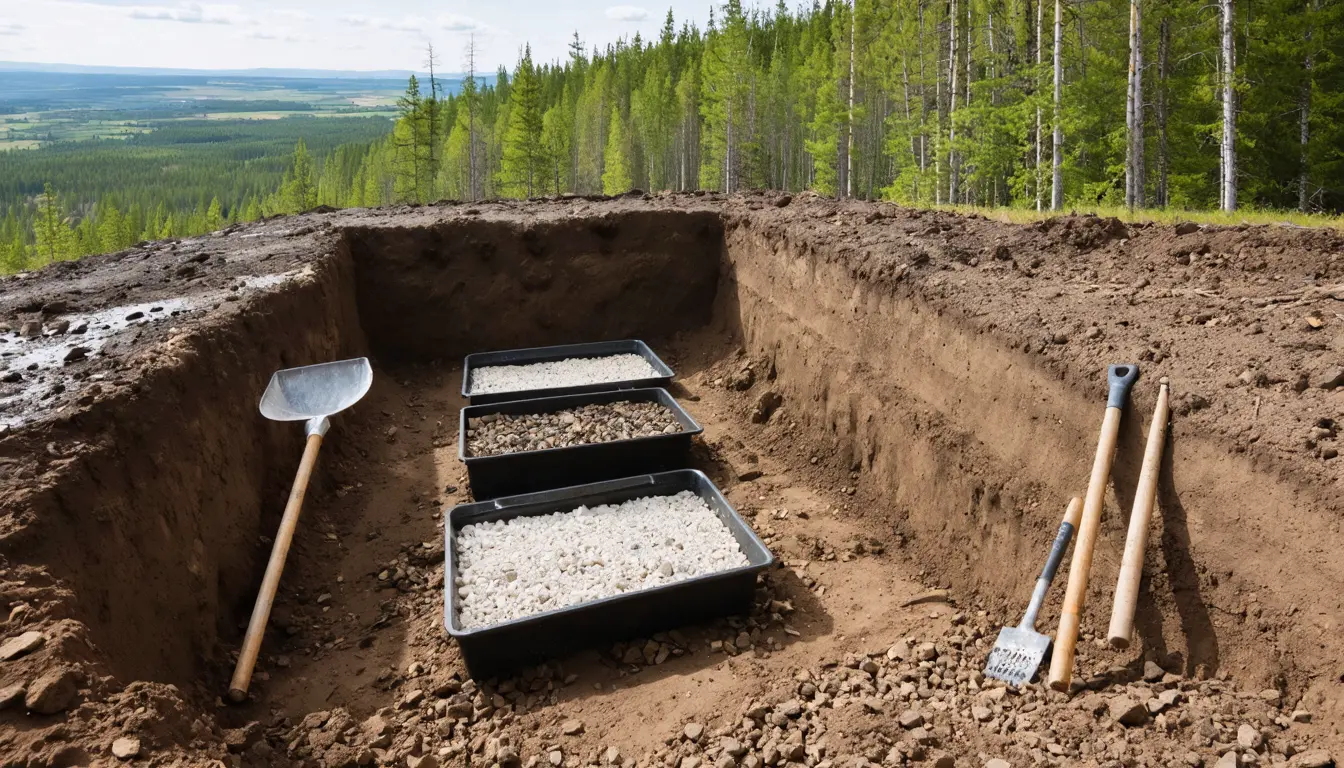
Three figures: the paper's title dates the early base camp to 13,800 years ago; the youngest of the site's three components dates to 12,700 years ago; the Bering Land Bridge, formed 35,000 years ago, disappeared around 12,000 years ago.
| Figure | Value | Note | Claim |
|---|---|---|---|
| Early base camp, per the paper's title | 13,800 years ago | 2 | |
| Youngest component | 12,700 years ago | 1 | |
| Bering Land Bridge disappeared, around | 12,000 years ago | formed 35,000 years ago | 8 |
What happened
- The site sits on a small ridge above the Tanana River, covered in shrub-tundra in the late Pleistocene and in spruce today.
- By Graf's account the occupants hunted mammoth, bison and horse, all extinct, and caribou, which Indigenous people in Alaska still hunt.
- A large stone anvil lay in a dwelling feature among bashed-up bison bones and quartz and quartzite hammerstones, near a large earth oven.
- Graf said it is the only Alaskan site with a clear diamond-shaped bifacial point; the other northern examples of the period are on the Russian side of the land bridge.
- The paper, in Science Advances, is titled as highlights from an early base camp in Beringia 13,800 years ago.
Why it matters
- constraint The Alaskan end of any cross-Bering comparison of point shapes rests on one assemblage, so a second Alaskan find would change how much weight the link carries.
- decision Anyone using the site as a model of Beringian settlement has to decide whether 'base camp' describes the 13,800-year component or the whole ridge, because the paper's title ties it to the older date.
- constraint Claims about marrow extraction and grease rendering rest on how bones, stones and an oven lay together, so they stay interpretations until tested on the bone itself.
The three dates are unevenly spaced. The oldest component is 800 years older than the middle one [14], and the middle one is 300 years older than the youngest [15]. The span is 1,100 years [16]. Phys.org's account has the land bridge going under rising seas around 12,000 years ago [8]. The youngest component is about 700 years older than that date [17].
The paper's title attaches the words "base camp" to the 13,800-year occupation [2]. The finds in the press account come from several seasons of work. Kelly Graf, who directs the project, first made the trek in 2013, visited every year until the pandemic, and returned in 2021, 2023 and 2025 [9]. Together they total more than 80,000 specimens [5]. The account describes the dwelling feature, the oven and the activity areas without saying which component each belongs to, so the base-camp label cannot be checked against the layer it names from this text alone.
Bone processing is an inference from association. The anvil, the hammerstones and the bison bones lay together in a dwelling feature next to the oven [6]. Graf hedges her own reading: "So we think they were using these stones to fully process the bones to extract marrow and likely to render grease," she said [7].
The points carry the cross-Bering argument. Graf said they are numerous and were perhaps the sharpened tips of weapons [13]. "It suggests people traveled across the Bering Land Bridge to and possibly from this location," she said [19]. The thing this doesn't tell you is direction. A shared shape ties two regions together but does not show who moved first. Graf's wording is firmer about travel to the site than from it.
What the features do support is a stay of some length. A dwelling feature, a large earth oven and well-preserved activity areas all fit it [6][5], though the duration is our inference from the features. Needles made from bird bone were found too [11].
What to watch
- The Science Advances paper's own tables: specimen counts and finds by component would show which behaviors belong to the 13,800-year occupation.
- Any report of diamond-shaped points from other Alaskan sites, or a direct comparison with the Russian-side assemblages.
- Fracture or residue analysis of the bison bones, which would test the marrow and grease interpretation.
Clarity's read
What the record supports and how the coverage leans. The claims behind it follow.
Reality
- Evidence62
- Adoption
- Insufficient
- Hype gap+10
- Incentives
- Insufficient
- Confidence50
Claim ledger
Ranked by verification strength, evidence, and original report placement.
- [1]
The Alaska site contains three early archaeological components dating to 13,800, 13,000 and 12,700 years ago.
- [2]
The Science Advances article is titled "Highlights from an early base camp in Beringia 13,800 years ago: Sheg' Xdaltth'i' and the Late Pleistocene Peopling of Alaska."
- [3]
The site is on a small ridge overlooking the Tanana River; spruce trees surround it today, and in the late Pleistocene it was covered by shrub-tundra vegetation.
- [4]
At the site the occupants hunted mammoth, bison and horse, which are extinct, and caribou, which is extant and still hunted by Indigenous people in Alaska today.
- [5]
More than 80,000 archaeological specimens were found during Graf's excavations, including a unique hafted-biface form, osseous tools, diverse fauna and well-preserved activity areas.
- [6]
A large stone anvil sat within a dwelling feature surrounded by bashed-up bison bones and quartz and quartzite hammerstones, near a large earth oven.
- [7]
"So we think they were using these stones to fully process the bones to extract marrow and likely to render grease."
- [8]
The Bering Land Bridge formed 35,000 years ago and disappeared under rising sea levels around 12,000 years ago.
- [9]
Graf began making the trek to the site in 2013, visited every year until the COVID-19 pandemic, returned in 2021, 2023 and 2025, and is director of the excavation project.
- [10]
Beringian archaeological occupations are concentrated in an area slightly larger than the U.S. state of Maryland.
- [11]
Bird bones were used to fashion needles found at the site.
- [12]
Kelly Graf, professor of anthropology at the University of Kansas, co-wrote the paper with KU's Ted Goebel, Mia Harbort and Mason Sewing, along with academics from the U.S. and Europe.
- [13]
The site yielded numerous diamond-shaped bifacial points, which Graf said were perhaps the sharpened tips of weapons.
- [14]
The oldest component is 800 years older than the middle component.
- [15]
The middle component is 300 years older than the youngest component.
- [16]
The three components span 1,100 years.
- [17]
The youngest component is about 700 years older than the date the land bridge went under rising seas.
- [18]
Graf said the site is the only one in Alaska featuring a clear diamond shape of bifacial point, and the only other places at this time with such points in a northern context are on the Russian side of the land bridge.
- [19]
"It suggests people traveled across the Bering Land Bridge to and possibly from this location."
Get this ledger inside ChatGPT. Ask about any of our stories and the answer brings its figure, each claim’s verdict and the sources. Free, no account.
Sources
1 independent publisher whose own reporting we read for this story.
- phys.orgBering Land Bridge base camp reveals what life was like nearly 14,000 years ago
1 article · October 14, 2026
Topics and entities
Follow any of these and your For You feed starts watching them — no settings page required.
Topics
- Beringia archaeologyFollow
- Peopling of the AmericasFollow
Entities
- Kelly GrafFollow
- University of KansasFollow
- Science AdvancesFollow
- Bering Land BridgeFollow
- Ted GoebelFollow