ProductIndependently confirmed2 publishers2 min readPublished Updated
Nscale's IPO asks public markets to fund a 13x jump in megawatts
The London builder is reportedly seeking $3 billion while telling investors it can go from 831MW to about 11GW. Anyone booking 2027 compute should price the gap, not the headline.
The Product Desk
What happened
- Bloomberg reports Nscale plans a $3 billion US listing as soon as next month, with Goldman Sachs and JPMorgan running the deal.
- The company tells investors it intends to take capacity from 831 megawatts to about 11 gigawatts.
- Contracted revenue across customer agreements stands at roughly $51 billion, according to Bloomberg's sources.
- Switch filed for its own IPO earlier this month at a reported $50 billion valuation.
Why it matters
- decision Anyone signing 2027 capacity now has to decide whether to contract against a fleet that exists or underwrite a pipeline thirteen times larger than it.
- exposure One customer's March order outweighs everything Nscale currently runs by half again, so every other tenant's delivery date sits behind Microsoft's.
- constraint Nearly three quarters of the target hangs on a single West Virginia site, so one interconnect or permitting problem there caps most of the growth story.
- precedent With two merchant builders listing weeks apart, public equity becomes the standard funding route for speculative AI capacity, and quarterly filings become a buyer's diligence tool.
Divide the raise by the capacity it is meant to unlock and it stops looking like a build budget. Roughly 10.2 gigawatts of incremental capacity [15] against $3 billion of equity [1] works out to about $295,000 per megawatt [21], which buys land options and engineering, not energised halls. The listing is a balance-sheet enabler: it puts public equity underneath a contracted revenue book of about $51 billion [6], which is itself 3.5 times the $14.6 billion valuation Nscale carried out of its March round with Nvidia and Nokia in it [4][16]. Debt and tenant prepayments do the rest of the work, and they price off that backlog.
So the composition of the backlog is the thing to read. Microsoft commissioned 1.35 gigawatts in March, to be delivered on Nvidia Vera Rubin NVL72 systems carrying 72 GPUs apiece [9], and separately placed 300,000 Blackwell Ultra chips across four other Nscale locations under a contract reported at $14 billion [10]. That second deal alone comes to about $46,700 per GPU over its life [19] and roughly 27 percent of the contracted total [20]. Who holds the other three quarters is not in the Bloomberg account.
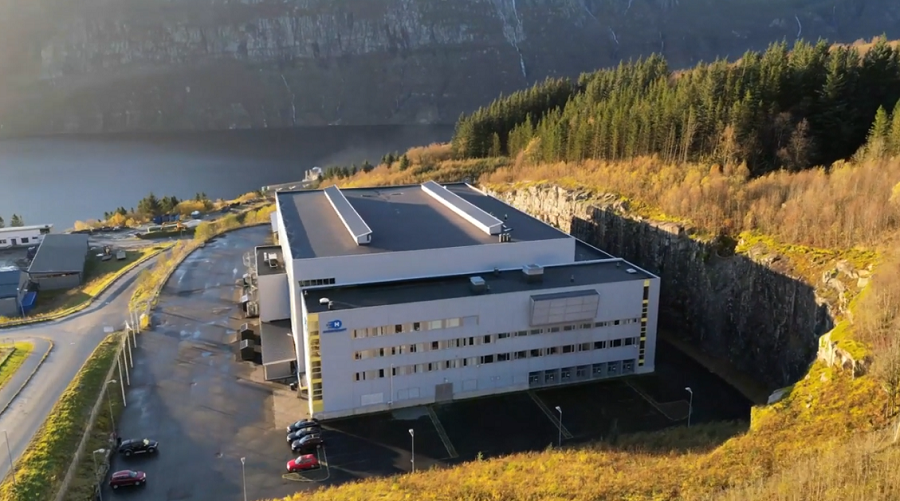
The operating record is younger than the pipeline. Nscale opened its first data centre in Norway last year and now has infrastructure under construction in more than a dozen locations [5]. The West Virginia campus is designed to run a dedicated grid with on-site generation [8], which is the longest-lead item in the whole plan and the one an IPO calendar helps least.
For anyone booking 2027 capacity, the figure to negotiate against is not 11 gigawatts [3]. It is megawatts with signed power, a substation date and a delivery slot that does not sit behind Microsoft's. The useful diligence question is which of those dozen sites are energised, and what a Vera Rubin schedule slip does to a queued tenant.
The software side reinforces the same reading. Managed Kubernetes and Slurm plus a prompt engineering tool [13], and $1.65 billion for Anyscale's commercial version of Ray [12], are margin layered on megawatts that mostly do not exist yet. Buyers pay for the wrapper on delivery day; the wrapper does not shorten an interconnect queue.
What to watch
- Whether the IPO filing separates contracted and energised megawatts from theoretical ones, and what it says the West Virginia on-site generation will cost.
- Whether a second anchor tenant appears, or the roughly $51 billion backlog stays concentrated in Microsoft agreements.
- How Switch prices against its reported $50 billion target, since that becomes the comparable Nscale inherits.
Clarity's read
What the record supports and how the coverage leans. The claims behind it follow.
Reality
- Evidence45
- Adoption50
- Hype gap+35
- Incentives65
- Confidence55
Claim ledger
Ranked by verification strength, evidence, and original report placement.
- [1]
Bloomberg, citing sources, reported that Nscale Global Holdings Ltd. plans to raise $3 billion in an initial public offering that could take place as soon as next month.
ReportedSupportedSource: Bloomberg, cited by SiliconANGLE3 sources— create a free account to open themView cited source - [2]
The London-based company intends to list its shares on a U.S. stock exchange and has hired Goldman Sachs Group Inc. and JPMorgan Chase & Co. to manage the IPO, according to the Bloomberg report.
ReportedSupportedSource: Bloomberg, cited by SiliconANGLE3 sources— create a free account to open themView cited source - [3]
Bloomberg reported that Nscale hopes to grow its data center capacity from 831 megawatts to about 11 gigawatts.
ReportedSupportedSource: Bloomberg, cited by SiliconANGLE3 sources— create a free account to open themView cited source - [4]
Nscale received a $14.6 billion valuation following its most recent funding round, a March raise that included Nvidia Corp. and Nokia Corp.; the sources did not specify the valuation targeted in the IPO.
- [5]
Nscale opened its first data center last year in Norway and is now building AI infrastructure in more than a dozen locations worldwide.
- [6]
Bloomberg's sources stated that Nscale's total contracted revenue, the value of its data center contracts with customers, is about $51 billion.
ReportedSupportedSource: Bloomberg, cited by SiliconANGLE2 sources— create a free account to open themView cited source - [7]
Nscale's flagship project is a 2,250-acre data center campus in West Virginia, which the company estimates can theoretically accommodate more than eight gigawatts of computing capacity.
- [8]
The West Virginia campus will host a dedicated electrical grid with on-site power generation infrastructure.
- [9]
Microsoft Corp. is the campus anchor tenant and commissioned 1.35 gigawatts of capacity from Nscale in March, to be delivered using Nvidia Vera Rubin NVL72 systems, each featuring 72 Rubin GPUs.
- [10]
Nscale will also host 300,000 previous-generation Blackwell Ultra chips for Microsoft in four other locations, part of an infrastructure contract reportedly worth $14 billion.
- [11]
Rival AI data center builder Switch Inc. filed for an IPO earlier this month that could reportedly value it at $50 billion.
- [12]
Last month Nscale acquired startup Anyscale Inc. for $1.65 billion, buying a commercial version of Ray, an open-source tool that helps optimize AI clusters.
- [13]
Nscale offers managed versions of the Kubernetes and Slurm frameworks plus a prompt engineering tool for improving model response quality.
- [14]
The stated target of about 11 gigawatts is roughly 13 times Nscale's current 831 megawatts of capacity.
- [15]
The plan implies about 10.2 gigawatts of capacity Nscale does not yet operate.
- [16]
The approximately $51 billion contracted revenue figure is about 3.5 times the $14.6 billion valuation from Nscale's March round.
- [17]
The West Virginia campus's theoretical eight-gigawatt-plus capacity accounts for roughly 73 percent of the 11 gigawatt target.
- [18]
Microsoft's single 1.35 gigawatt March order is about 1.6 times Nscale's entire current 831 megawatt fleet.
- [19]
The reported $14 billion Blackwell Ultra contract works out to about $46,700 per GPU across 300,000 chips.
- [20]
The $14 billion Microsoft chip contract is roughly 27 percent of the approximately $51 billion contracted revenue book.
- [21]
The $3 billion raise equates to about $295,000 per megawatt of the incremental capacity Nscale says it will add.
Sources
2 independent publishers whose own reporting we read for this story.
- datacenterdynamics.comNscale targets $3bn raise in US IPO - report
1 article · August 24, 2026
- siliconangle.comAI data center builder Nscale reportedly seeking $3B IPO
1 article · August 21, 2026
Topics and entities
Follow any of these and your For You feed starts watching them — no settings page required.