Monash theorists put a droplet where the cold-atom field said one could not exist
A Physical Review Letters paper says bosons and fermions can bind into a self-holding droplet, and that today's ultracold-atom rigs are enough to check it.
The Scientist · Science desk
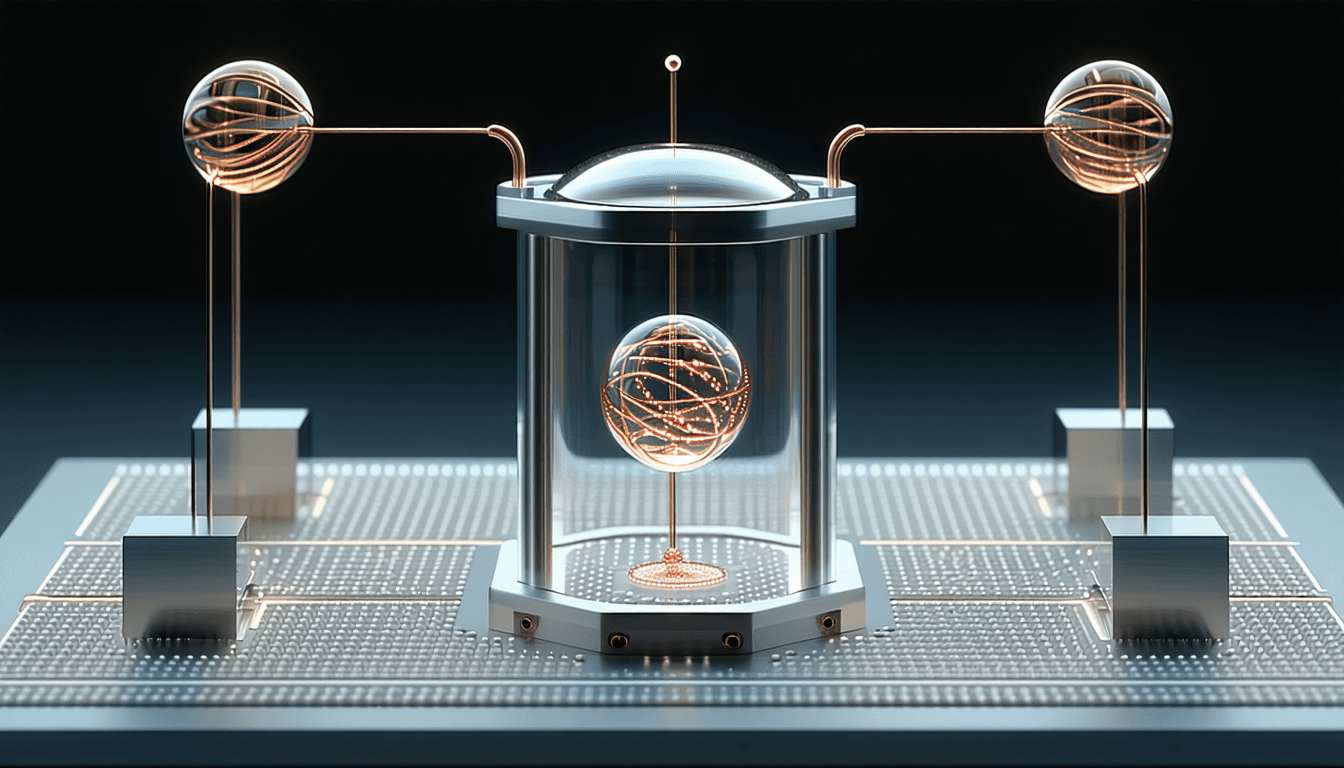
What happened
- Monash University theorists calculate that bosons and fermions, two different classes of quantum particle, can bind into stable self-holding droplets.
- The stability comes from an attraction between the particles being cancelled by pressure produced by the fermions.
- The group says the droplets should be producible on ultracold-atom apparatus that is already running.
Why it matters
- capability The strong-coupling method is the reusable part: mixtures near resonance can now be computed rather than assumed away, which is where Foster says the interesting physics sits.
- decision Cold-atom groups now face a beam-time choice with a defined payoff, because a prediction reachable on existing rigs can be confirmed or refuted in one campaign.
- contradiction The old verdict of no droplets was reached in the coupling regime the old theory could not handle, which weakens it as a reason to skip the experiment.
- constraint Nobody can cost a run from the announcement alone: species, atom number and temperature have to be pulled from the paper before a design exists.
The load-bearing quantity here is a cancellation. An attraction pulls the mixed cloud inward, the pressure produced by the fermions pushes back, and the droplet is what survives where the two offset each other exactly [4]. That is a narrower claim than "new form of matter" usually signals, because the balance depends on interaction strength: at the coupling the calculation points to, the thing either holds together or it collapses.
The methodological delta matters more than the droplet. Lead author Sam Foster says earlier descriptions of these systems only worked while the particles interacted relatively weakly, and that the new approach reaches into much stronger coupling [1]. That is precisely where the field's negative expectation sat, since self-bound droplets were judged unlikely in strongly interacting Bose-Fermi mixtures [3] - the regime the older tools could not describe [9]. An expectation formed outside a method's domain of validity was never evidence, and it took a resonant calculation to say so.
Then the sentence experimental groups will actually act on: the calculations indicate the droplets could be produced in ultracold-atom experiments that already exist [11]. That turns the paper into a scheduling question rather than a wish list, and it cuts both ways. A prediction testable on installed apparatus is a prediction that can be killed on installed apparatus, and a careful null result at the predicted resonance would be a real cost to the theory.
The second finding is softer and should be kept separate. The team reports signs of behaviour resembling a liquid-to-gas transition, which they read as evidence that these mixtures hold a wider set of quantum phases than has been recognised [5]. "Resembling" is doing work in that sentence; a mapped phase boundary is a different deliverable from a bound droplet, and only one of the two comes with a stated route to the lab.
The Monash announcement also reaches for sensors and quantum computing as downstream beneficiaries [13], with Foster hedging in the same release that this is fundamental research of the kind that sometimes becomes a foundation later [12]. Nothing in the material links droplet stability to a working device, so read that as institutional framing rather than a roadmap.
One practical gap: the release names no candidate isotope pair, no particle number, no temperature scale and no binding energy [10], so any group weighing a run has to get those from the paper itself, published in Physical Review Letters as "Quantum Droplets in a Resonant Bose-Fermi Mixture" [6]. The author list includes Foster, Olivier Bleu, Jesper Levinsen and Meera Parish at Monash, with collaborators at Heidelberg University [7].
What to watch
- Whether a cold-atom group commits to the run, and which isotope pair and resonance it chooses.
- Whether the liquid-gas-like signature hardens into a mapped phase boundary or stays a hint in the calculations.
- Whether an independent theory group reproduces the droplet at strong coupling with a different method.
Clarity's read
What the record supports and how the coverage leans. The claims behind it follow.
Reality
- Evidence42
- Adoption
- Insufficient
- Hype gap+34
- Incentives72
- Confidence46
Claim ledger
Ranked by verification strength, evidence, and original report placement.
- [1]
Lead author Sam Foster said previous theories could only describe these systems when the particles interacted relatively weakly, while the new approach lets researchers explore much stronger interactions.
- [2]
Researchers at Monash University calculated that bosons and fermions can combine to create stable, self-bound quantum droplets.
- [3]
Scientists had previously considered such droplets unlikely to form in strongly interacting Bose-Fermi systems.
- [4]
In the predicted droplet, an attractive force pulling the particles together is precisely counteracted by pressure produced by the fermions, keeping the droplet from collapsing.
- [5]
The results point to phenomena resembling the transition between a liquid and a gas, suggesting these systems may contain a broader and more complex range of quantum phases than previously recognised.
- [6]
The paper 'Quantum Droplets in a Resonant Bose-Fermi Mixture' is published in Physical Review Letters, 2026, volume 137 issue 7, DOI 10.1103/5pr6-5fmd.
- [7]
The study was conducted by Sam Foster, Olivier Bleu, Associate Professor Jesper Levinsen and Professor Meera M. Parish of the Monash School of Physics and Astronomy, with collaborators at Heidelberg University.
- [8]
The announcement is dated August 21, 2026 and its materials were provided by Monash University.
- [9]
The regime in which droplets were considered unlikely - strong interactions - is the same regime that prior theoretical descriptions of Bose-Fermi mixtures could not reach.
- [10]
The Monash announcement gives no candidate atomic species pair, no particle number, no temperature scale and no droplet binding energy for the proposed experiment.
- [11]
The calculations indicate the predicted droplets could be produced using ultracold atom experiments that already exist, giving a realistic path to experimental testing.
- [12]
Foster said that understanding how matter organises itself under extreme quantum conditions gives new tools for designing and controlling quantum systems, and that while this is fundamental research, such discoveries often become the foundation for later quantum technologies.
- [13]
The Monash release says the findings could improve understanding of quantum materials relevant to emerging technologies including ultra-precise sensors and quantum computing.
Sources
1 independent publisher whose own reporting we read for this story.
- sciencedaily.comA strange new quantum droplet can hold itself together
1 article · August 20, 2026
Topics and entities
Follow any of these and your For You feed starts watching them — no settings page required.
Topics
Entities
- Physical Review LettersFollow
- Jesper LevinsenFollow
- Heidelberg UniversityFollow
- ScienceDailyFollow
- Olivier BleuFollow
- Meera M. ParishFollow
- Monash UniversityFollow
- Sam FosterFollow