Science1 publisherNot yet confirmed elsewhere3 min readPublished Updated
La Brea's newest species came out of a drawer, not a pit
Spea labreae was collected in the 1950s and named in 2026. The binding constraint on this kind of paleontology is re-examination time, not fresh excavation.
The Scientist · Science desk
Drafted by a language model from the sources cited here and checked against its claim ledger before publication. How we use AISend a correction
What happened
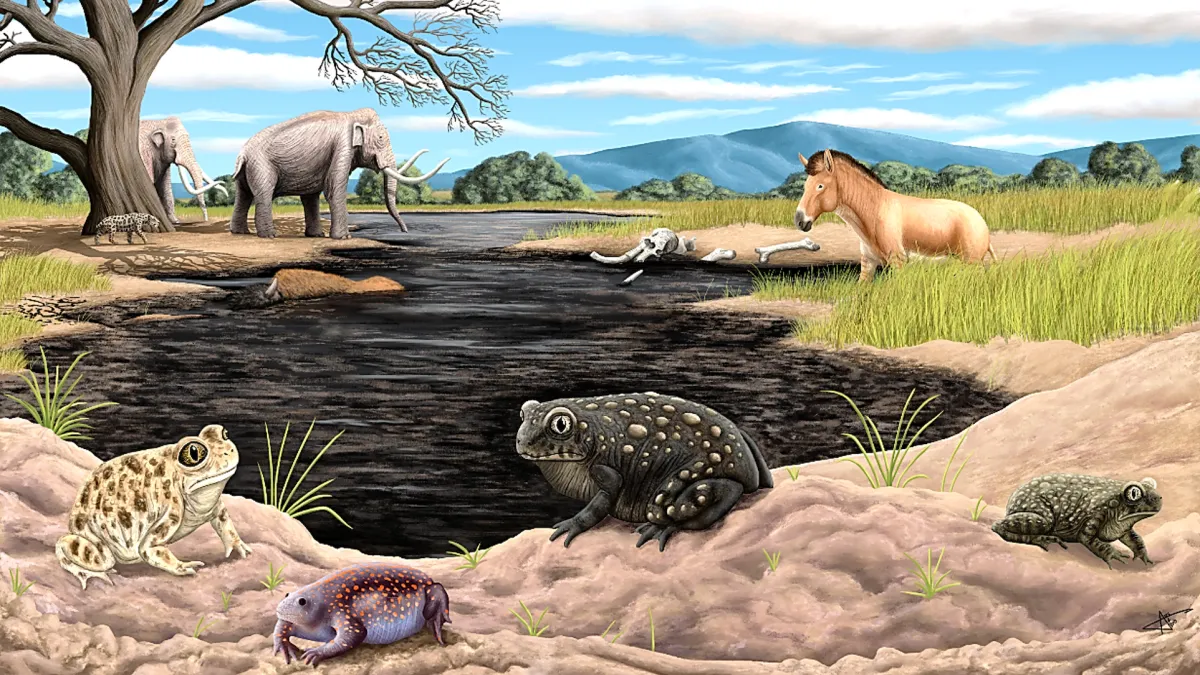
- Researchers at La Brea Tar Pits identified a previously unknown extinct amphibian from Ice Age Los Angeles, a spadefoot toad named Spea labreae, described as the first new extinct amphibian species discovered from the site.
- Only one other extinct Pleistocene amphibian has been discovered in North America, a tree frog from Florida.
- The species is described in the Journal of Vertebrate Paleontology.
- The bones had been sitting in La Brea's fossil collections since the 1950s before a researcher noticed features that set them apart from known species.
- Lead author Dr. Alberto Cruz did not set out to discover a new species; he began studying the Tar Pits' relatively understudied reptile and amphibian collections while working there as a postdoctoral fellow.
Compiled by The ScientistSomething wrong?How this is made
Why it matters
The Natural History Museum of Los Angeles County said on August 16, 2026 that researchers at La Brea Tar Pits have identified a previously unknown extinct spadefoot toad, named Spea labreae, the first new extinct amphibian species described from the site [5] [14]. Nobody had to dig for it: the bones had been in the collections since the 1950s before a researcher noticed features that separated them from known species [2].
The find is genuinely scarce in the record. According to the museum, only one other extinct Pleistocene amphibian has been described from North America, a tree frog from Florida [1]. The description is published in the Journal of Vertebrate Paleontology [6].
The path to it is the interesting part for anyone who runs a collection. Lead author Alberto Cruz did not set out to name a species; he began working through the Tar Pits' relatively understudied reptile and amphibian material while a postdoctoral fellow there [7]. "I'm really more of a paleoecologist, paleogeographer, not a taxonomist," Cruz says [9]. His first hypothesis was that the odd bones came from an animal that had been sick or injured in life, a paleopathology case, and it took comparisons with modern spadefoot toads to convince him otherwise [3]. "I reviewed and reviewed a lot of specimens until I was convinced," he says. "This material is originally from the 1950s, but when you study it again, you can find gold in these specimens" [4]. Cruz is now a research associate at La Brea and works full time as a researcher at Mexico's SECIHTI Centro de Investigacion Paleontologica Quinametzin, part of INAH [8].
So the marginal input that produced a new Pleistocene amphibian was not a shovel. It was roughly seven decades of storage, plus a specialist willing to spend months on small bones outside his main specialty [15] [7] [8].
The scientific payoff argues for more of that. Large Ice Age mammals draw the attention at La Brea, but the small reptiles and amphibians can carry more detailed information about past climate and environment [12]. Amphibians do not travel far in a lifetime and are highly sensitive to their surroundings, so mapping where a species was present or absent lets researchers reconstruct change at a local scale rather than a regional one [10]. That sensitivity is also why they are so rarely available: frog, toad and salamander skeletons are delicate and do not fossilize easily, which makes them uncommon anywhere except asphaltic sites like La Brea [11].
Emily Lindsey, curator and excavation site director at the museum's Samuel Oschin Global Center for Ice Age Research, frames the result as evidence that the site still has yield after a century of excavation and research, and says "there's definitely more to come" [16]. The museum notes the work is emerging from that center as the institution goes through what it calls a historic transformation [13].
Worth watching: whether the rest of the Tar Pits' herpetology material gets the same treatment, and how quickly, since Cruz's fellowship there has ended [7] [8]. Also worth watching whether the asphalt collections produce further extinct small vertebrates, which would say something about how much of the Pleistocene record is sitting in cabinets rather than in the ground [11] [16].