Science1 publisher2 min readPublished
Ultrafast X-rays catch water reorganizing in step with a light-driven proton-coupled electron transfer
PNNL-led researchers used ultrafast X-rays at SLAC to watch a molecule's electrons shift as it gained a proton while the surrounding water reorganized in step. That pins down timing in one reaction, though whether the water actually drives the proton hop, the part a catalyst designer could use, is still open.
The Scientist · Science desk
Drafted by a language model from the sources cited here and checked against its claim ledger before publication. How we use AISend a correction
What happened
- The team paired ultrafast X-ray spectroscopy and X-ray scattering at SLAC's Linac Coherent Light Source with quantum chemistry and molecular dynamics simulations.
- According to PNNL, no earlier experiment had captured this process in one study with both local and structural sensitivity.
- The light-driven reaction they chose already had a known basic mechanism, while the timing and order of electron and proton moves in other proton-coupled electron transfer reactions remain open.
- PNNL says the work, published in Nature Communications, could eventually help improve flow batteries, fuel cells and catalysts.
Compiled by The ScientistSomething wrong?How this is made
Why it matters
- capability Researchers can now follow electronic change and solvent structure on one clock in a single experiment, so the order-of-events questions in less understood PCET reactions can be tested directly.
- decision Modellers deciding whether to treat the solvent explicitly in PCET simulations now have a measured case where the water moves with the proton, and that argues for keeping explicit water in.
- cost Each run needs beamtime at an X-ray facility such as SLAC's LCLS plus matched quantum-chemistry and molecular-dynamics work, so for now the method is a research probe for large collaborations and too heavy for screening electrolyte or catalyst candidates.
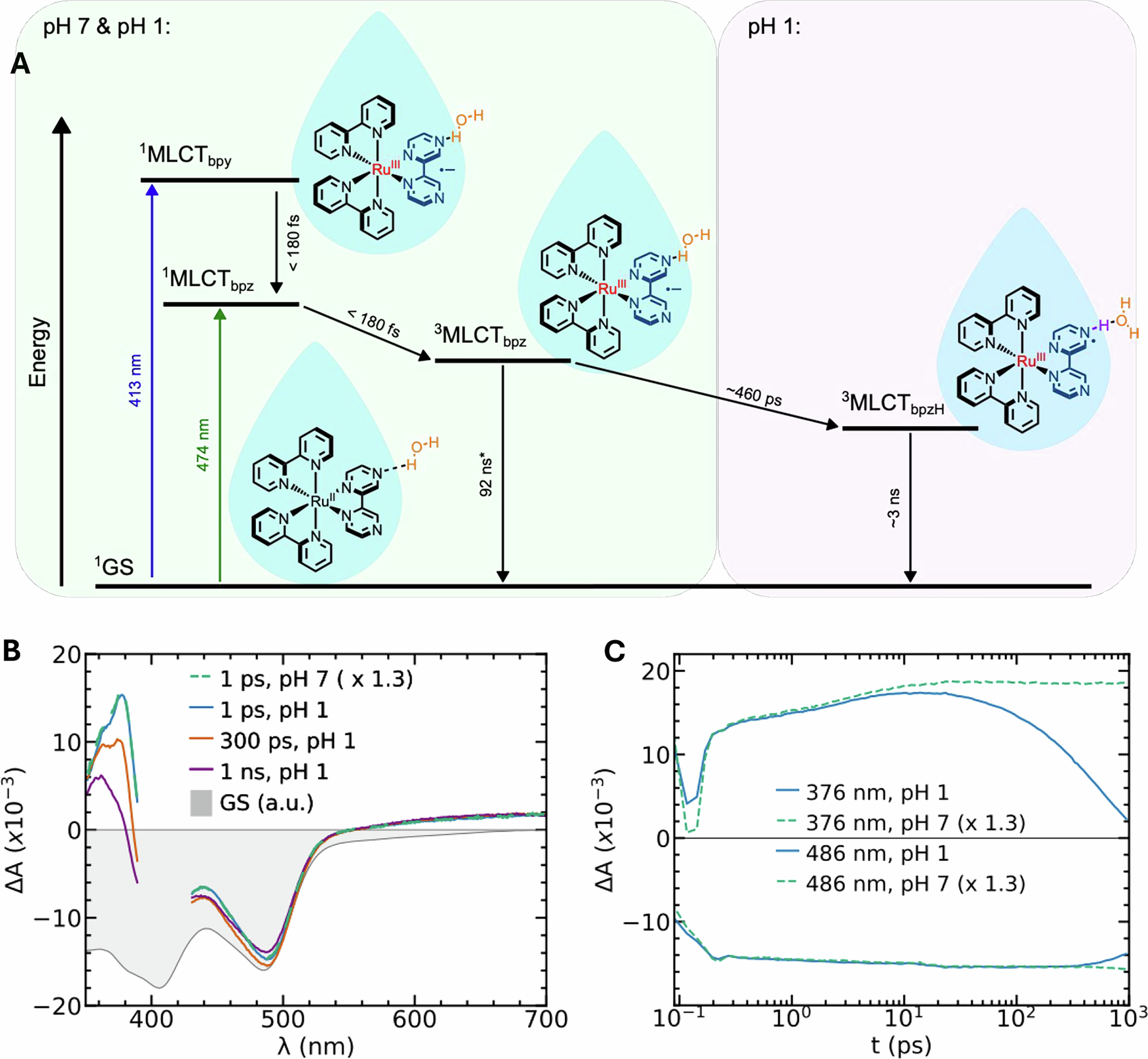
The useful thing about doing both measurements in one experiment is that they share a clock. Light striking the molecule starts the reaction [1], and the electronic and structural snapshots are both timed from that trigger. In those snapshots, the electronic structure changed at specific sites as the molecule gained a proton. At the same time, the water around it reorganized [4]. The release describing the result does not name the molecule or give the timescales [4].
Biasin calls the relationship coupling. "We have captured for the first time how electronic changes associated with proton transfer are coupled to reorganization of the surrounding solvent," she said [6]. What the experiment documents is that the two changes happen together in one reaction [4]. The thing this doesn't tell you is whether the water has to move for the proton to move, or how much the solvent changes the rate. Biasin counts the water's role among the field's open questions. "Are they happening together or not? At which molecular site? And how is the water network facilitating the proton hop?" she said [7].
Of all the design decisions, I like the choice of an already-understood reaction best [5]. A new measurement is easiest to trust when its first target has a known answer. Theory was also built into the team. PNNL theorists Niranjan Govind and Amity Andersen worked with experimental chemical physicist Elisa Biasin and former PNNL scientist Abdullah Kahraman [11]. "To answer them, you need ultra-fast time resolution, chemical and structural sensitivity, and alignment with theory. We have made a step forward to shed light on these questions," Biasin said [8].
Engineers care about this chemistry because it is efficient. When electrons and protons move together, a molecule can skip intermediate steps that would demand more energy, so the reaction runs faster and more efficiently [9]. Plants use proton-coupled electron transfer to harvest light in photosynthesis, and animals use related chemistry to turn food into energy [10]. This study used a single light-triggered molecule in water [1][4]. Testing whether the same coupling holds in a flow-battery electrolyte or on a catalyst surface would take a separate experiment.
What to watch
- A follow-up that turns the combined spectroscopy and scattering method on a PCET reaction whose electron-proton order is unresolved, and reports which moves first.
- An experiment that alters the water network around a PCET molecule and measures whether the proton-transfer rate changes; that would test dependence directly.