SecurityNot yet confirmed elsewhere1 publisher3 min readPublished
Self-hosting an open-weight model transfers six security jobs to the buyer
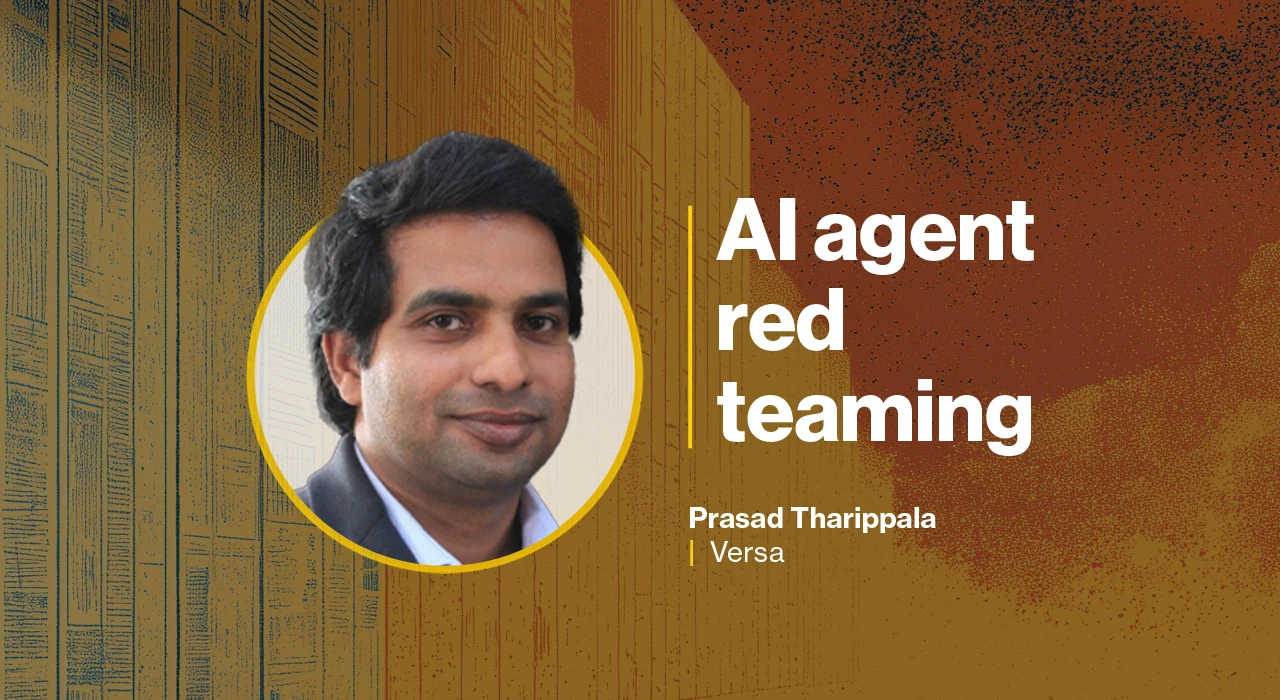
Versa field CISO Prasad Tharippala says in-house inference buys control and data residency, but security has to be built rather than assumed. For a team with 90 days and no money, he puts agent inventory and blast-radius work first.
The Watch · Security desk
What happened
- Prasad Tharippala, Field CISO at Versa, told Help Net Security that running an open-weight model in your own environment improves control and data residency without automatically making the deployment more secure.
- Hardening, patching, access control, monitoring, model evaluation and incident response all move onto the organization running the model, according to the interview.
- For teams with 90 days and little budget he ranks the work as agent inventory first, blast radius reduction second, and ongoing testing third.
- He argues agent red-teaming has to measure what an agent can do after it is manipulated, not just whether it can be compromised, which puts it past ordinary application penetration testing.
Why it matters
- decision Data residency alone can no longer carry a self-hosting business case, because the six transferred duties have to be priced and staffed before the weights land in your racks.
- cost Compliance spend scales with release cadence rather than with the number of deployments, since each model or adapter update reopens the licensing and validation review.
- constraint Hiring, not the GPU order, bounds how fast an in-house deployment reaches production, and the cost of getting that wrong shows up as business value that never arrives.
- exposure Until agents are inventoried and their permissions scoped, results from sixteen test classes have no owner to act on them, and the excessive-permission case stays live in the meantime.
The sequencing has a mechanical reason behind it. Tharippala's test list runs to nine classes of agent attack, then adds seven more, which is sixteen distinct things to exercise before production [9][10][18]. Sixteen classes against an agent population nobody has enumerated produces findings without owners, which is why inventory sits first and blast radius reduction second in his ranking [7]. He does not allocate days; split evenly, three workstreams across 90 days is 30 days each [19]. Permission scoping also pays earlier than the test does, because narrowing what a compromised agent can reach lowers the value of a successful injection whether or not you have yet proved the injection works [8].
The ring around the model is where the money goes. He counts twelve operational items, including GPU infrastructure, power and cooling, capacity planning, orchestration, audit evidence and ongoing optimization [2][15]. Licensing and compliance review is the line he says rarely makes the budget at all: open weights are not unrestricted, many licenses carry usage restrictions, and the EU AI Act adds obligations for larger models [3]. That review recurs, because every model or adapter update needs re-validation [4].
Utilization is the other number that moves. Poor workload management leaves idle GPU capacity or unpredictable performance during demand spikes, and the levers he names are scheduling, quotas, batching, caching, model routing and demand forecasting, with quantization and multi-tenant GPU sharing changing the economics further [6]. That work is operational, not security work, and it draws on the same people security needs. The skill set he describes spans platform engineering, MLOps, GPU and Kubernetes expertise, site reliability, AI security and red-teaming, identity and data governance [16]. Where an organization assumes its existing infrastructure or security team can absorb the load, he reports significant delays and, in some cases, projects that never deliver the expected business value [5].
Read the source with its position in view. This is one interview, Tharippala is a field CISO at a vendor [12], and his stated conclusion is that build versus buy is the wrong axis, with a hybrid split between in-house workloads and managed services often the practical answer [17]. The part that stands independent of that position is the responsibility transfer: six duties move to whoever runs the weights, and none of them arrive staffed [1][14]. The threshold itself is missing from the material available here. The interview is summarized as covering what counts as a failing result and five questions buyers should ask agent platforms [11]. Without those, the acceptance gate on any red-team engagement is yours to draft, which is another argument for spending the first thirty days counting agents rather than buying tooling.
What to watch
- Whether the five buyer questions and the failing-result threshold end up in agent platform contracts rather than in vendor documentation.
- EU AI Act guidance on obligations for larger models, which would fix how often re-validation of models and adapters has to run.
- Whether teams that follow the inventory-first order publish agent counts and permission maps, giving buyers a baseline for blast radius.
Clarity's read
What the record supports and how the coverage leans. The claims behind it follow.
Reality
- Evidence32
- Adoption
- Insufficient
- Hype gap+14
- Incentives66
- Confidence41
Claim ledger
Ranked by verification strength, evidence, and original report placement.
- [1]
Self-hosting shifts responsibility for hardening, patching, access control, monitoring, model evaluation and incident response onto the organization running the model.
ReportedSupportedSource: Prasad Tharippala, Versa2 sources— create a free account to open themView cited source - [2]
He says the real operational cost comes from everything around the model: GPU infrastructure, networking, storage, power and cooling, capacity planning, orchestration, model updates, monitoring, security controls, data governance, audit evidence and ongoing optimization.
ReportedSupportedSource: Prasad Tharippala, Versa2 sources— create a free account to open themView cited source - [3]
Licensing and compliance review rarely makes it into the budget; open weight does not mean unrestricted, many open weight licenses carry usage restrictions, and regulations like the EU AI Act add obligations for larger models.
ReportedSupportedSource: Prasad Tharippala, Versa2 sources— create a free account to open themView cited source - [4]
Every model or adapter update needs re-validation, so licensing and compliance review is an ongoing cost rather than a one-time exercise.
ReportedSupportedSource: Prasad Tharippala, Versa2 sources— create a free account to open themView cited source - [5]
Organizations often assume existing infrastructure or security teams can absorb the work; operating inference reliably at scale is a different discipline, which can lead to significant delays and in some cases projects that never deliver the expected business value.
ReportedSupportedSource: Prasad Tharippala, Versa2 sources— create a free account to open themView cited source - [6]
GPUs are expensive and poor workload management can cause significant idle capacity or unpredictable performance during demand spikes; scheduling, quotas, batching, caching, model routing and demand forecasting help, and quantization and multi-tenant GPU sharing can make a real difference.
ReportedSupportedSource: Prasad Tharippala, Versa2 sources— create a free account to open themView cited source - [7]
For teams with 90 days and little budget, he ranks the order of work as inventory, blast radius reduction, then ongoing testing.
ReportedSupportedSource: Prasad Tharippala, Versa2 sources— create a free account to open themView cited source - [8]
Agent red-teaming needs to go beyond traditional application penetration testing, testing not only whether the agent can be compromised but what it can do after it is compromised or manipulated.
ReportedSupportedSource: Prasad Tharippala, Versa2 sources— create a free account to open themView cited source - [9]
He would test for prompt injection, indirect prompt injection, excessive permissions, data leakage, unauthorized tool use, privilege escalation, unsafe actions, manipulation of memory or context, and the ability to move from one connected system to another.
ReportedSupportedSource: Prasad Tharippala, Versa2 sources— create a free account to open themView cited source - [10]
He would add memory and RAG poisoning, malicious tool outputs, compromised connectors, credential theft, cross agent trust abuse, supply chain vulnerabilities and resource exhaustion attacks.
ReportedSupportedSource: Prasad Tharippala, Versa2 sources— create a free account to open themView cited source - [11]
The published interview is summarized as also covering what counts as a failing result and the five questions buyers should ask agent platforms.
ReportedSupportedSource: Help Net Security2 sources— create a free account to open themView cited source - [12]
Prasad Tharippala is Field CISO at Versa and discussed running open-weight models in house in an interview with Help Net Security.
- [13]
Tharippala says running the model in your own environment can improve control and data residency, but does not automatically make the deployment more secure.
- [14]
The responsibilities Tharippala lists as transferring to the operator number six.
- [15]
The operational cost items he enumerates around the model number twelve.
- [16]
The required skills span platform engineering, MLOps, GPU and Kubernetes expertise, site reliability, AI security and red-teaming, identity and data governance.
- [17]
He says the decision should not come down to build versus buy alone but to data sensitivity, sovereignty, latency, workload volume, in-house skills and regulatory requirements, and that a hybrid approach with some workloads in house and others consumed as a managed service is often the practical answer.
- [18]
Tharippala's agent red-team list totals sixteen distinct attack classes.
- [19]
Split evenly, the three ranked workstreams get 30 days each inside a 90-day window.
Sources
1 independent publisher whose own reporting we read for this story.
- helpnetsecurity.comWhat 90 days and a small budget can buy in AI agent security
1 article · August 27, 2026
Topics and entities
Follow any of these and your For You feed starts watching them — no settings page required.
Topics
Entities
- OWASP guidance for agentic applicationsFollow
- Help Net SecurityFollow
- EU AI ActFollow
- KubernetesFollow
- Prasad TharippalaFollow
- MITRE ATLASFollow
- VersaFollow