ScienceNot yet confirmed elsewhere1 publisher3 min readPublished
Self-reported recycling in Wales falls from 94% at home to 61% at work
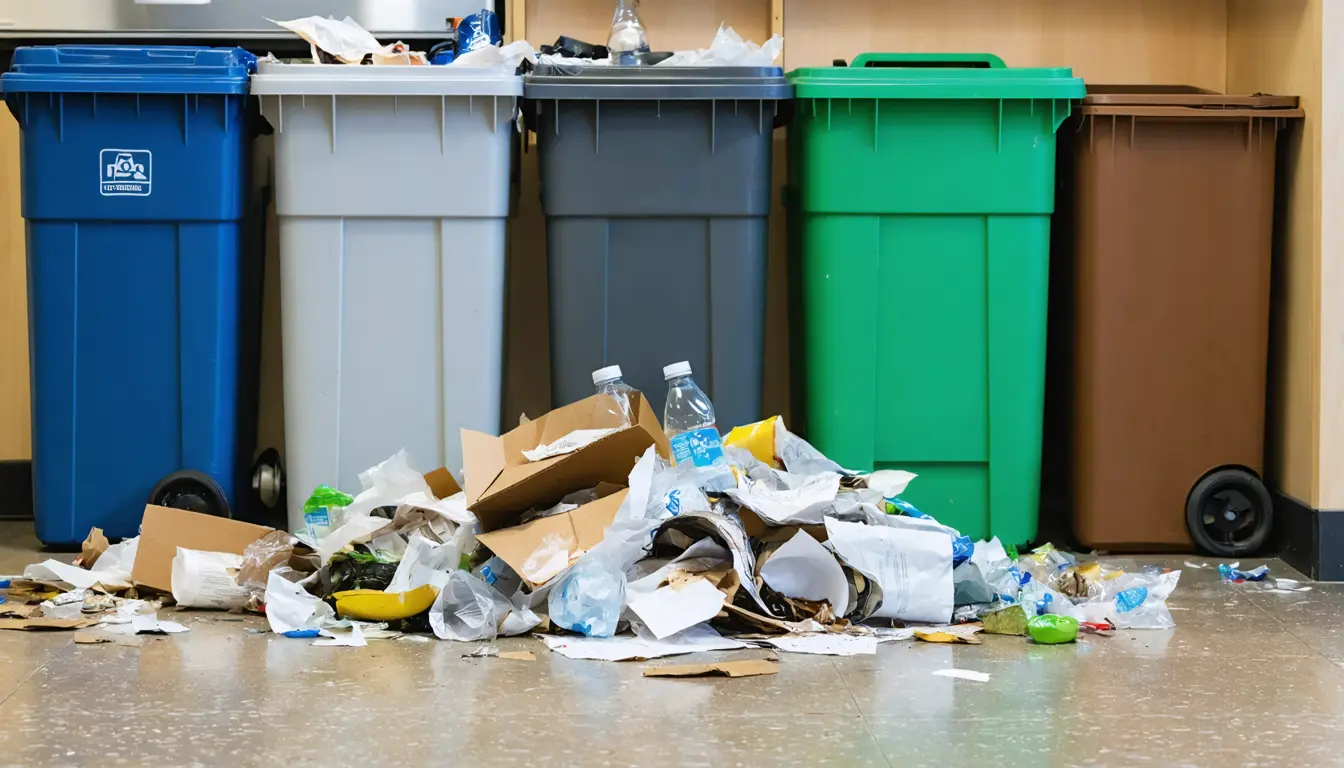
WRAP's annual tracker finds 61% of people in Wales recycle very often at work, against 94% at home, despite a 2024 law requiring businesses to sort waste. The report's one before-and-after case, a Newport recruitment firm, changed several things at once.
The Scientist · Science desk
What happened
- Among students at college or university, the share who say they recycle very often drops below half.
- Welsh businesses must now sort their waste into six categories, though collection arrangements vary from one area to another.
- Director Mark Rudge said the main change was removing desk bins in favour of central recycling areas, a move staff resisted at first.
Why it matters
- constraint WRAP's tracker records what people say and remember. It cannot tell a workplace with no sorted bins apart from staff who walk past them, so it cannot say which fix to pay for first.
- contradiction The BBC credits food waste as Acorn's biggest change while its director credits removing desk bins, so the firm's drop in collections cannot be put down to either one.
- decision A business copying Acorn would be adopting a bundle: personal bins removed and sorted stations added in every zone. That bundle is the only version anyone has tried.
Both of WRAP's headline figures are self-reports from its annual tracker survey [9]. As the BBC reports them, the two are phrased differently: 94% of people in Wales say they recycle at home, while 61% say they do so "very often at work" [9][10]. Some of the 33-point gap [20] could come from the wording of the questions. The BBC report does not give WRAP's sample size or its exact questions.
The facilities questions get closer to a cause. Half of respondents fall into neither the "seen lots" group nor the "can't recall any" group [21], and remembering a bin is not the same as having one nearby. Angela Spiteri of WRAP said: "It's still a relatively new thing to have recycling bins when we're away from home." [15] Workers' own accounts vary widely. "Because I work at a hospital we've got the recycling categories everywhere, so we have to," said Natalie James [16]. James Jenkins said of his workplace: "We only recycle cardboard because that's our only waste." [17]
Acorn by Synergie is the only workplace in the report with numbers on both sides [3][4]. The before figure is six large wheelie bins' worth of rubbish a week in 2003. The after figure is one weekly collection [3][4]. A bin and a collection are different units, and the baseline is 21 years older than the 2024 law [19]. Acorn measured one office against its own past.
The office also changed several things. The BBC calls food waste the firm's biggest adaptation [4]. Director Mark Rudge put it differently: "The main thing that we changed was removing desk bins and individual bins." [5] Staff pushed back at first. "Individuals liked having their own little waster station," he said [6]. The personal bins gave way to "central recycling areas within each zone of the business" [7]. So taking bins away came with adding shared, sorted ones, and more bins with clearer labelling is what WRAP itself suggests [14]. In my view the Acorn case supports the combination: with the desk bin gone, the nearest place to drop anything is a sorted station. It cannot rank removal against provision, because the firm did both at once.
Environmental manager Anthony Lee, speaking for his own firm, said staff took a few months to bring their home habits to work and that there had been a "significant improvement in compliance" [8].
For Wales as a whole, consultant Rebecca Colley-Jones expects the figure to climb. "It is a new system, so there's always a period of settling down," she said, adding she was sure "we would see that 61% rise" [22]. In the Vale of Glamorgan, the council said the change has produced a "higher quality of recycling" [18].
What to watch
- Whether WRAP's next annual tracker shows the 61% workplace figure rising, as consultant Rebecca Colley-Jones expects.
- Whether the 20% of respondents who recall no workplace recycling facilities shrinks as the six-category sorting rule beds in.
- Bin-weight data from Acorn by Synergie or another Welsh office that separates the effect of removing desk bins from adding food-waste collection.
Clarity's read
What the record supports and how the coverage leans. The claims behind it follow.
Reality
- Evidence45
- Adoption55
- Hype gap+15
- Incentives40
- Confidence50
Claim ledger
Ranked by verification strength, evidence, and original report placement.
- [1]
The Welsh government's Workplace Recycling Law was introduced in 2024.
- [2]
Businesses in Wales are now required to sort their waste into six categories, though collection arrangements can vary from area to area.
- [3]
When recruitment firm Acorn by Synergie first moved into its offices on the outskirts of Newport in 2003, it was producing six large wheelie bins' worth of rubbish a week.
- [4]
Acorn by Synergie now has just one weekly collection thanks to increased recycling, including food waste, which the BBC described as its biggest adaptation, following the introduction of the Workplace Recycling Law.
- [5]
"The main thing that we changed was removing desk bins and individual bins."
ReportedSupportedSource: Mark Rudge, director, Acorn by Synergie, to BBC2 sources— create a free account to open themView cited source - [6]
"We had quite a bit of resistance to that. Individuals liked having their own little waster station."
ReportedSupportedSource: Mark Rudge, director, Acorn by Synergie, to BBC2 sources— create a free account to open themView cited source - [7]
"But we put central recycling areas within each zone of the business, and eventually, people get the hang of that."
ReportedSupportedSource: Mark Rudge, director, Acorn by Synergie, to BBC2 sources— create a free account to open themView cited source - [8]
Environmental manager Anthony Lee said it had taken a few months for staff to fully mirror their home recycling habits at the workplace, and that there had been a "significant improvement in compliance".
ReportedSupportedSource: Anthony Lee, environmental manager, Acorn by Synergie, to BBC2 sources— create a free account to open themView cited source - [9]
WRAP's annual tracker survey indicated that 94% of people in Wales say they recycle at home.
- [10]
According to WRAP's tracker, only 61% of people in Wales recycle "very often at work".
- [11]
The figure for recycling very often drops to below half for students at college or university.
- [12]
Only 30% of respondents said they had seen lots of recycling facilities at their workplace, despite the new requirements.
- [13]
20% of respondents said they could not recall seeing any recycling facilities at their workplace.
- [14]
Waste reduction charity WRAP said providing more bins or clearer labelling are some of the ways businesses could make a difference.
- [15]
"It's still a relatively new thing to have recycling bins when we're away from home."
- [16]
"Because I work at a hospital we've got the recycling categories everywhere, so we have to."
- [17]
"We only recycle cardboard because that's our only waste."
- [18]
In the Vale of Glamorgan, the local authority said the change has resulted in a "higher quality of recycling".
- [19]
Acorn's 2003 baseline is 21 years older than the 2024 Workplace Recycling Law.
- [20]
The gap between the home and work recycling figures is 33 percentage points.
- [21]
Half of respondents were in neither the 'seen lots of facilities' group nor the 'could not recall any' group.
- [22]
"It is a new system, so there's always a period of settling down." Consultant Rebecca Colley-Jones said she was sure "we would see that 61% rise".
Sources
1 independent publisher whose own reporting we read for this story.
- bbc.co.uk'People don't think recycling at work is part of their job description'
1 article · October 9, 2026
Topics and entities
Follow any of these and your For You feed starts watching them — no settings page required.