Science1 publisher3 min readPublished
A spiral galaxy at redshift 2 suggests Webb's little red dots are partly a resolution problem
Push the Saguaro galaxy's arms below Webb's detection limit and what is left looks like a little red dot, according to a study published on July 29 in The Astrophysical Journal.
The Scientist · Science desk
Drafted by a language model from the sources cited here and checked against its claim ledger before publication. How we use AISend a correction
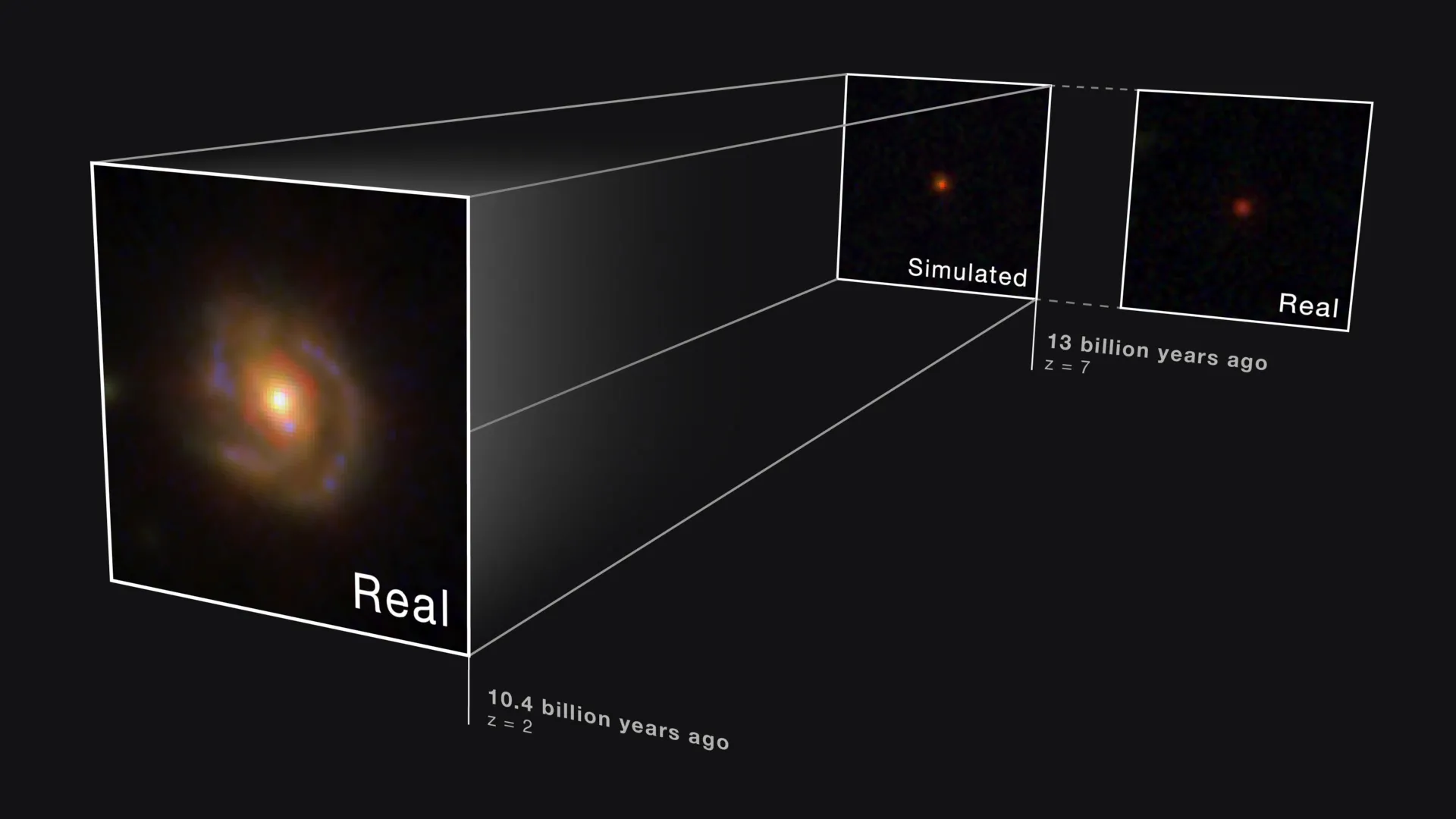
What happened
- The galaxy nicknamed the Saguaro has at its center a compact red source that closely resembles a little red dot.
- The study was led by Pierluigi Rinaldi of the University of Arizona's Steward Observatory, who is now at the Space Telescope Science Institute in Baltimore, and was published on July 29 in The Astrophysical Journal.
- NASA's James Webb Space Telescope first revealed little red dots (LRDs) in 2022; they are compact, extremely distant red sources that appear throughout the early universe and whose nature has remained difficult to explain.
- When the team simulated what the Saguaro would look like much farther away, its spiral structure essentially vanished, leaving only the bright red core.
- LRDs are common at high redshift, but their numbers fall sharply at lower redshifts.
Compiled by The ScientistSomething wrong?How this is made
Why it matters
A team led by Pierluigi Rinaldi of the University of Arizona's Steward Observatory, now at the Space Telescope Science Institute, published a study on July 29 in The Astrophysical Journal reporting that a spiral galaxy at redshift 2 has a compact, bright red center closely resembling the "little red dots" that the James Webb Space Telescope has been finding in the early universe since 2022 [1][2][3]. When the team simulated how that galaxy would look much farther away, its spiral structure essentially vanished, leaving only the bright red core [4].
The reason to care is bookkeeping rather than aesthetics. Little red dots are common at high redshift and their numbers fall sharply at lower redshift [5], a pattern that can be read either as a population that evolved into something else or as an instrument that stops resolving whatever surrounds the core. The leading explanation has been that the dots are supermassive black holes seen as active galactic nuclei, but they do not behave quite like the active galactic nuclei observed in the nearby universe [6].
The test object is catalogued as WISEA J123635.56+621424.2 and nicknamed the Saguaro, because its prominent arms resemble the Sonoran Desert cactus [7]. At redshift 2, it is seen as it appeared roughly 3.3 billion years after the Big Bang [8]. Rinaldi examined thousands of sources across several surveys, and the Saguaro stood out largely because the archive happened to be unusually good for it [9]: one of Webb's microshutter arrays was positioned directly over the galaxy's core, giving spectroscopy of the center [10], and the lower redshift left the larger structure legible [11]. The team combined archival Hubble ultraviolet imaging with Webb infrared imaging and spectra [12]. Spitzer had already glimpsed the dust-obscured compact galaxy population at lower redshift that includes the Saguaro [13].
The paper's claim is narrower than "the dots are an artifact." According to the authors, little red dots may not be an entirely separate population, and their unusual appearance could partly result from observational bias, with faint surrounding structure dropping below the detection limit at extreme distance and leaving only the bright central source visible [14]. A compact red nucleus is still there in the Saguaro [1], and NASA's account of the work does not say what the Webb spectrum of that nucleus indicates about an accreting black hole [15]. The sample is also thin by construction: co-author Fabio Pacucci of the Harvard-Smithsonian Center for Astrophysics called the Saguaro "a prototypical little red dot" and "one of the few we have found at lower redshift" [16]. Co-author George Rieke of the University of Arizona framed the result as a search strategy rather than a settled identification, saying the team has had little idea what little red dots become and that the results show how to find their progeny [17].
What to watch: whether more low-redshift analogues turn up with hosts resolved, since one well-observed galaxy establishes that a spiral can masquerade as a dot, not that most dots are spirals. Also watch the core spectroscopy, which is where an active galactic nucleus would separate from compact, dust-reddened star formation, and watch whether the sharp decline in dot counts toward lower redshift shrinks once this selection effect is modelled into the surveys.