Science2 publishers2 min readPublished
Hubble spent the day of its 200,000th orbit watching for a supernova to return
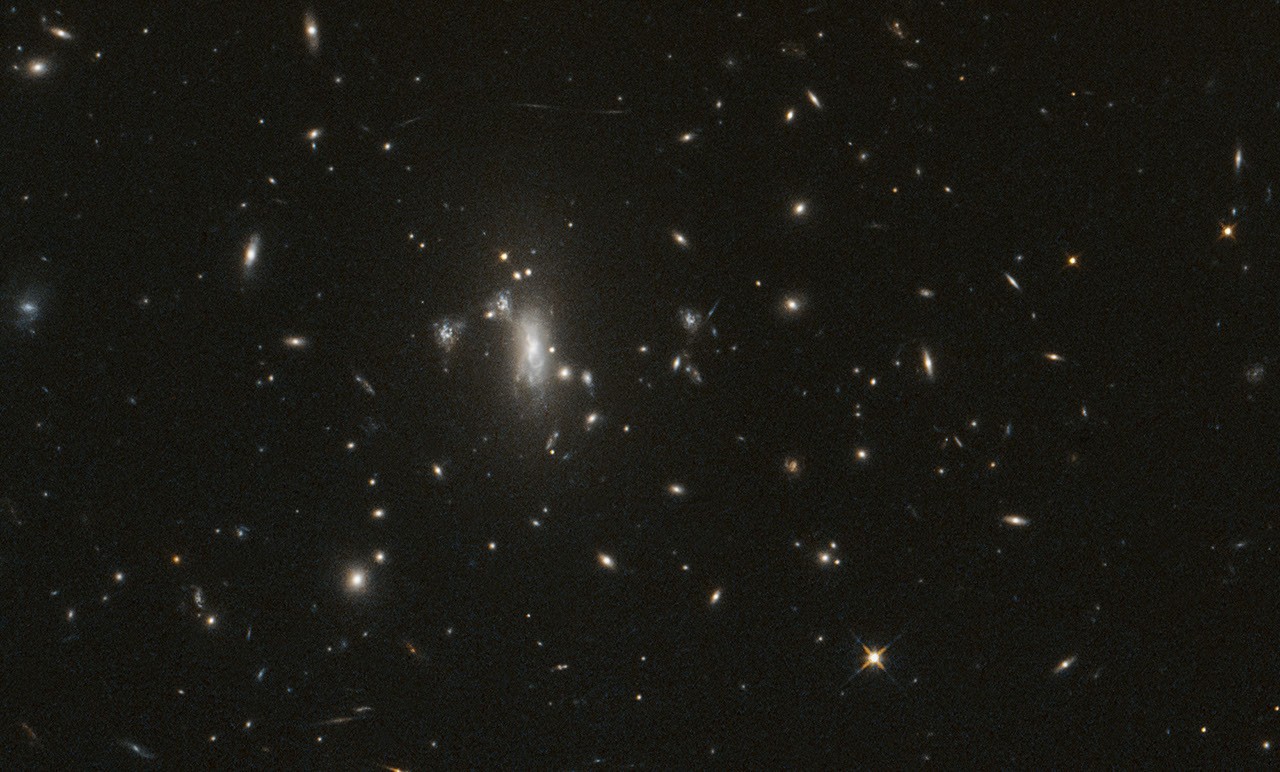
NASA pointed the telescope at galaxy cluster MACS J0417 on September 19 to catch a second appearance of supernova Athena, predicted before early March 2027, and the timing would constrain both the cluster's mass and the expansion rate.
The Scientist · Science desk
What happened
- Hubble completed its 200,000th orbit around Earth on September 19, according to NASA.
- An observation made that same day pointed the telescope back at galaxy cluster MACS J0417 to monitor for the reappearance of a supernova called Athena.
- The cluster bends and magnifies light from objects behind it, so one explosion can reach Earth by several paths and appear more than once, separated by months or even years.
- Athena was discovered by the James Webb Space Telescope in 2025, and NASA predicts it will reappear between now and early March 2027.
Compiled by The ScientistSomething wrong?How this is made
Why it matters
- constraint The measurement is tied to a calendar of about five and a half months. If the second image brightens outside the predicted window, there is no delay to measure, and what the campaign returns is a check on the lens model.
- cost Repeat visits over that window are drawn from a pool where only about one requested hour in seven can be scheduled, so each revisit comes out of another programme's time.
- capability Follow-up here needs an instrument that can go back to the same field in ultraviolet and visible light. Webb found the supernova; the 36-year-old telescope is the one NASA is assigning to watch for its return.
A lensed supernova yields a delay measurement only if the telescope is pointed at the field when the next image brightens. NASA puts Athena's window between now and early March 2027 [6], roughly five and a half months from the September 19 observation [3]. The repeat appearances happen because the cluster bends light along paths of different length, so the same explosion can arrive more than once, separated by months or even years [4].
The quantity the campaign wants is the gap between those arrivals. NASA says measuring the timing of Athena's reappearances can help map the mass of MACS J0417 and refine understanding of the expansion rate of the universe [5]. Both results come out of one measurement. How long the light takes on each path depends on how mass is distributed in the cluster, so an expansion-rate number from this method carries the lens model's uncertainty with it.
NASA has not published a predicted delay in days or an uncertainty on the reappearance window, so the releases give no way to say how much a well-timed detection would move the expansion-rate estimate. NASA's stated aim is to "refine our understanding" of the expansion rate [5]. The image credit lists M. Pascale of UCLA alongside NASA, ESA and STScI, with image processing by J. DePasquale of STScI [10].
The milestone numbers do divide into something usable. More than 5 billion miles over 200,000 orbits [1][2] is about 25,000 miles a lap [1]. More than 1.7 million observations across the same orbits [3] is roughly 8.5 per orbit [2]. Astronomers ask for about seven times the observing time available each year [7], which works out to roughly one requested hour in seven being scheduled [4].
A monitoring programme needs a telescope that can go back to the same field. The observation made on the day of the 200,000th orbit used exactly that: Hubble's record of returning to the same regions of sky over time, here to watch for Athena [9]. Webb found the supernova in 2025 [6]. The revisits are going to an observatory whose ultraviolet and visible coverage NASA describes as complementary to Webb and Roman [8], and which has been going back to the same fields for 36 years [2].
What to watch
- Whether Athena's second image is detected before early March 2027, and whether its arrival date matches the lens model's prediction.
- A published delay measurement with an uncertainty on it. The expansion-rate part of this waits on that number.
- Whether the monitoring cadence holds up against Hubble's seven-to-one oversubscription for observing time.